

On this page
In atomic physics and chemistry, the "last electron" refers to the differentiating electron—the final electron added to an atom to build its ground-state configuration from the preceding element in the periodic table. While students often mistake the last electron for the outermost valence electron, the two are not always the same. As outlined in the NCERT Class 11 Chemistry curriculum, orbitals fill in order of increasing energy governed by the Aufbau principle and the (n + l) rule.
Because orbital energy depends on both the principal shell and orbital shape, incoming electrons can enter an inner shell even when an outer shell already contains electrons. For example, in the d-block elements, the differentiating electron enters the penultimate (n − 1)d subshell rather than the outermost ns subshell. Understanding this distinction is essential for mastering quantum numbers and electron configuration in school boards and national competitive exams.
How do you assign n, l, ml, and ms step by step?
Every electron in an atom is defined by a unique set of four quantum numbers, a rule established by Wolfgang Pauli in his 1925 exclusion principle paper in Zeitschrift für Physik. To determine the four values for the differentiating electron, follow this systematic four-step sequence:
Write the ground-state electron configuration using the Aufbau sequence (1s, 2s, 2p, 3s, 3p, 4s, 3d, ...).
Identify the subshell that receives the final electron. The number before the subshell letter gives the principal quantum number n (n = 1, 2, 3, ...), which determines orbital size and energy level. The letter gives the azimuthal quantum number l, which defines orbital geometry: l = 0 for s, l = 1 for p, l = 2 for d, and l = 3 for f.
Draw the degenerate orbital boxes for that subshell. The magnetic quantum number ml describes the spatial orientation of the orbital and takes 2l + 1 integer values from −l to +l. In standard convention, label the boxes sequentially from left to right as −l, −l + 1, ..., 0, ..., +l.
Fill electrons into the boxes using Hund's rule of maximum multiplicity: occupy each degenerate orbital singly with parallel spin before pairing any electrons. By standard convention, the first electron in an orbital gets spin-up (ms = +1/2), and the second paired electron gets spin-down (ms = −1/2), reflecting the intrinsic angular momentum identified in Uhlenbeck and Goudsmit's discovery of electron spin published in Nature.
How do you apply these steps to chlorine, iron, and potassium?
Let us apply this four-step sequence to three representative elements commonly tested in classroom assessments:
Chlorine (atomic number 17):
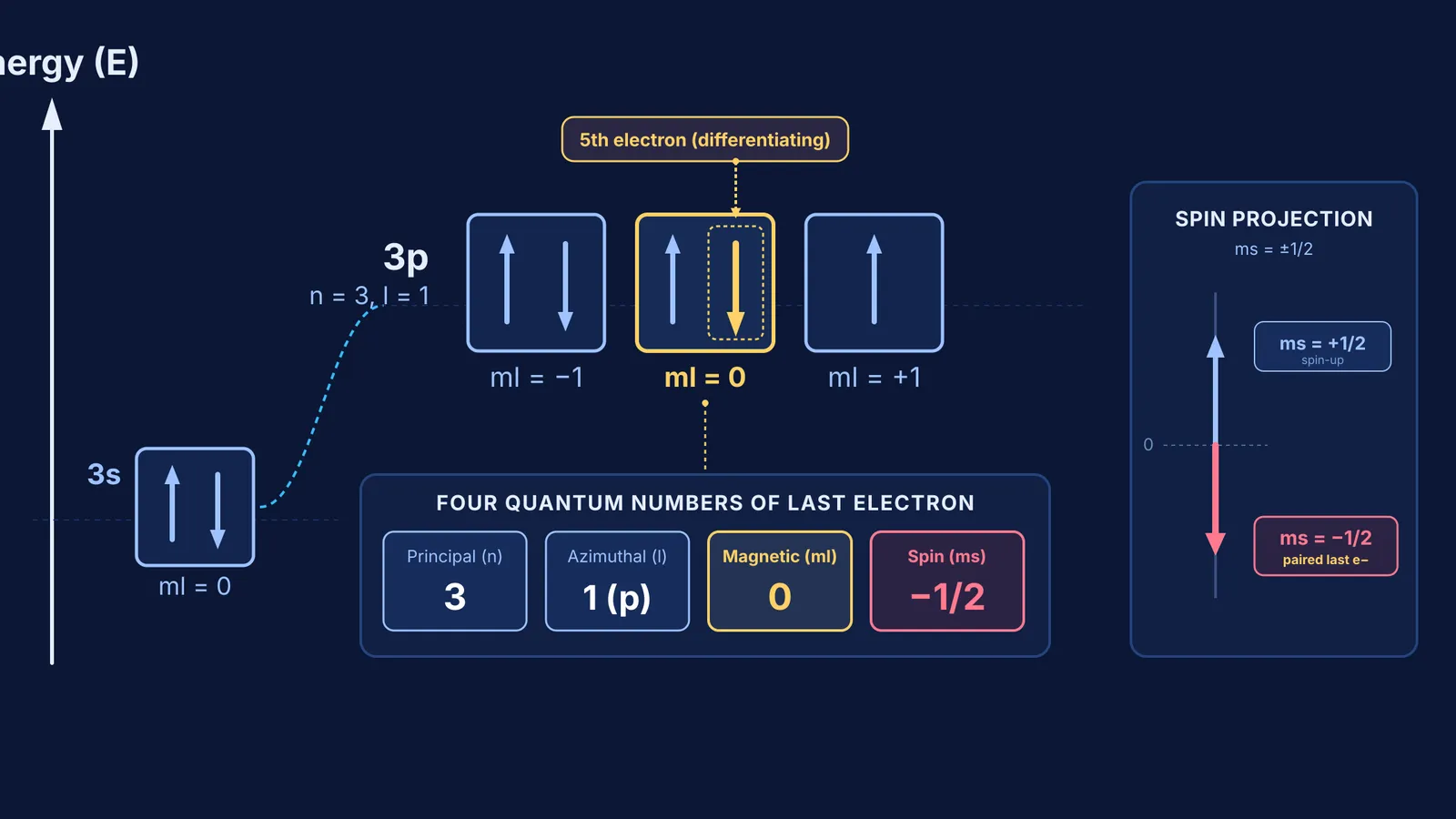
Configuration: 1s² 2s² 2p⁶ 3s² 3p⁵.
The 17th electron enters the 3p subshell (n = 3, l = 1).
The 3p subshell has 3 degenerate orbitals: ml = −1, 0, +1.
Electrons 1, 2, and 3 singly occupy ml = −1, 0, and +1 with ms = +1/2. Electrons 4 and 5 pair up in ml = −1 and ml = 0 with ms = −1/2. The 5th (differentiating) electron enters ml = 0.
Quantum numbers: n = 3, l = 1, ml = 0, ms = −1/2.
Iron (atomic number 26):
Configuration: 1s² 2s² 2p⁶ 3s² 3p⁶ 4s² 3d⁶.
Although 4s is outermost, 3d has higher (n + l) energy (3 + 2 = 5 vs 4 + 0 = 4). Under the Aufbau principle, 4s fills first, so the 26th electron enters 3d.
Subshell parameters: n = 3, l = 2.
Five d-orbitals (ml = −2, −1, 0, +1, +2) fill singly with parallel spin (ms = +1/2). The 6th electron pairs in the first orbital (ml = −2) with opposite spin.
Quantum numbers: n = 3, l = 2, ml = −2, ms = −1/2.
Potassium (atomic number 19):
Configuration: [Ar] 4s¹.
The 19th electron enters the 4s subshell.
Quantum numbers: n = 4, l = 0, ml = 0, ms = +1/2.
When tackling complex configurations and multi-electron ions, practicing with detailed feedback builds speed. The Fermi Problem Library has worked problems with a step-by-step solver that explains the reasoning rather than printing an answer.
Why do transition metals trip students up?
Transition metals frequently cause confusion because electron entry and electron removal follow opposite sequences. When building a neutral atom, electrons fill 4s before 3d because 4s has lower (n + l) energy. The differentiating electron of a 3d transition metal always enters the 3d subshell.
However, during ionization, electrons are lost first from the outermost shell (highest principal quantum number n). An iron atom loses its two 4s electrons first to form Fe²⁺, leaving a 3d⁶ core. Confusing entry order with ionization order leads students to mistakenly treat 4s as the differentiating electron. Reviewing the electron configuration of transition metal ions ensures you handle both atom building and cation formation without hesitation.
How to avoid common sign and orbital convention traps?
Students often wonder whether choosing ml = +1 instead of −1, or ms = −1/2 instead of +1/2, makes an answer incorrect. In quantum mechanics, degenerate orbitals in an isolated atom without an external magnetic field share identical energy. Assigning ml = −1 to the leftmost box is a human convention, not an immutable law of physics.
In multiple-choice examinations conducted by the National Testing Agency, question setters typically handle this in one of two ways. They either explicitly define the sign convention (such as filling ml from −l to +l), or they design multiple-choice options where only one option contains an allowable set of quantum numbers satisfying n ≥ 1, 0 ≤ l ≤ n − 1, |ml| ≤ l, and ms = ±1/2.
For building a complete structural understanding of atomic orbitals and energy levels, the Fermi Concept Library organizes every concept in physics, chemistry, biology, mathematics and computing, each with its own lesson and its place in the map.


