

On this page
If you are vegetarian, you have probably heard that plant protein is "incomplete" and must be paired carefully at every meal. The real picture is simpler: plant foods contain every amino acid you need, in different proportions, and a normal Indian thali already mixes them.
What are the essential amino acids?
Proteins are chains of amino acids, and your body uses them to grow, repair tissue and break down food, according to MedlinePlus, from the US National Library of Medicine.
Essential amino acids are the ones your body cannot make, so they must come from food (MedlinePlus).
There are nine: histidine, isoleucine, leucine, lysine, methionine, phenylalanine, threonine, tryptophan and valine. The same MedlinePlus page says you do not need to eat them all at every meal, but getting a balance over the whole day is important.
Do plant foods have complete protein?
Yes, in the sense that matters. A 2019 review in the journal Nutrients by François Mariotti and Christopher Gardner states that all plant foods contain all 20 amino acids, including the 9 indispensable ones, and calls the terms "complete" and "incomplete" misleading.
What differs is the proportion. The same review explains that grains carry lysine in much lower than optimal proportions, while pulses are very slightly low in the sulphur amino acids, methionine and cysteine. That only becomes a problem for someone who eats one food, such as only rice, every day.
The review's conclusion: when diets are at least slightly varied, telling vegetarians to pay strict attention to complementary amino acid patterns is "simply over-precautious". It adds that mixing sources in the same meal may be a practical safeguard when total protein intake is low.
Why does dal with rice work?
Because each covers the other's weak spot. Here is a worked example using the US Department of Agriculture's FoodData Central values for boiled lentils (like a thick dal) and cooked white rice, per 100 g:
Lentils: 9.02 g protein, 630 mg lysine, 77 mg methionine and 118 mg cystine.
Rice: 2.69 g protein, 97 mg lysine, 63 mg methionine and 55 mg cystine.
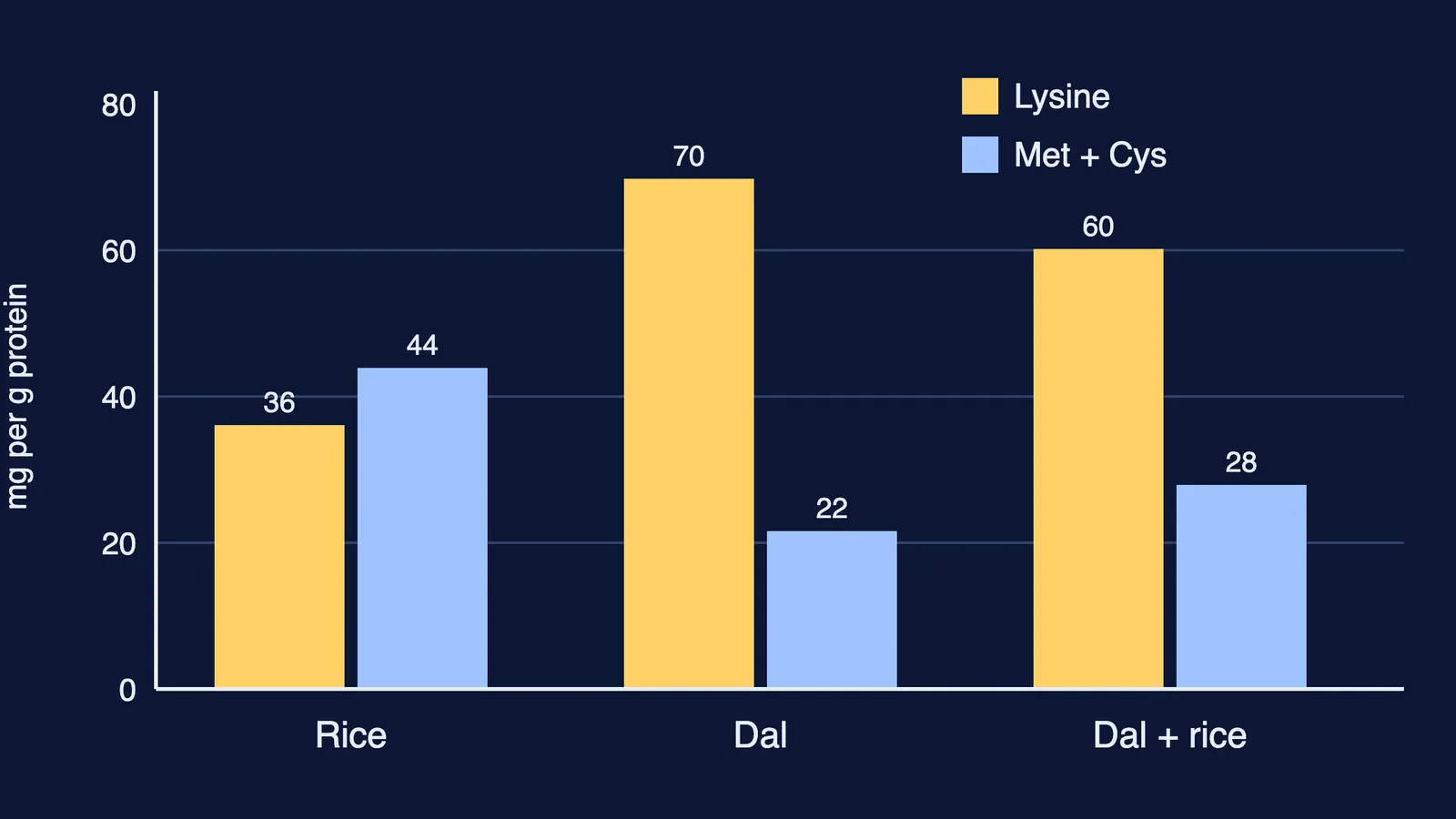
Per gram of protein, rice gives about 36 mg of lysine but 44 mg of methionine plus cystine. Lentils flip it: about 70 mg of lysine and only 22 mg of methionine plus cystine.
Now make a plate: 150 g of cooked dal and 200 g of cooked rice.
Protein: 13.5 g from dal plus 5.4 g from rice gives 18.9 g.
Lysine: 945 mg plus 194 mg gives 1,139 mg, about 60 mg per gram of protein.
Methionine plus cystine: 293 mg plus 236 mg gives 529 mg, about 28 mg per gram of protein.
On both measures the plate sits above the weaker food. That is complementary protein, and dal-chawal cooks got there without a calculator.
How much protein does a teenager need in India?
The Indian Council of Medical Research's National Institute of Nutrition (ICMR-NIN) sets the figures. Its 2020 brief note on nutrient requirements gives an adult RDA of 0.83 g of protein per kg of body weight per day.
For 16 to 18 year olds, the same note lists an RDA of 55.4 g a day for boys (reference weight 64.4 kg) and 46.2 g a day for girls (55.7 kg).
Two details matter for vegetarians. ICMR-NIN suggests a cereal-legume-milk ratio of 3:1:2.5 for good protein quality, and it notes that people on cereal-based diets with low-quality protein need 1 g per kg per day. In practice: more dal and milk, not just more rice.
What does a day of vegetarian protein look like?
Here is one sample day for a 16-year-old, using FoodData Central values for whole milk, plain whole-milk yogurt (curd), raw peanuts and boiled chickpeas:
Breakfast: 250 g of milk, about 7.9 g.
Lunch: dal with rice as in the worked example, about 18.9 g.
Evening snack: a 30 g handful of peanuts, about 7.7 g.
Dinner: 150 g of boiled chickpeas as chole, with 100 g of curd, about 13.3 g plus 3.5 g.
That adds up to about 51 g before counting rotis or vegetables, above the girls' RDA and close to the boys'. If you pack food for long days, our post on tiffin ideas for coaching students turns this into lunchboxes, and how to read a nutrition label in India helps you check packaged snacks.
A quick checklist for any day:
Is there a pulse (dal, chana, rajma, soy) in at least one meal?
Is there dairy, nuts or seeds somewhere else?
Are you eating enough overall, or skipping meals before exams?
If amino acids and protein structure are a gap in your biology, the Fermi Concept Library gives every concept in biology and chemistry its own lesson and its place in the map. For a related food-science read, see why millets are healthy.


