On this page
A student who leaves home at 7 am, sits in school until 2 pm and then in coaching until 8 pm eats most of the day out of a bag. The tiffin packed at 6:30 has two jobs: give enough food, especially protein, to last 13 hours, and still be safe when it is opened at 1 pm and again at 5 pm in a warm classroom. Here is what official guidance says on both, and a packing plan you can copy.
How much protein does a teenager need in a day?
India's nutrient requirements from ICMR-NIN (2020) set the recommended dietary allowance of protein at 55.4 g a day for boys aged 16-18 and 46.2 g a day for girls of the same age. The same report says people eating a cereal-based diet with low-quality protein need about 1 g per kg of body weight a day. It suggests a cereal-legume-milk ratio of 3:1:2.5 for good protein quality.
In plain terms, ICMR-NIN's advice is to pair cereals with legumes and milk. The simple fix is one protein food in every box:
dal, rajma, chole or sprouts with the lunch roti or rice
paneer bhurji or a besan chilla rolled into a roti
boiled eggs, if your family eats them
roasted chana or peanuts at the coaching break, and milk at breakfast or dinner
Which tiffin foods are riskiest in the heat?
The WHO Five Keys to Safer Food manual explains that microorganisms need food, water, time and warmth to multiply. It names meat, seafood, cooked rice, cooked pasta, milk, cheese and eggs as foods that give them ideal conditions.
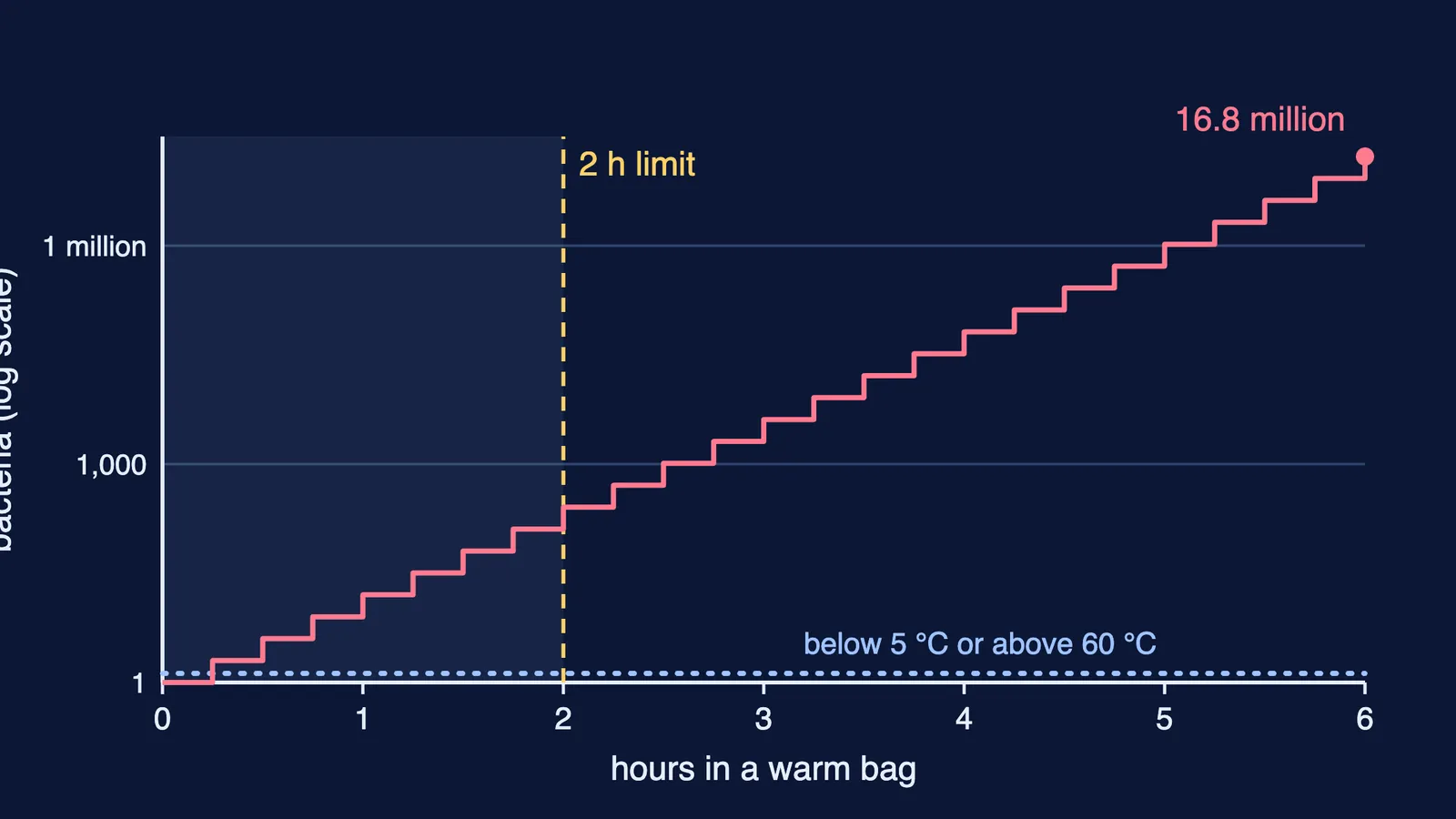
The danger zone is 5 °C to 60 °C, the temperature range in which microorganisms multiply very fast, according to the WHO manual. In the right conditions, one bacterium can become two in just 15 minutes and over 16 million within 6 hours, the same manual says.
That is why WHO's rule is short: do not leave cooked food at room temperature for more than 2 hours. A school bag on an Indian afternoon sits squarely in the danger zone.
Sorting a typical tiffin by that rule:
Eat within two hours, or keep cold or hot: curd rice, raita, paneer, egg dishes, pulao, dal, cut fruit, milk sweets.
Fine for the late box: roasted chana, peanuts, makhana, khakhra, chikki, and whole bananas, apples or oranges with the peel on.
How do you keep a tiffin safe in a hot bag?
The WHO manual says that holding food below 5 °C or above 60 °C slows down or stops the growth of microorganisms, though some dangerous ones still grow below 5 °C. So the aim is to keep each box out of the middle, or eat it soon.
Hot food goes in an insulated flask. Fill it with food that is piping hot, not just warm.
Cold food travels with ice. Freeze a full water bottle overnight and pack it against the curd or fruit box. It keeps the box cooler, not fridge-cold, so eat that food at lunch.
Two boxes, not one. Pack lunch and the coaching snack separately, so opening one does not warm the other.
Throw away what comes home. A half-eaten box that has spent all day in a bag is not tomorrow's breakfast.
Wash the box and flask every night, including the rubber seal in the lid.
How much water should a student carry?
The NHS advises aiming for 6 to 8 cups or glasses of fluid a day, and says you may need more in a hot environment or when physically active for long periods. Carry two bottles, the frozen one from the tiffin and a second at room temperature, and refill at the coaching centre.
A packing plan for a 7 am to 8 pm day
6:30 am, at home: a proper breakfast. Our post on what trials found about breakfast and school performance explains why it is worth the time.
Box 1, eaten around 1 pm: roti with dal or paneer sabzi, in an insulated flask packed hot, or in a box beside the frozen bottle.
Box 2, eaten around 5 pm: roasted chana or peanuts, makhana or khakhra, and a whole fruit.
Water: one frozen bottle, one normal, refilled at coaching.
8:30 pm, at home: a warm dinner with dal, curd or another protein, since the coaching snack is light.
For the rest of the week's meals, see our guide to a healthy eating routine for exams. If the long day itself is the problem, read what to do when coaching timings clash with school.
By the time you get home, there is little energy left for deciding what to study. Fermi's AI tutor can work out what you already know and build a plan for the session, so the hour after dinner starts with a clear next step.
Tonight, pack by the clock: count the hours to each box, then choose the food.