

On this page
A vector is a quantity with both a size and a direction, such as velocity, displacement or force. A speed alone does not tell you where a car ends up; a velocity does. Here are three places vectors do real work, each with a short sum you can check on a calculator.
How do pilots use vectors in a crosswind?
An aircraft moves through the air, and the air itself moves over the ground. NASA Glenn Research Center's explainer on cross winds shows ground speed as the vector sum of airspeed and wind speed, and says the addition must be performed according to the rules for vector addition. A crosswind deflects the flight path in the direction of the wind. That is why a pilot who wants to fly due north has to point the nose partly into the wind.
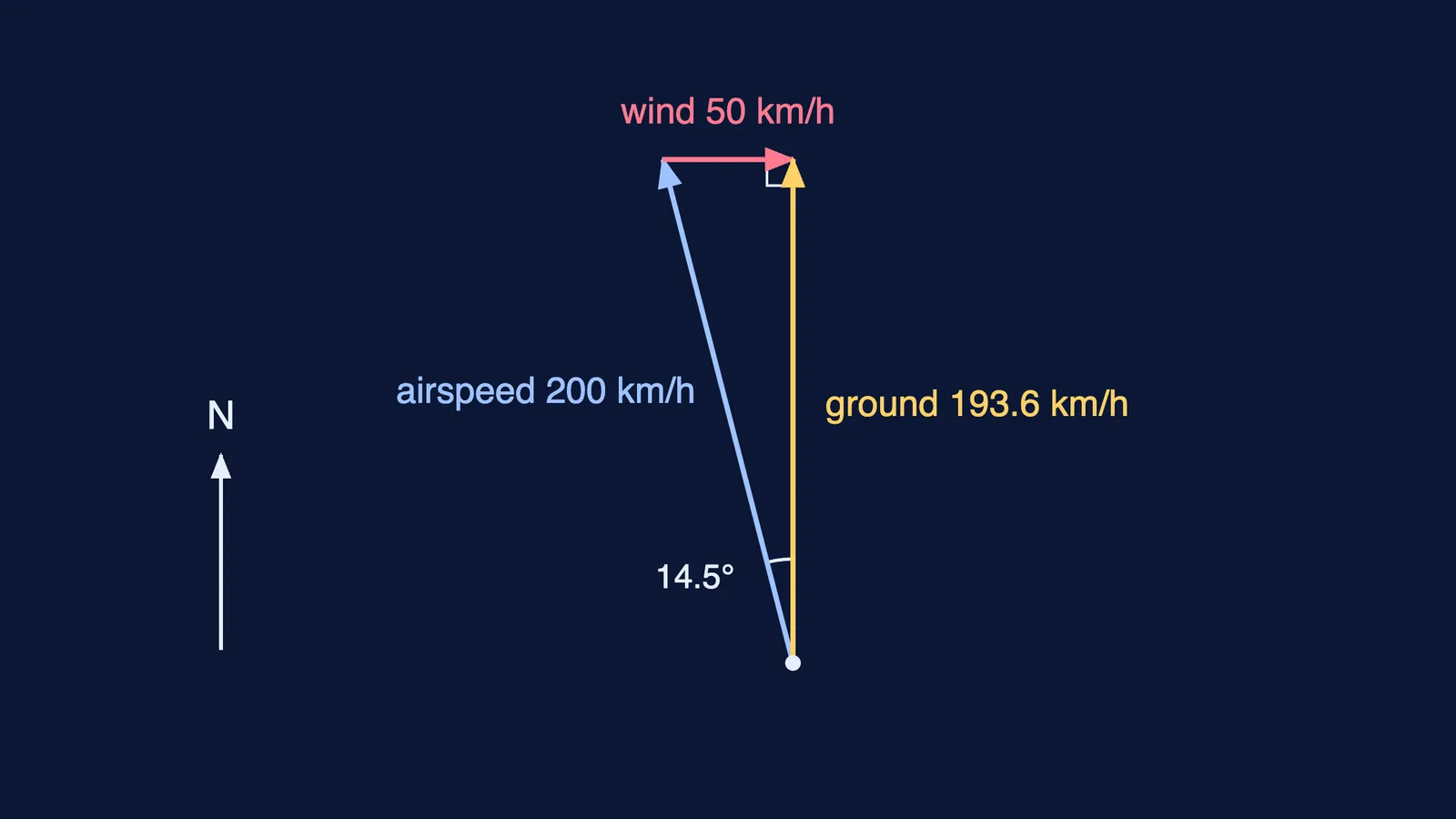
Worked sum. A small plane flies at 200 km/h through the air. A 50 km/h wind blows from west to east. The pilot wants a track due north.
The plane's sideways velocity must cancel the wind, so 200 sin θ = 50. That gives sin θ = 0.25 and θ ≈ 14.5° west of north.
The northward part is what remains: 200 cos θ = √(200² − 50²) ≈ 193.6 km/h.
So the nose points 14.5° west of north, the plane travels due north, and it covers ground at about 193.6 km/h, slower than its airspeed.
This is the same triangle as a boat crossing a flowing river; our post on shortest time versus shortest path across a river works through it step by step.
How does GPS use vectors to find your speed and direction?
According to GPS.gov's page on the space segment, the United States is committed to keeping at least 24 operational GPS satellites available 95% of the time. Each satellite flies at about 20,200 km and circles Earth twice a day. As GPS.gov's overview explains, the satellites send signals that give their position and the time, and your receiver uses them to calculate your three-dimensional position and time.
A position is itself a vector: an arrow from a reference point to you. Subtract two positions and you get a displacement. Divide by the time between them and you get an average velocity, which carries both speed and heading.
Worked sum. Take east as x and north as y. At one reading you are at (0, 0) metres; 10 seconds later you are at (60, 80) metres.
Displacement = (60, 80) − (0, 0) = (60, 80) m, with size √(60² + 80²) = 100 m.
Speed = 100 m ÷ 10 s = 10 m/s, or 36 km/h.
Direction = tan⁻¹(60/80) ≈ 36.9° east of north.
Real readings are a little fuzzy. GPS.gov's accuracy page says GPS-enabled smartphones are typically accurate to within a 4.9 m radius under open sky, which is one reason the dot on your map wanders while you stand still.
How do video games use vectors to light a scene?
Every surface in a 3D game has a normal vector, an arrow pointing straight out of it. The LearnOpenGL chapter on basic lighting shows how diffuse light is computed: take the dot product of the unit normal and the unit vector pointing towards the light, and clamp any negative result to zero. For unit vectors, the dot product equals the cosine of the angle between them, so a face turned towards the lamp is bright and a face turned away is dark.
Worked sum. A floor has normal n = (0, 1, 0). The light lies in the direction L = (0.6, 0.8, 0), which has length 1.
n · L = 0 × 0.6 + 1 × 0.8 + 0 × 0 = 0.8, so the floor gets 80% of the light's full diffuse brightness.
A wall with normal (1, 0, 0) gives 0.6, or 60%.
A wall facing the other way, normal (−1, 0, 0), gives −0.6, which is clamped to 0, so it stays dark.
In a shader like LearnOpenGL's, the graphics chip repeats this sum for every pixel it shades, every frame, part of why GPUs are built for parallel work. The lighting number is simply the component of one vector along another.
How can you practise spotting vectors in daily life?
Use this four-step check on any situation, from a fielder's throw to a Mumbai local braking at a platform:
Name the quantity. Does direction change the answer? If yes, it is a vector (velocity, force, displacement); if no, it is a scalar (mass, time, temperature).
Pick axes that suit the problem, such as east and north for maps, or along and across a slope.
Split each vector into components, add each axis separately, then recombine with Pythagoras and tan⁻¹.
Sanity-check the result. A crosswind should cut ground speed below airspeed; a face pointing away from a light should come out dark.
If the triangle is hard to picture, the Fermi Simulation Lab has interactive simulations for ideas that are easier to see than to read. And if you are not sure where to start with vectors, Fermi's AI tutor works out what you already know and builds a plan for the session.
Next time a plane's nose points slightly off its line, you will know which sum the pilot solved.


