On this page
Chapter 1 of NCERT Class 12 Psychology asks why people differ and how those differences can be measured. Here are its theories, the IQ formula, worked sums and a revision plan.
What does "variations in psychological attributes" mean?
In the NCERT chapter, individual differences are the distinctiveness and variations among people's characteristics and behaviour patterns. The chapter describes five domains of psychological attributes:
Intelligence: the global capacity to understand the world, think rationally and use available resources effectively when faced with challenges.
Aptitude: an individual's underlying potential for acquiring skills.
Interest: a preference for specific activities relative to others.
Personality: relatively enduring characteristics that make a person distinct.
Values: enduring beliefs about an ideal mode of behaviour.
What are the theories of intelligence in Class 12?
NCERT groups them into two approaches. Psychometric theories treat intelligence as an aggregate of abilities; information-processing theories study how people reason and solve problems.
Psychometric theories:
Binet, uni-factor theory: one set of abilities used for every problem.
Spearman, two-factor theory (1927): a general factor (g) plus specific factors (s), found with factor analysis.
Thurstone, primary mental abilities: seven independent abilities, such as verbal comprehension, numerical ability, memory and inductive reasoning.
Jensen, hierarchical model: Level I is associative learning; Level II is cognitive competence.
Guilford, structure-of-intellect: operations, contents and products, giving 6 × 5 × 6 = 180 cells.
Gardner's theory of multiple intelligences describes eight independent types, from linguistic to naturalistic.
Information-processing theories:
Sternberg's triarchic theory (1985): componential, experiential and contextual intelligence.
PASS model (Das, Naglieri and Kirby, 1994): planning, attention-arousal, and simultaneous-successive processing.
How do you calculate IQ?
According to NCERT, Alfred Binet and Theodore Simon made the first successful attempt to formally measure intelligence in 1905 and introduced mental age (MA) in 1908. In 1912 William Stern devised the intelligence quotient: IQ = MA ÷ chronological age (CA) × 100.
Worked examples (the last two answer NCERT's Activity 1.3):
A 10-year-old with a mental age of 12: 12 ÷ 10 × 100 = 120.
The same child with a mental age of 7: 7 ÷ 10 × 100 = 70.
A 14-year-old with a mental age of 16: 16 ÷ 14 × 100 ≈ 114.
A 12-year-old with an IQ of 90: MA = 90 × 12 ÷ 100 = 10.8 years.
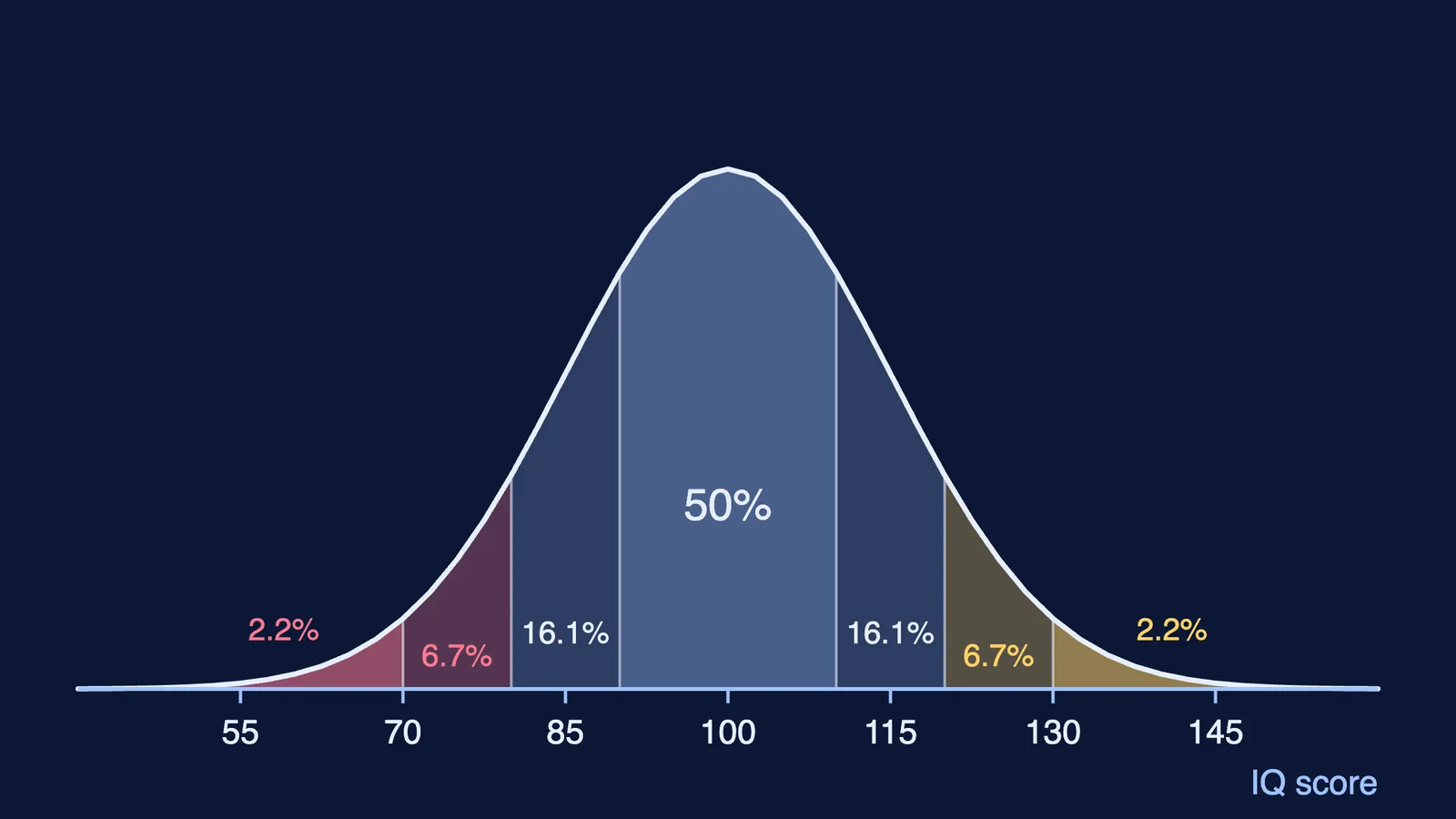
IQ scores roughly follow a bell-shaped normal curve with a mean of 100. NCERT's Table 1.1 places 50% of people at 90 to 109, 16.1% at 110 to 119, 6.7% at 120 to 130 and 2.2% above 130, mirrored below 90. People above 130 are called intellectually gifted; intellectual disability, in the definition NCERT cites, means an IQ below 70 plus deficits in adaptive behaviour during the developmental period (0 to 18 years).
What is emotional intelligence, and how is it different from IQ?
Peter Salovey and John Mayer framed emotional intelligence in a 1990 paper as skills for appraising, expressing and regulating emotion in yourself and others, and using feelings to plan and achieve. NCERT quotes their definition: "the ability to monitor one's own and other's emotions, to discriminate among them, and to use the information to guide one's thinking and actions". Emotional quotient (EQ) expresses it the way IQ expresses intelligence.
IQ captures reasoning; NCERT calls emotional intelligence the feeling side of intelligence. It also links the idea to integral intelligence in the Indian tradition, where buddhi includes feelings and determined action alongside cognitive skill.
Aptitude vs intelligence: what is the difference?
Intelligence tests measure general mental ability. Aptitude, in NCERT's words, is "a combination of characteristics that indicates an individual's capacity to acquire some specific knowledge or skill after training". Success needs aptitude and interest together. The Differential Aptitude Tests (DAT), which NCERT calls the most commonly used battery in educational settings, have eight subtests, and J.M. Ojha developed an Indian adaptation.
If assessment interests you as a career, read how to become a clinical psychologist in India.
A five-day plan to revise this chapter
Day 1: write the five domains from memory, then check them against the textbook.
Day 2: one page with psychometric theories on the left and information-processing on the right; see making mind maps for revision.
Day 3: redo the four IQ sums without notes and sketch the Table 1.1 curve.
Day 4: write the emotional intelligence and aptitude definitions, who NCERT links to each, and one example from your own life.
Day 5: answer a long question as definition, proponent, components, example and one limitation; for scenarios, follow how to answer case-based questions in CBSE board exams.
If you take physics or maths alongside psychology, Fermi's AI tutor can work out what you already know in those subjects and build a plan for the session, so your other revision days start with a clear next step.
Start Day 1 tonight: five definitions take about as long as one practice question.