On this page
For 2026-27, NCERT has replaced the four separate Class 9 social science books for geography, history, political science and economics with one two-part book, *Understanding Society: India and Beyond*. The NCERT textbook page now lists only Part I and Part II for Class 9. Part I opens with Chapter 1, Understanding Social Science. Here are its key ideas, a worked example, common mistakes and a revision plan.
What is social science, according to Class 9 Chapter 1?
The chapter defines social science as "the systematic study of human society" (NCERT Chapter 1). It asks not just what happened and where, but why, and how the past shapes the present.
Keep one contrast ready: physics, chemistry and biology study the natural world, while social science studies society, institutions, cultures and the ways people interact. Social scientists still work from evidence: observation, interviews, surveys, documents and comparisons across times and places.
The chapter starts close to home: your food, roads, school and electricity all depend on governance, production, cooperation and the environment.
What are the four disciplines of social science in Class 9?
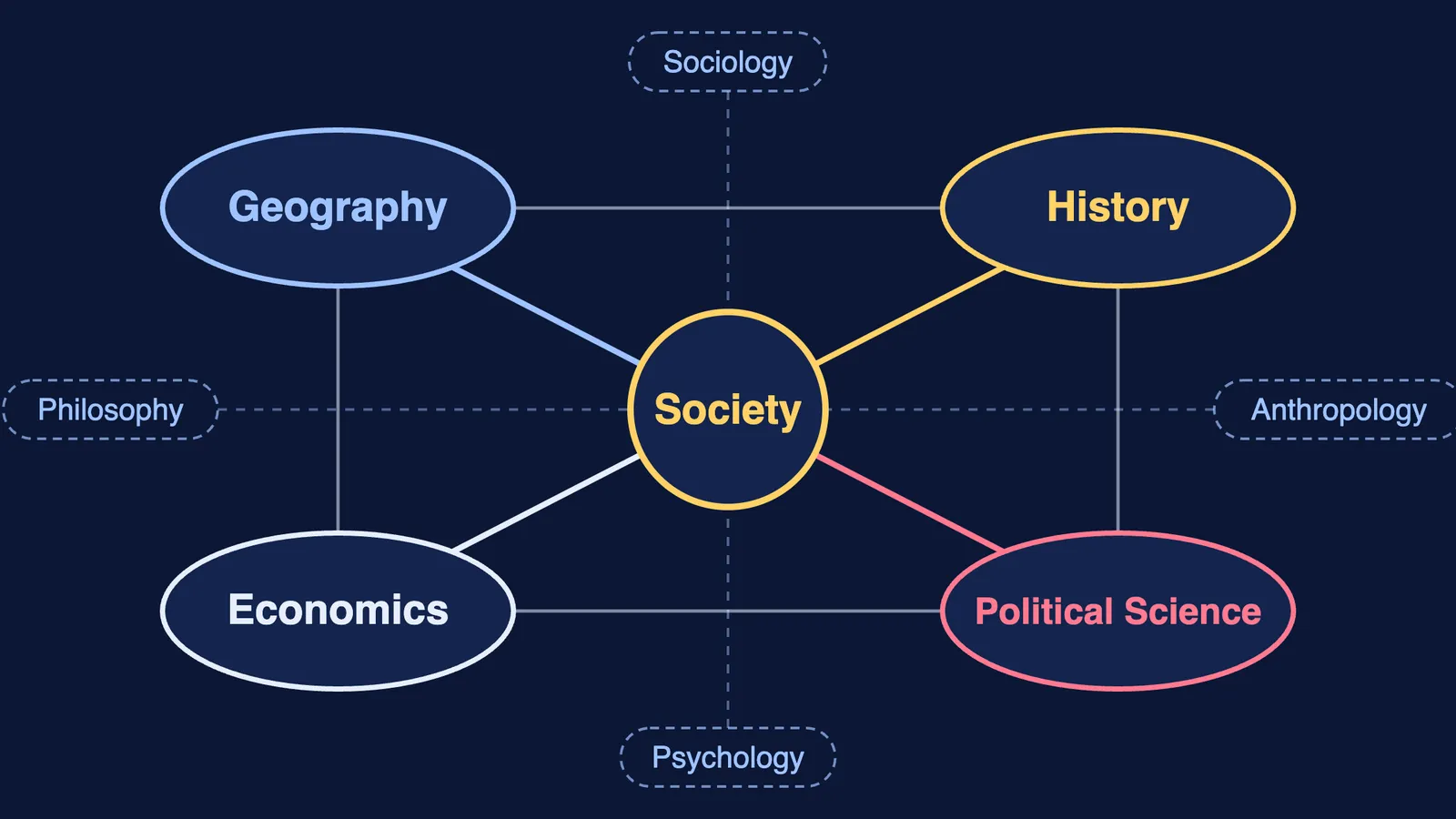
For Classes 9 and 10, the book draws mainly on four core disciplines (NCERT Chapter 1):
Geography: where things are, why they are there, and how people and places shape each other. It combines location with change over time, uses maps, atlases and GIS, and borrows from physics, chemistry and biology.
History: the human past and how societies change. It reads literary, archaeological, epigraphic (inscriptions) and numismatic (coins) sources, and uses tools such as carbon-14 dating.
Political science: governance, power, constitutions, state institutions, and citizens' rights and duties, down to the Panchayati Raj system in villages.
Economics: how societies use limited resources, and how consumers, producers and governments decide what is produced, exchanged and shared.
Sociology, philosophy, anthropology and psychology belong to the wider social science family and are developed further in higher classes. Later chapters of the same book put the lenses to work: see our guides to Shaping of the Earth's Surface, Chapter 2 for geography and Elections, Chapter 7 for political science.
How are the disciplines connected? A worked example
The chapter links them through a drought, which hits crops, incomes, relief, migration and old ways of coping. Practise on a fresh case:
Case: a town replaces a busy bus route with a new metro line.
Geography: which areas does the line serve, and which neighbourhoods are left far from a station?
History: how did people travel before, and how did the town grow around the old routes?
Political science: who chose the route, who was consulted, and where do residents complain?
Economics: how does the fare compare with the bus, and which shops gain or lose customers?
Then join two lenses in one sentence: the route (geography) decides who gets cheaper, faster travel (economics).
Why does the chapter bring in Indian knowledge traditions?
The book argues that careful thinking about society has deep roots in India (NCERT Chapter 1). It cites the Pañchamahābhūtas (earth, water, fire, air and space) as an early way of seeing nature and human life as one system, and vasudhaiva kuṭumbakam, the idea of the world as one family. It names the Arthaśhāstra, attributed to Kauṭilya and composed about 2,300 years ago, as a text on administration, taxes and a ruler's duties, and, in its history section, the itihāsa-purāṇa tradition, which preserved cultural memory through stories. CBSE lists this Indian perspective in the chapter's content, so learn one example of each.
What mistakes do students make in this chapter?
Mixing up sources: epigraphic means inscriptions on stone or metal; numismatic means coins.
Calling social science guesswork. It relies on careful observation, evidence and logical reasoning.
Listing the four disciplines without showing a link between them.
Calling the Arthaśhāstra modern. It is an ancient text, older than today's disciplines.
How should you prepare Chapter 1 for CBSE 2026-27?
The CBSE Class IX Social Science curriculum for 2026-27 gives this theme 4 instructional hours. It expects you to explain why social science matters and how the four disciplines connect. Chapter marks are not out yet: the document says the course structure will be provided shortly, so check again before exams.
A three-session plan:
Day 1, 30 minutes: read the chapter once and write a one-line definition of each discipline in your own words.
Day 2, 30 minutes: learn the four kinds of historical sources with one Indian example each, and the Indian-tradition examples above.
Day 3, 30 minutes: take a news story from this week, run the four-question lens, and write 120 words linking two disciplines.
Geography in the next chapters leans on science, such as plate tectonics in Chapter 2. If a science idea there is the gap, the Fermi Concept Library has a lesson for every concept in physics, chemistry, biology, mathematics and computing.
Wondering how much this year counts? See where Class 9 marks matter and where they don't.