On this page
Chemists were asking this question before the word "carbocation" existed. In 1900 Moses Gomberg reported triphenylmethyl in the Journal of the American Chemical Society as "an instance of trivalent carbon", a carbon with only three bonds. In 1902, as this LibreTexts chapter on carbocations records, Norris and Kehrmann independently found that colourless triphenylmethanol gives deep-yellow solutions in concentrated sulfuric acid.
Most carbocations last only a moment in a reaction. The trityl cation, Ph3C+, is different.
Why is the triphenylmethyl carbocation so stable?
Trityl is stable enough to form isolable salts with poorly nucleophilic anions such as tetrafluoroborate (BF4−), according to William Reusch's Virtual Textbook of Organic Chemistry. The same page says resonance is generally stronger than inductive effects and is the main thing stabilising the trityl cation.
So the short answer has three parts:
Resonance, not just induction. The empty p orbital on the central carbon overlaps with the π electrons of the rings, so the positive charge moves into them.
Three rings, not one. Each phenyl ring takes a share of the charge, so no single carbon carries all of it.
The overlap survives the twist. The rings tilt out of plane, but only partly, so most of the sharing still works.
How many resonance structures does the trityl cation have?
Count them ring by ring. This is the same method as in our guide on how to count resonance structures without double-counting.
Start with the positive charge on the central carbon. That is one structure.
Move a π bond from one ring toward the central carbon. The positive charge lands on an ortho carbon.
Keep pushing electrons around that ring. The charge moves to the para carbon, then to the other ortho carbon. That gives three structures per ring.
Repeat for the other two rings: 3 × 3 = 9 ring structures.
Add the first one: 9 + 1 = 10.
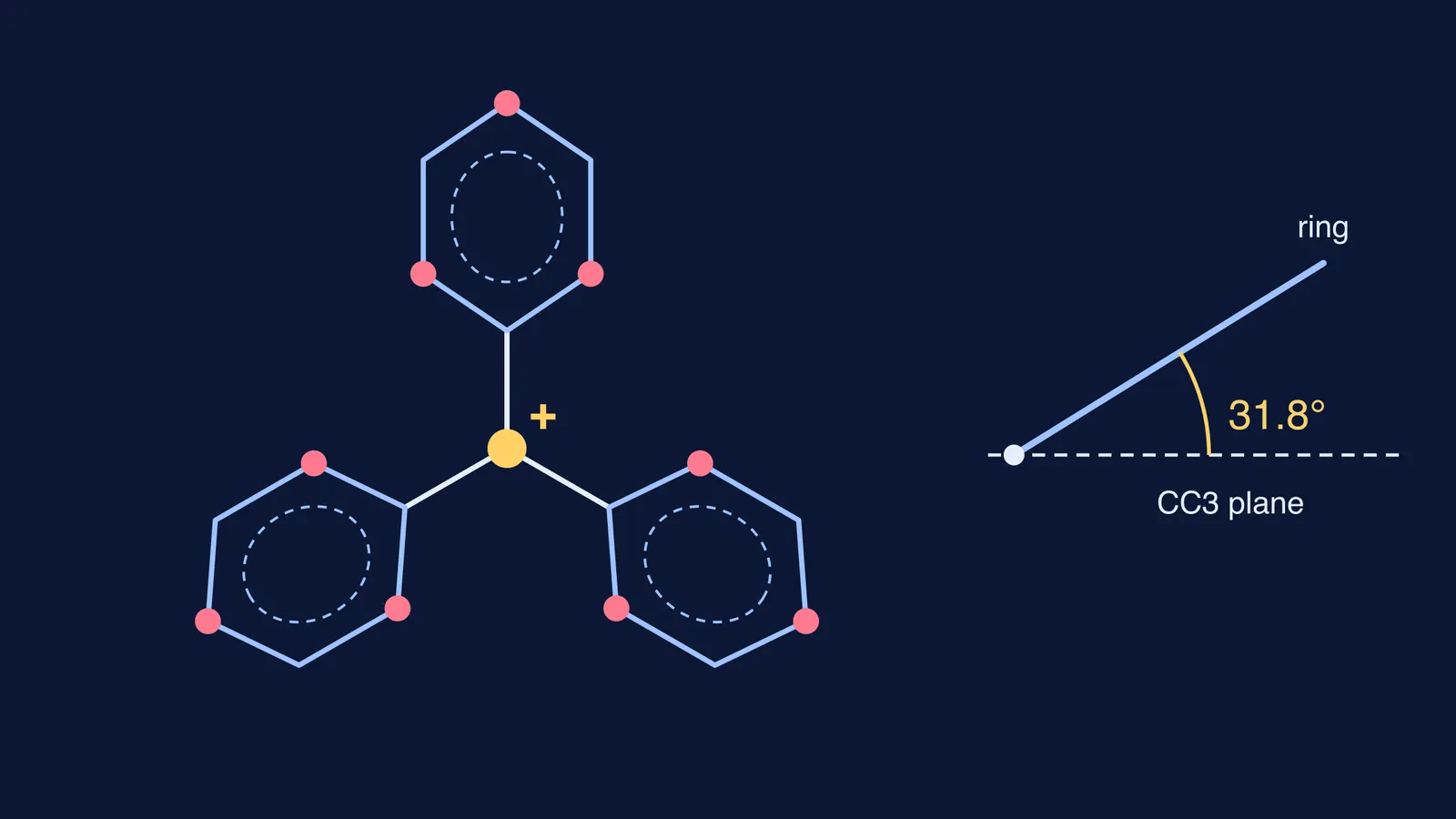
The meta carbons never carry the charge. In the diagram at the top, the nine pink dots are the ortho and para carbons that do.
The same count gives 4 structures for the benzyl cation (1 + 3) and 7 for the diphenylmethyl cation (1 + 6). More structures that place the charge on different atoms means the charge is spread more thinly.
Why are the three rings twisted like a propeller?
If all three rings lay flat, the overlap would be at its best. But the ortho hydrogens on neighbouring rings would then bump into each other. The molecule settles on a compromise.
Roald Hoffmann, Robert Bissell and Donald Farnum studied this "balance of steric and conjugative effects" in a 1969 paper in The Journal of Physical Chemistry. They cite a single-crystal X-ray structure of a trityl salt, published in 1965, that shows a propeller shape with each ring twisted 31.8 ± 0.6° out of the plane of the four central carbons. Their calculations found that the benzyl cation, with one ring and no neighbour to clash with, prefers to be flat.
The same paper found that the energy of twisting the benzyl cation follows cos²θ very closely, where θ is the twist angle. As a rough estimate only, borrowing that one-ring result for each trityl ring gives cos²(31.8°) ≈ 0.72. Each ring would then keep roughly three-quarters of the stabilisation it would give if it were flat. Three rings at about three-quarters each is still far more help than one.
Trityl, benzyl or tert-butyl: which carbocation is most stable?
JEE-style question. Which carbocation is the most stable? (a) (CH3)3C+ (b) C6H5CH2+ (c) (C6H5)2CH+ (d) (C6H5)3C+
Step 1: Count resonance structures. tert-Butyl has none involving a π system. Benzyl has 4, diphenylmethyl 7 and trityl 10.
Step 2: Count the other help. tert-Butyl has 9 alpha hydrogens for hyperconjugation, plus the +I effect of three methyl groups. If you need a refresher, see how to count alpha hydrogens for hyperconjugation.
Step 3: Weigh resonance against hyperconjugation. Reusch's carbocation stability page ranks the benzyl cation at about the same level as tert-butyl. In other words, one benzene ring is worth roughly as much as three methyl groups. Two rings beat that, and three beat it clearly.
Step 4: Check that nothing breaks the overlap. The twist is partial, not 90°, so trityl keeps its lead.
Answer: (d). The order is trityl > diphenylmethyl > benzyl ≈ tert-butyl.
A warning on the tie: if an option hinges only on benzyl versus tert-butyl, remember the gap is small. Let the clear gaps decide the answer. The same benzylic resonance explains why allylic and benzylic halides react fast by the SN1 route.
If you want more questions in this pattern, the Fermi Problem Library has worked problems with a step-by-step solver that explains the reasoning rather than printing an answer. If resonance or hyperconjugation itself still feels shaky, the Fermi Concept Library gives each concept its own lesson and shows its place in the map.
Next time you see Ph3C+, count the ten structures, picture the 32° propeller, and you have the whole answer.