

On this page
Two of India's famous "toy trains" solve the same problem in two different ways. The Nilgiri line to Ooty adds teeth to the track. The Darjeeling line makes the track longer. Both answer one question from Class 11 physics: how much can friction push a train uphill?
Why can't a normal train climb a steep hill?
A locomotive's driven wheels push backwards on the rail, and static friction pushes the train forwards. That push can be at most μN, where N is the weight resting on the driven wheels and μ is the coefficient of friction between wheel and rail.
For steel on steel, μ is typically between 0.35 and 0.5 on railways, according to this overview of adhesion railways; the same article says steam locomotives were designed around a coefficient of 0.25. Rain, oil or leaves on the rail lower it.
On a slope of angle θ, gravity pulls the whole train, coaches included, back down with a force Mg sin θ. Only the locomotive's weight presses its driven wheels onto the rail, so the grip is about μ × (locomotive weight) × cos θ (why the normal force is mg cos θ). When the pull back down beats the grip, the wheels spin. Friction-based railways reach about 10% at most, as the rack railway article notes.
How does the Nilgiri rack railway work?
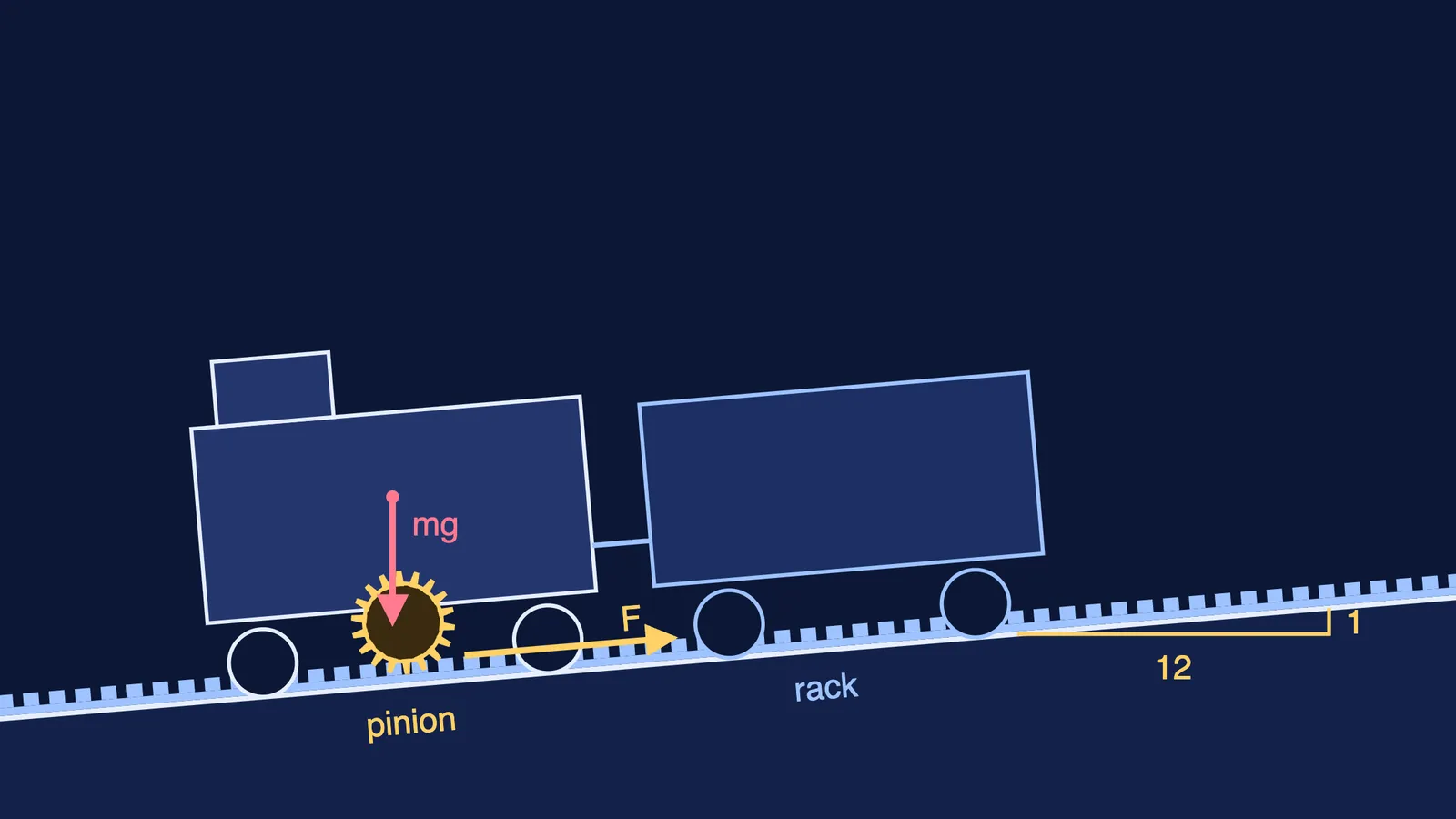
The Nilgiri Mountain Railway has a maximum gradient of 8.33%, or 1 in 12: the track rises 1 metre for every 12 metres along it. Between Kallar and Coonoor it uses the Abt rack and pinion system, and on this rack section the gradient averages 1 in 24.5 (4.08%), peaking at 1 in 12, according to the Nilgiri Mountain Railway article.
A rack is a toothed bar laid between the rails. A pinion is a cog wheel under the locomotive that meshes with it. The Abt design of 1882 uses two or three toothed bars side by side with their teeth offset, so a pinion tooth is always engaged, as the rack railway article describes.
Now the pinion pushes on the face of a tooth, and the tooth pushes back with a normal force, like your foot on a stair instead of a wet ramp. Friction no longer sets the limit; the teeth and the engine do. The same article gives 1 in 4 (25%) as the Abt system's limit.
How do the Darjeeling loops and zigzags help?
The Darjeeling Himalayan Railway has no rack. It uses six zigzags and three loops (originally five) to gain height, according to the Darjeeling Himalayan Railway article.
A loop is a spiral: the track circles round and crosses over itself, so the train climbs while turning. The Batasia Loop, 5 km from Darjeeling below Ghum, was built in 1919 to lower the gradient of the climb. A zigzag climbs a hillside in short legs: the train runs up one, stops, and reverses up the next.
Both use the idea behind every hairpin bend on a ghat road: gradient is height gained divided by distance travelled, so a longer path to the same height is gentler.
Worked example: could the Nilgiri train climb 1 in 12 on friction alone?
Take a locomotive that is a quarter of the train's mass, every wheel driven, at steady speed. These numbers are illustrative, not a real train's.
On 1 in 12, tan θ = 1/12 ≈ 0.083.
The climbing rule needs μ × (1/4) ≥ 0.083, so μ ≥ 0.33.
Compare the adhesion railway article: a dry rail at 0.35 to 0.5 only just clears 0.33, and the 0.25 steam locomotives were designed around falls short. On a wet or oily rail it would not be enough.
Rolling resistance, starting from rest and braking on the way down all need extra grip.
So the margin is thin or missing, and the rack removes the doubt. A Darjeeling-style loop that doubles the distance for the same height halves the gradient, and roughly halves the grip needed. Another fix is more locomotives, which we cover in why trains need extra engines on steep ghat sections.
Try it at home: find your own adhesion limit
Put an eraser on a hardbound book and lift one end slowly.
Stop the moment it starts to slide. Measure the height h of the raised end and the horizontal distance d from the hinge to the point below it.
The coefficient of static friction is μ = tan θ = h/d.
Repeat with a damp cloth under the eraser and note how much μ falls.
That slip angle is the steepest slope a locomotive with every wheel driven, the same grip and no coaches could climb. Every coach you add lowers it.
If forces on an incline are hard to picture, the Fermi Simulation Lab has interactive simulations for ideas that are easier to see than to read. Fermi's AI tutor can draw the figure and work through a problem like this one with you, checking your understanding as it goes.


