

On this page
Tin is the soft, shiny metal in solder, in the coating on food cans and in old organ pipes. Yet a bar of pure tin kept in deep cold can grow grey warts, swell and break into powder. This is tin pest: not rust, but the same element rearranging its atoms into a different crystal.
What is tin pest?
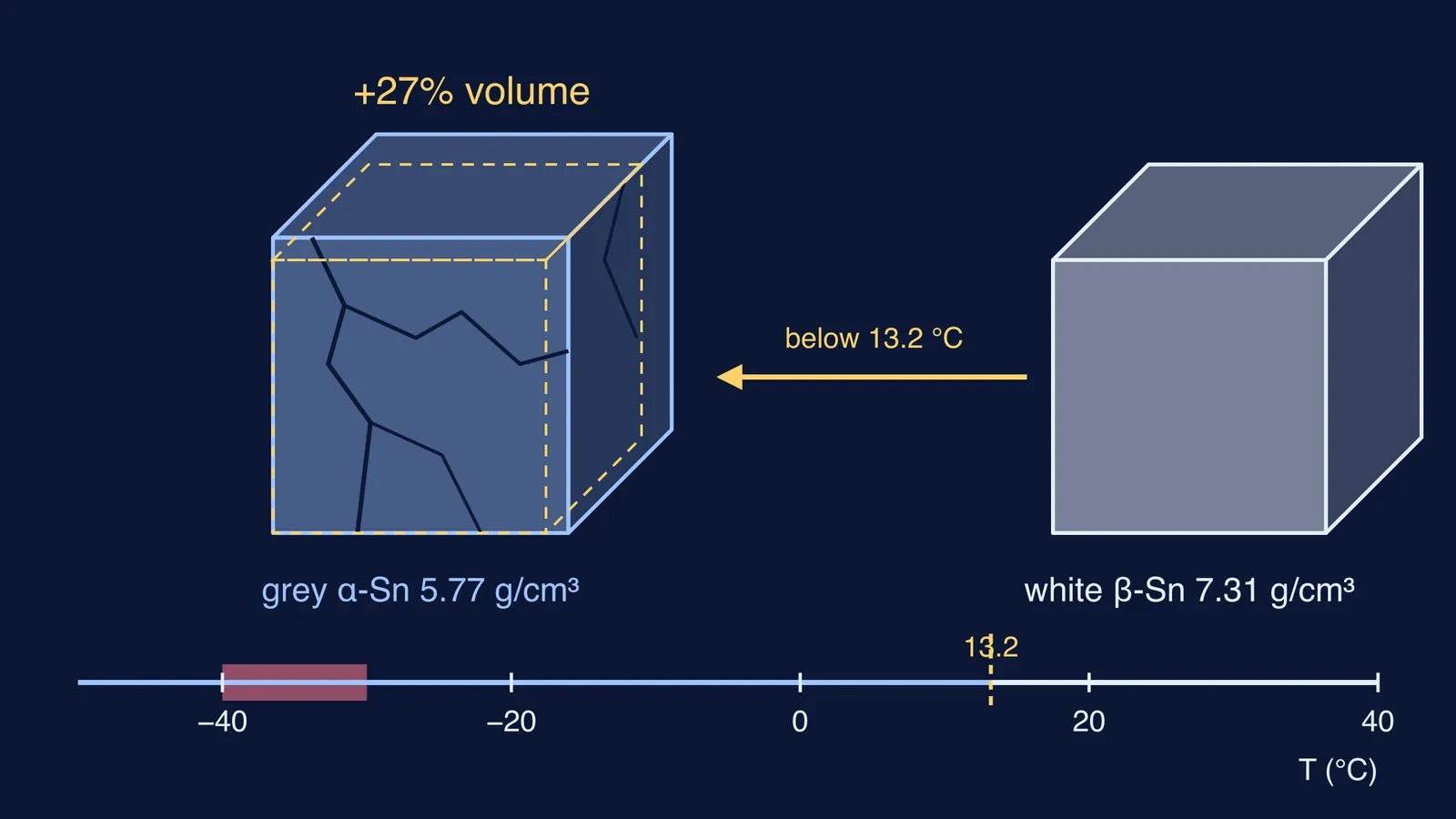
Tin pest is the slow change of white tin (β-tin) into grey tin (α-tin). A LibreTexts general chemistry chapter/21%3A_The_Chemistry_of_the_Main_Group_Elements/21.07%3A__Silicon_and_the_Group_4A_Elements) puts it simply: white tin has a metallic lattice and metallic properties, while grey tin has a diamond-like structure and is a semiconductor. The metallic β form is stable above 13.2 °C, and the non-metallic α form is stable below 13.2 °C.
Two crystal forms of one element are allotropes, like diamond and graphite, or like rhombic and monoclinic sulphur, which also swap at a fixed transition temperature.
Why does tin crumble into powder in extreme cold?
White tin has a density of 7.31 g/cm³ and grey tin 5.77 g/cm³, according to the CALCE centre at the University of Maryland. The change brings a volume increase of about 27% (CALCE; University of Oxford mineral care guide).
You can check the 27% yourself from the two densities:
Take 1 cm³ of white tin. Its mass is 7.31 g.
Mass does not change when atoms rearrange. As grey tin, 7.31 g fills 7.31 ÷ 5.77 = 1.27 cm³.
So the volume grows by about 27%.
Each edge grows by the cube root of 1.27, which is about 1.08: an 8% stretch in every direction.
Grey tin starts at small spots that try to grow 8% in every direction while the metal around them does not. The Oxford guide says the stress is released through cracking, blistering and fragmentation, and that internal stresses, microcracks and defects make grey tin mechanically very weak and brittle (Oxford).
Why doesn't every tin object fall apart in winter?
Below 13.2 °C grey tin is the more stable form, but stable does not mean fast. The change needs a seed of grey tin, and then atoms must reorganise. The Oxford guide notes the change is often only noticeable after a large degree of undercooling, below about −13 °C. CALCE reports that the maximum rate is at −30 °C to −40 °C, and that tin can sit in cold storage for months to years before any sign appears.
Impurities slow it further. In tests summarised by CALCE, tin with 0.5 mass% antimony showed no visible warts beyond a 5.5-year observation, and as little as 0.0035 mass% bismuth inhibited growth. When electronics moved from tin-lead to mostly tin solders, engineers studied the risk again; see the review by Cornelius, Treivish, Rosenthal and Pecht in Microelectronics Reliability and W. J. Plumbridge's paper on tin pest in lead-free solders.
This is thermodynamics versus kinetics: a form can be more stable and still change too slowly to see, the same idea behind why diamond does not quietly turn into graphite.
Did tin pest really destroy Napoleon's army?
The story says tin buttons crumbled on French uniforms in the Russian winter of 1812. It is probably a legend: the Wikipedia article on tin pest notes that none of the many survivors' accounts mention tin buttons. The empty kerosene cans that Robert Scott's South Pole party found in 1912 are often blamed on tin pest too, but the same article reports that the Tin Research Institute found no tin pest in them. Use these stories as a hook, not as evidence.
How does grey tin fit group 14 trends?
Carbon is a non-metal, silicon and germanium are metalloids, and tin and lead are poor metals; metallic properties increase down the group as ionisation energies decrease (LibreTexts, Group 14/Descriptive_Chemistry/Elements_Organized_by_Block/2_p-Block_Elements/Group_14%3A_The_Carbon_Family/1Group_14%3A_General_Properties_and_Reactions)).
Grey tin has the diamond cubic structure, the same as diamond and silicon (Tin, Wikipedia). Tin sits on the boundary: its diamond-like form is stable only in the cold, and the metallic form takes over above 13.2 °C. Lead, one row down, is the only group 14 element that is metallic in both structure and properties under all conditions (LibreTexts/21%3A_The_Chemistry_of_the_Main_Group_Elements/21.07%3A__Silicon_and_the_Group_4A_Elements)). So tin is where you can watch the non-metal-to-metal trend flip with temperature.
How to write this up in an exam
A full answer has five parts, using the figures from CALCE:
Name both allotropes: white β-tin (metallic) and grey α-tin (diamond-like, covalent).
State the transition temperature: 13.2 °C.
Explain the crumbling with densities: 7.31 to 5.77 g/cm³, so about 27% more volume.
Explain why it is slow: it needs nucleation, impurities hinder it, and it is fastest near −30 to −40 °C.
Link it to the group 14 trend from non-metal to metal.
If allotropes or the group 14 trend still feel shaky, the Fermi Concept Library gives every concept in chemistry its own lesson and its place in the map. For density and volume numericals like the one above, the Fermi Problem Library has worked problems with a step-by-step solver that explains the reasoning rather than printing an answer.


