On this page
Push a block up a rough ramp and it slows, stops and slides back, and the return takes longer than the climb over the same distance. A standard JEE-style question turns this around: given the two times, find the coefficient of friction.
Why does the block take longer to come down a rough incline?
Kinetic friction opposes the sliding, and its size is f = μN, as OpenStax University Physics, section 6.2 sets out. On an incline of angle θ, the normal force is N = mg cos θ, according to the same OpenStax section. If that still feels like a rule you memorised, our explainer on why the normal force is mg cos θ on an inclined plane walks through it.
The component of gravity along the slope, mg sin θ, points down the slope on both trips. Friction is the force that flips:
Going up, the block slides up, so friction acts down the slope. Both forces slow it: a_up = g(sin θ + μ cos θ).
Coming down, the block slides down, so friction acts up the slope and now works against gravity: a_down = g(sin θ − μ cos θ).
So a_up is larger than a_down whenever μ is above zero. Same distance, smaller acceleration, more time. For the picture without the algebra, see why a block takes longer to slide down a rough incline.
Our post on the angle of repose and the tan θ = μ result covers that threshold.
How do you derive the time of ascent and descent ratio?
You need one constant-acceleration equation from OpenStax University Physics, section 3.4: x = v₀t + ½at².
Going up, the block starts at speed u and stops after distance s; run backwards, that is a start from rest, so s = ½ a_up t_up². Coming down, it starts from rest over the same s, so s = ½ a_down t_down². Set them equal:
t_down / t_up = √(a_up / a_down) = √[(sin θ + μ cos θ) / (sin θ − μ cos θ)]
Call this ratio n. Square both sides, cross-multiply and collect the μ terms:
n²(sin θ − μ cos θ) = sin θ + μ cos θ, which gives μ = tan θ × (n² − 1)/(n² + 1).
Check: if μ = 0, then n = 1, and both trips take the same time. Also, since speed is acceleration times time on each leg, the block returns at u/n.
How do you find μ from the time ratio? A worked numerical
This uses only the OpenStax relations above.
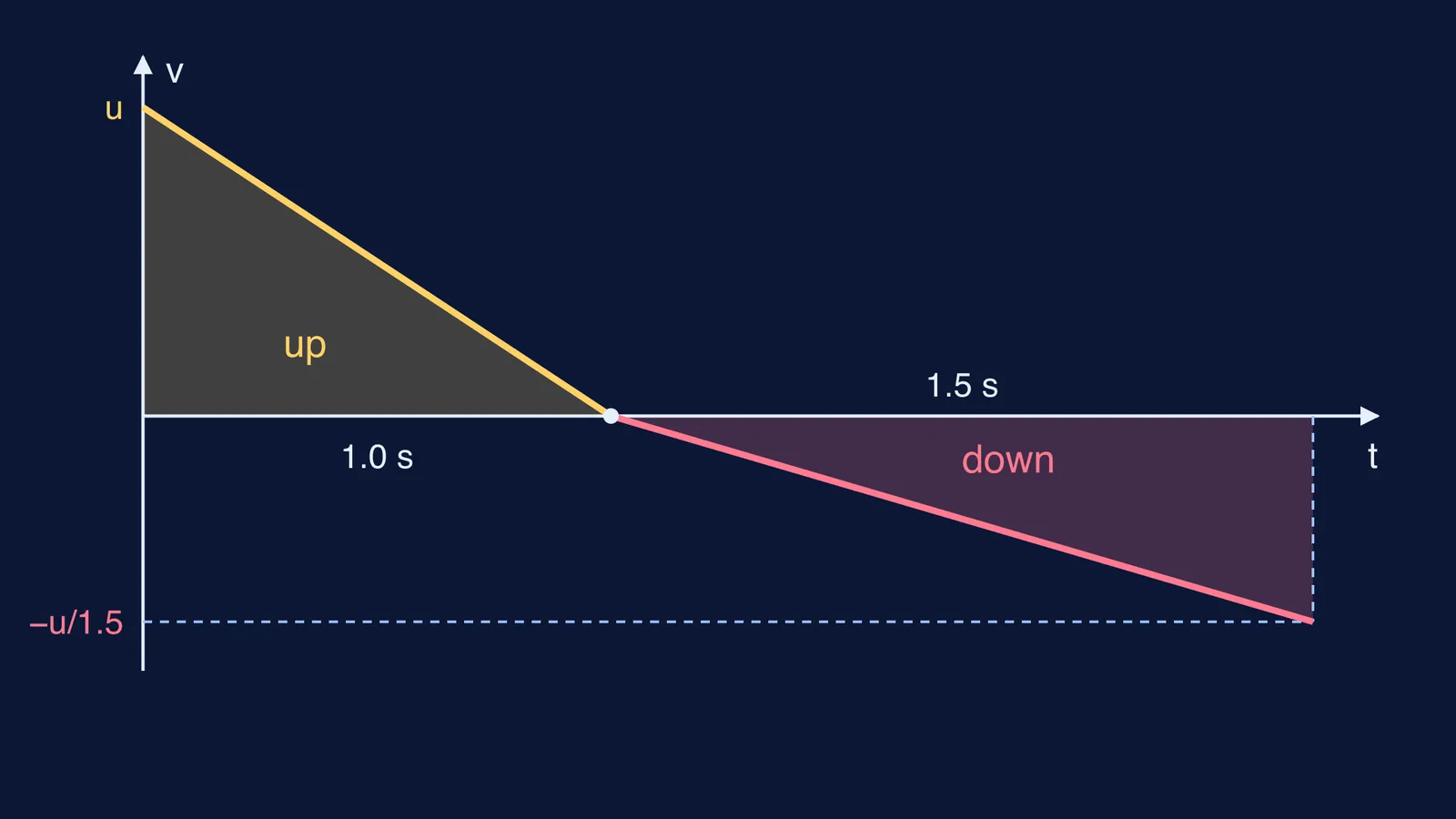
Problem. A block pushed up a 30° rough incline stops after 1.0 s and takes 1.5 s to slide back. Find μ, the launch speed and the distance up the slope. Take g = 9.8 m/s².
Ratio: n = 1.5/1.0 = 1.5, so n² = 2.25.
Formula: μ = tan 30° × (2.25 − 1)/(2.25 + 1) = 0.577 × 0.385 ≈ 0.22.
Accelerations: μ cos 30° ≈ 0.192, so a_up = 9.8 × (0.5 + 0.192) ≈ 6.78 m/s² and a_down = 9.8 × (0.5 − 0.192) ≈ 3.02 m/s². Their ratio is 2.25, which matches n².
Launch speed: u = a_up × t_up ≈ 6.78 m/s.
Distance: s = ½ × 6.78 × 1.0² ≈ 3.39 m.
Check the descent: t_down = √(2 × 3.39 / 3.02) ≈ 1.50 s. It matches.
Return speed: 3.02 × 1.5 ≈ 4.52 m/s, which is 6.78/1.5, as the u/n rule predicts.
A value near 0.22 is believable: OpenStax's table of friction coefficients lists a kinetic coefficient of 0.3 for wood on wood. The graph at the top of this post is this exact case; its two shaded triangles have equal area because the distance up equals the distance down.
Another version of the question sets θ = 45°, so μ = (n² − 1)/(n² + 1); a descent twice as long gives μ = 0.6.
What mistakes cost marks on this problem?
Keeping friction pointing the same way on both legs. Redraw the free-body diagram when the velocity reverses.
Using the static coefficient for a sliding block.
Flipping the ratio. The descent is the slower leg, so n is greater than 1; a negative μ means you swapped the times.
Skipping the tan θ check before writing a time of descent.
Mixing ratios: times and speeds scale as n, accelerations as n².
Getting friction's direction wrong is a method mistake, and the fix is fresh problems rather than rereading notes. The Fermi Problem Library has worked problems with a step-by-step solver that explains the reasoning rather than printing an answer, so you can see the step where friction changes sign. If friction itself is the gap, the Fermi Concept Library gives each concept its own lesson.
Next time a question says the block takes n times as long to come down, write μ = tan θ (n² − 1)/(n² + 1), then check it with two free-body diagrams.