

On this page
When a block slides up and down a rough inclined plane, it feels like the descent should be faster because gravity is pulling it down. But if you measure the time, you will find that the block always takes longer to come down than it took to go up.
This happens because friction always opposes the direction of motion, meaning it changes its direction halfway through the trip, as detailed in the classical mechanics of friction. This simple reversal changes the entire dynamic of the object's acceleration.
Does a block take longer to come down a rough incline?
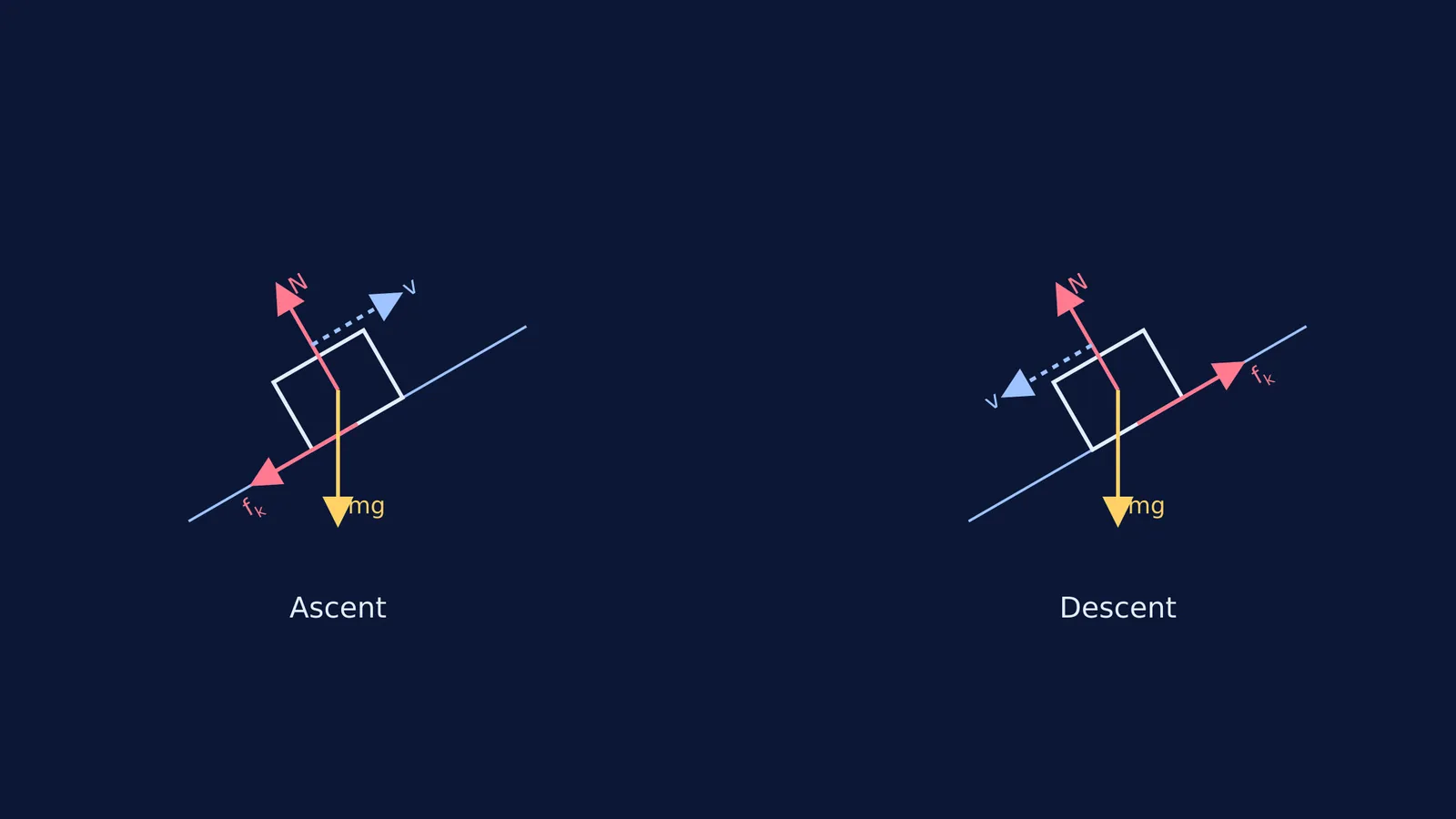
Yes, the descent always takes more time. When you push a block up a rough incline, two forces are actively working against the upward motion to bring the object to a stop:
Gravity: A component of the block's weight (mg sin θ) pulls it consistently down the slope.
Kinetic friction: Because the block is moving up, the rough surface exerts a frictional force (f_k = μ_k mg cos θ) pointing directly down the slope, actively resisting the slide.
Because both gravity and friction pull in the exact same direction during the ascent, the net force is large. The block experiences a high deceleration, a_up = g(sin θ + μ_k cos θ), bringing it to a halt very quickly. A higher deceleration means the block spends less time covering the distance to its peak height before its velocity drops to zero.
What forces change direction during descent?
Once the block reaches its peak and begins sliding back down, the physical situation flips entirely.
Gravity continues to pull the block down the slope (mg sin θ), exactly as it did during the ascent. However, the block is now moving downward. Because kinetic friction always opposes the current direction of motion, it changes its direction to point *up* the slope.
Now, friction is fighting gravity instead of helping it. The net force driving the block down is much smaller, leading to a significantly lower acceleration: a_down = g(sin θ − μ_k cos θ). You can see how this delicate balance of forces dictates whether an object stays at rest or slides by studying the angle of repose and friction. Because the net downward force is weaker, the block takes a longer time to build up speed and cover the distance back to the bottom of the ramp.
How do you compare the time of ascent and descent?
Since the block covers the exact same distance S going up and coming down, we can compare the times mathematically using the standard kinematic formula S = ½at².
The time to slide up the incline is t_up = √(2S / a_up). The time to slide back down is t_down = √(2S / a_down).
Because the deceleration on the way up (a_up) is much greater than the acceleration on the way down (a_down), the denominator for the ascent time is larger. This means the time spent going up is significantly shorter than the time spent coming down. The rougher the surface (the higher the coefficient of kinetic friction, μ_k), the greater this difference becomes. Recognising this relationship instantly can save valuable time on multiple-choice questions.
These classical mechanics principles appear throughout kinematics, from plotting the equation of trajectory of a thrown object to integrating acceleration given as a function of velocity. Understanding how to set up the free-body diagram for each phase of motion is the key to solving them correctly.
Testing the theory in motion
Visualizing how these vectors flip and affect the resulting motion can be tricky when you are just reading equations on a page. It helps to watch the forces interact dynamically. In the Fermi Simulation Lab, you can set the angle of the incline, adjust the coefficient of friction, and launch the block up the ramp. You will see the force vectors change direction in real time as the block reaches the top, stops for a fraction of a second, and starts its slow slide back down.


