On this page
The Adventure is Jayant Narlikar's science-fiction story in Hornbill, and it is on the CBSE English Core (301) syllabus for 2026-27. A historian, Professor Gangadharpant Gaitonde, spends two days in an India where the Marathas won the Battle of Panipat. His friend Rajendra Deshpande explains it with two scientific ideas.
What happens in The Adventure?
The chapter in the current NCERT Hornbill is an adapted version that opens with Gaitonde already on a train from Pune to Bombay. Permits are checked where British territory begins, and outside Victoria Terminus the East India Company is still flourishing, though in his world it was wound up after 1857.
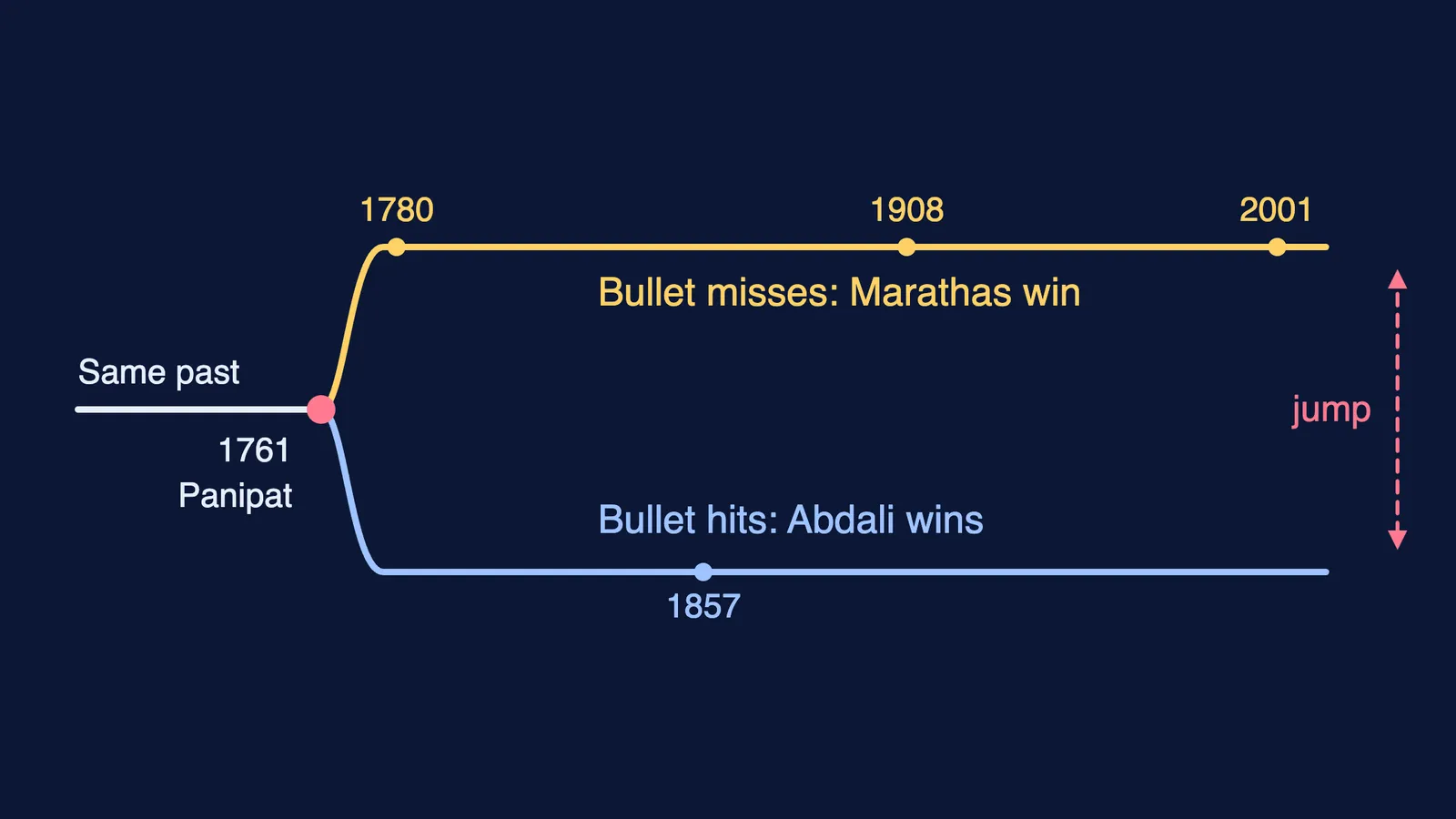
His son cannot be found, so Gaitonde goes to the Asiatic Society library in the Town Hall and reads his own five-volume history. Everything matches until volume five, at the Battle of Panipat. In this world the Marathas won, Abdali was chased back to Kabul, and the British were kept to a few coastal pockets. Bombay was leased to Britain until 2001 under a 1908 treaty.
An old chronicle, the Bhausahebanchi Bakhar, gives the clue: a bullet narrowly missed Vishwasrao instead of killing him. That evening, at a lecture in Azad Maidan, he insists on taking the empty presiding chair and is mobbed off the stage. Next morning he is found in Azad Maidan, back in his own world, carrying one torn page from the library's Bakhar.
In real history, the Third Battle of Panipat was fought in 1761 between Ahmad Shah Abdali and the Marathas under Sadashivrao Bhau, and Abdali won. The district's official history says the Maratha defeat left a power vacuum that later helped the British take over India. Encyclopedic accounts give the date as 14 January 1761 and record that Vishwasrao was shot dead.
What is catastrophe theory in The Adventure?
In the story, catastrophe theory is the idea that a small change at a critical moment can push a whole system into a completely different outcome. The textbook notes that the theory was started by the French mathematician René Thom in the 1960s and looks at how small changes can cause abrupt jumps.
Rajendra applies it to Panipat. The two armies were evenly matched, so leadership and morale counted for a great deal. When Vishwasrao fell and Bhausaheb vanished into the fighting, the Maratha troops lost heart. If the bullet missed, the same moment would lift their spirits instead. One tiny difference, the width of a sesame seed in the Bakhar's telling, flips the result of the battle.
How does Rajendra explain the jump with quantum theory?
Rajendra's second idea comes from quantum physics. You can predict where a fired bullet will land, but for an electron you can only give the odds of finding it in a place. He imagines many worlds existing together, one for each possible result, with an observer seeing only one at a time.
He then compares Gaitonde to an electron jumping between a higher and a lower energy state. Gaitonde did not travel in time. He stayed in the present but crossed into another world, perhaps triggered by thinking hard about Panipat at the moment a truck hit him. Rajendra admits that why it happened is an open question.
If energy levels and probability feel hazy, the Fermi Concept Library covers every concept in physics, chemistry, biology, mathematics and computing, each with its own lesson, so you can look up the real science behind Rajendra's analogy. For a simple take on quantum states, read our guide to what a qubit is.
Who are the main characters?
Professor Gangadharpant Gaitonde: a proud historian who, in the chapter, has spoken at 999 meetings and planned his thousandth presidential address on Panipat going the other way.
Rajendra Deshpande: a scientist friend who listens, studies the torn page and offers the scientific explanation.
Khan Sahib: a fellow passenger bound for Peshawar whose business talk shows Gaitonde this other India.
At the end, Gaitonde decides never to preside over a meeting again.
How should you answer exam questions on The Adventure?
The CBSE 2026-27 curriculum sets Hornbill questions as a prose extract (3 marks), short answers of 40-50 words (3 marks each) and a long answer of 120-150 words (6 marks). For The Adventure, practise these in your own words:
How does catastrophe theory explain the different result at Panipat in the other world?
Compare the India Gaitonde knew with the one he visited.
Explain how Rajendra uses electrons to account for the transition.
What does the Azad Maidan episode reveal about Gaitonde's pride, and how does it change him?
For a 6-mark answer, use a four-part plan: state the idea in one line, give the Panipat example, link it to Rajendra's science, and close with your own view on whether history can turn on chance.
If you are revising Hornbill prose, our Portrait of a Lady summary uses the same approach, and The Book That Saved the Earth is another science-fiction text you may remember from Class 10.