

On this page
The term independent of x is the constant term of an expansion: the one where the powers of x cancel. The method never changes. You write one general term, track the power of x in it, and ask which r makes that power zero.
What is the general term of a binomial expansion?
The NCERT Class 11 textbook states the binomial theorem as (a + b)ⁿ = Σ ⁿCₖ aⁿ⁻ᵏ bᵏ, with k running from 0 to n (NCERT Class 11 Mathematics, Chapter 7: Binomial Theorem). The same chapter notes that the expansion has n + 1 terms, and that the index of a falls by one while the index of b rises by one from each term to the next.
Take one summand, call the counter r, and you have the general term: T(r+1) = ⁿCᵣ aⁿ⁻ʳ bʳ. The "+1" is there because counting starts at r = 0. So r = 0 gives the 1st term and r = 6 gives the 7th.
If you want the middle term and coefficient questions in the same place, our guide to the binomial theorem for JEE: general term, middle term and coefficients covers them.
How do you find the term independent of x, step by step?
Identify a, b and n. Keep any minus sign inside b.
Write T(r+1) = ⁿCᵣ aⁿ⁻ʳ bʳ with the actual a and b.
Collect every power of x into one exponent, written in terms of r.
Set that exponent equal to zero and solve for r.
Check that r is a whole number between 0 and n. If it is, substitute it back to get the term.
Worked example: the constant term in (x² − 1/x)⁹
Here a = x², b = −1/x and n = 9.
The general term is T(r+1) = ⁹Cᵣ (x²)⁹⁻ʳ (−1/x)ʳ.
Split off the sign and the powers: (x²)⁹⁻ʳ = x¹⁸⁻²ʳ, and (−1/x)ʳ = (−1)ʳ x⁻ʳ. Together, T(r+1) = (−1)ʳ ⁹Cᵣ x¹⁸⁻³ʳ.
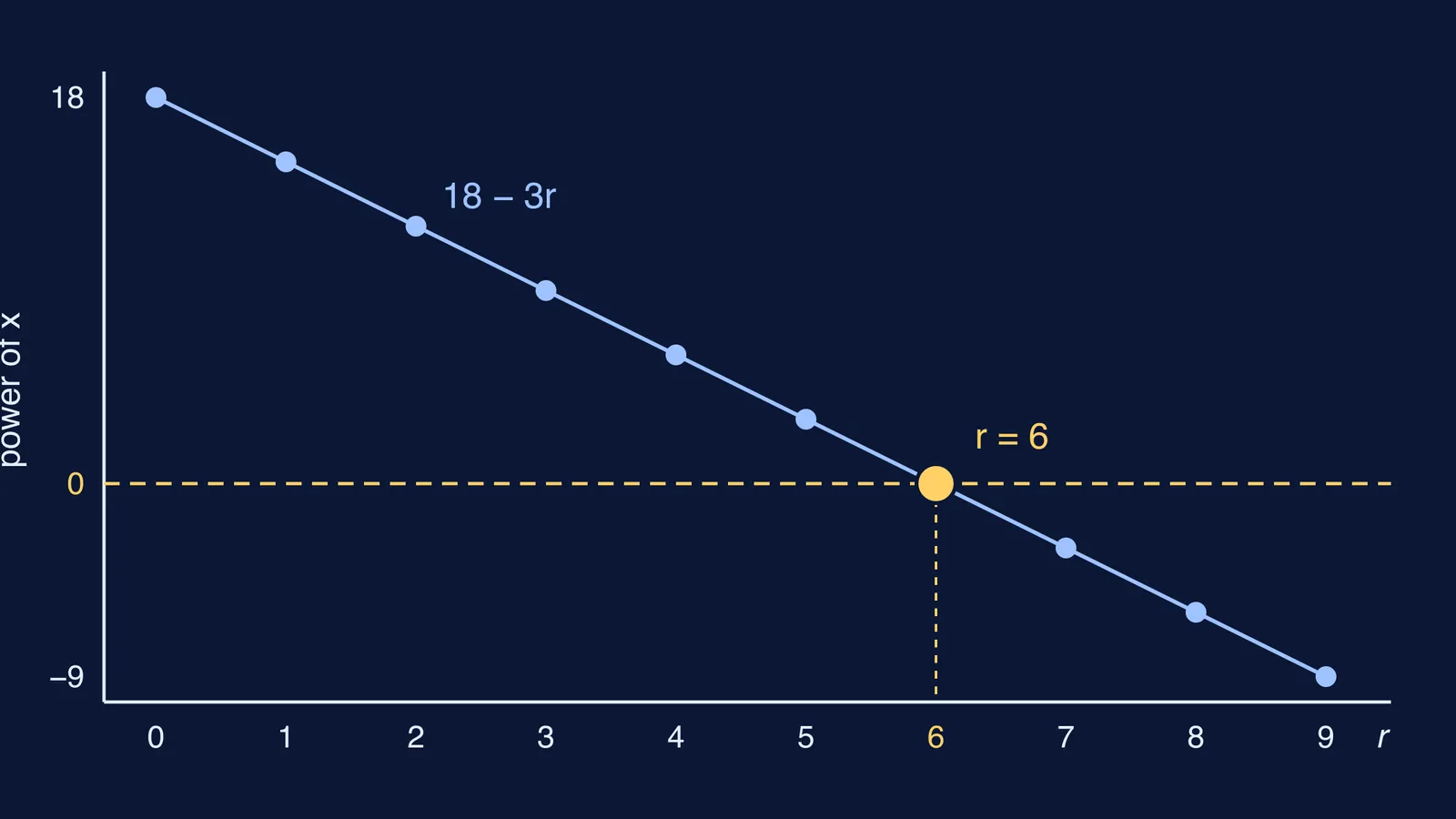
Set the power to zero: 18 − 3r = 0, so r = 6.
The term is T₇ = (−1)⁶ ⁹C₆ = ⁹C₃ = (9 × 8 × 7) ÷ (3 × 2 × 1) = 84.
So the 7th term of (x² − 1/x)⁹ is independent of x, and it equals 84.
It helps to see why there is exactly one such term. The power 18 − 3r runs 18, 15, 12, 9, 6, 3, 0, −3, −6, −9 as r goes from 0 to 9. It falls by 3 each step and lands on zero exactly once, at r = 6.
The same general term answers coefficient questions too. For the coefficient of x³, set 18 − 3r = 3, so r = 5. That term is (−1)⁵ ⁹C₅ x³ = −126x³, so the coefficient is −126.
What does it mean when r comes out as a fraction?
It means no term of the expansion is free of x, so the constant term is zero. Recheck your exponent algebra once first: r counts terms, so it can only be 0, 1, 2 and so on up to n.
Try (x² − 1/x)¹⁰. Now the power of x is 20 − 3r, and 20 − 3r = 0 gives r = 20/3. The powers run 20, 17, 14, 11, 8, 5, 2, −1, ... and jump straight past zero. There is no constant term.
The same verdict applies if r is a whole number but lies outside 0 to n. In (x² + x)ⁿ the power is 2(n − r) + r = 2n − r, and setting it to zero gives r = 2n, which is larger than n. Every term has a positive power of x, so again there is no constant term.
This "is r an allowed whole number?" test is also the heart of counting rational terms, as in how many rational terms are in (√2 + ∛3)¹⁰.
How can you check your answer in a minute?
Write the power of x for r = 0, 1 and 2. They should change by the same step each time; here the step is −3.
Test the formula on a small n you can expand by hand. For n = 3, (x² − 1/x)³ = x⁶ − 3x³ + 3 − 1/x³. The formula gives power 6 − 3r, so r = 2 and the term is (−1)² ³C₂ = 3, which matches.
That last check works on any formula you are unsure of, including one an AI chatbot gave you; we walk through it in how to verify a general term formula with a small expansion.
If your exponents keep going wrong, the Fermi Problem Library has worked problems with a step-by-step solver that explains the reasoning rather than printing an answer. If the general term itself still feels shaky, the Fermi Concept Library gives every concept in mathematics its own lesson.
Next time you see "independent of x", write T(r+1), set the power to zero, and check that r is a whole number from 0 to n.


