

On this page
A tattoo outlasts sunburns, scrapes and years of scrubbing because the ink is not on your skin. It is in it, and your own immune cells keep holding on to it.
Where does tattoo ink actually go?
A tattoo needle deposits ink into the dermis, the second layer of skin, according to the US Food and Drug Administration's consumer guide to tattoo removal. The guide says the cells of the dermis are more stable than those of the epidermis, so the ink will mostly stay in place for a person's lifetime. If the layers are hazy, our explainer on how the epidermis and dermis differ walks through them.
The ink itself contains tiny solid particles. A study in the Beilstein Journal of Nanotechnology notes that tattoo inks contain pigment nanoparticles smaller than 100 nanometres, and it examined ink nanoparticles within the collagen fibril networks of the dermis.
Compare mehendi, which stains only the dead outer layer and fades as those cells flake off (see how mehendi stains the skin). Tattoo pigment sits below that conveyor belt.
Why don't immune cells clear tattoo ink?
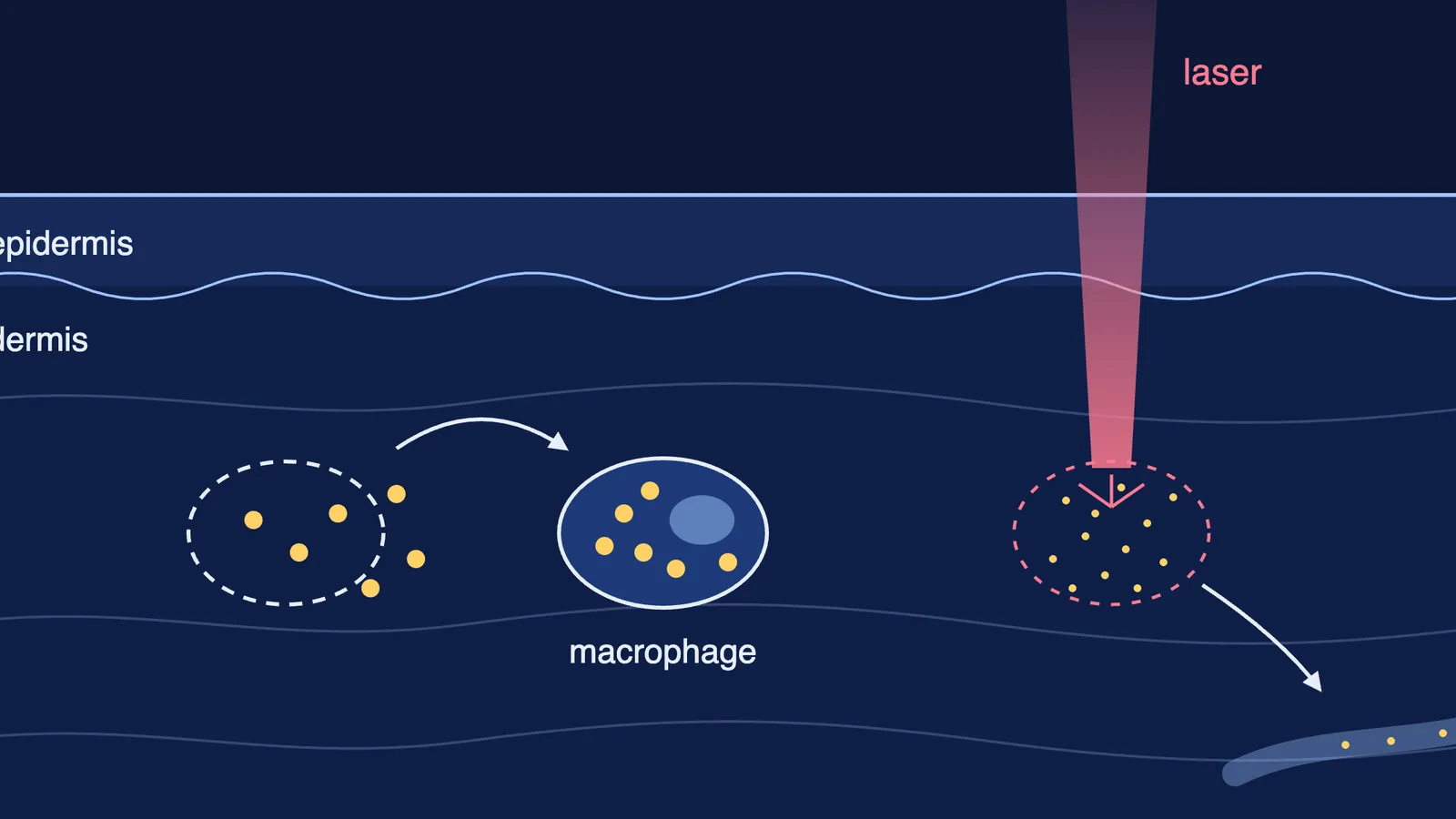
Immune cells called macrophages swallow the ink particles, the same engulfing process described in our guide to phagocytosis and the other ways cells take things in. So why don't they carry it away, or die and take the tattoo with them?
In a 2018 study in the Journal of Experimental Medicine, Anna Baranska, Bernard Malissen and colleagues at the Centre d'Immunologie de Marseille-Luminy worked out which skin cells capture and hold tattoo pigment in mice. They were exclusively dermal macrophages. When the team deliberately killed those macrophages, the pigment went through successive cycles of capture, release and recapture, without the tattoo vanishing.
The authors concluded that a tattoo's long life likely relies on macrophages being renewed, not on individual macrophages living a long time. Think of a baton passed between generations of cells. The work was in mice, so human skin may differ in detail.
How does laser tattoo removal break the pigment?
Laser removal builds on an idea called selective photothermolysis, published by R. Rox Anderson and John Parrish of Harvard Medical School in Science in 1983. Their paper showed that suitably brief pulses of selectively absorbed light can damage pigmented structures selectively, because the optical and thermal properties of the tissue do the aiming.
For tattoos, the FDA guide puts it simply: laser energy shatters the ink into small particles, which the body's immune system clears over time. Different ink colours absorb different wavelengths, so multi-coloured tattoos may need more than one laser. The FDA says green, red and yellow are the hardest colours to remove, while dark blue and black are the easiest.
The Marseille paper's title says macrophage dynamics explain "strenuous removal" as well as persistence: pigment freed from one cell can be recaptured by fresh macrophages instead of leaving the skin. The FDA notes that removal needs multiple treatments a few weeks apart, and complete removal may not be possible.
Worked example: how brief is a 'brief' pulse?
Anderson and Parrish reported selective damage to melanin granules inside pigment cells with 351-nanometre pulses lasting 2 × 10⁻⁸ seconds, and to tiny skin blood vessels with 577-nanometre pulses lasting 3 × 10⁻⁷ seconds (Science, 1983). Put those numbers through Class 11 and 12 physics:
Pulse length: 2 × 10⁻⁸ s is 20 nanoseconds, and 3 × 10⁻⁷ s is 300 nanoseconds.
Distance light travels in air during the shorter pulse: d = ct = (3 × 10⁸ m/s)(2 × 10⁻⁸ s) = 6 m. The whole flash is over in the time light crosses a classroom.
Energy per photon: E = hc/λ, or about 1240/λ electronvolts with λ in nanometres. At 351 nm, E ≈ 3.5 eV; at 577 nm, E ≈ 2.1 eV.
Why short matters: heat leaks out of a hot particle over time. Deliver the energy faster than it can leak away, and the target heats sharply while the tissue around it stays cooler.
If light and heat are hard to picture, the Fermi Simulation Lab has interactive simulations for ideas that are easier to see than to read.
Thinking about getting a tattoo, or removing one?
This is not medical advice, but these points from the FDA guide are worth talking through as a family:
Needle tattoos are meant to be permanent. The ink mostly stays for life.
The FDA has not approved tattoo removal creams or home kits, says they cannot reach pigment in the deeper dermis, and warns they may cause rashes, burns or scars.
Laser removal takes many sessions, and some tattoos never fully clear, especially green, red and yellow ones.
Listed laser risks include skin lighter than the surrounding skin, scarring, infection, pinpoint bleeding, redness and soreness.
The FDA suggests talking with a health care professional about the procedure, its benefits and its risks.
To go deeper into the biology, the Fermi Concept Library gives every concept in physics, chemistry, biology, mathematics and computing its own lesson.


