On this page
Textbooks put four similar words on one page, and exams ask you to tell them apart. There are really only two directions (in or out) and two kinds of cargo going in (solid particles or fluid).
What is the difference between endocytosis and exocytosis?
Small molecules can cross the plasma membrane by diffusion or through transport proteins, as our guide to the fluid mosaic model and membrane transport explains. Large molecules, droplets of fluid and whole cells cannot, so the cell moves them in bulk, wrapped in membrane.
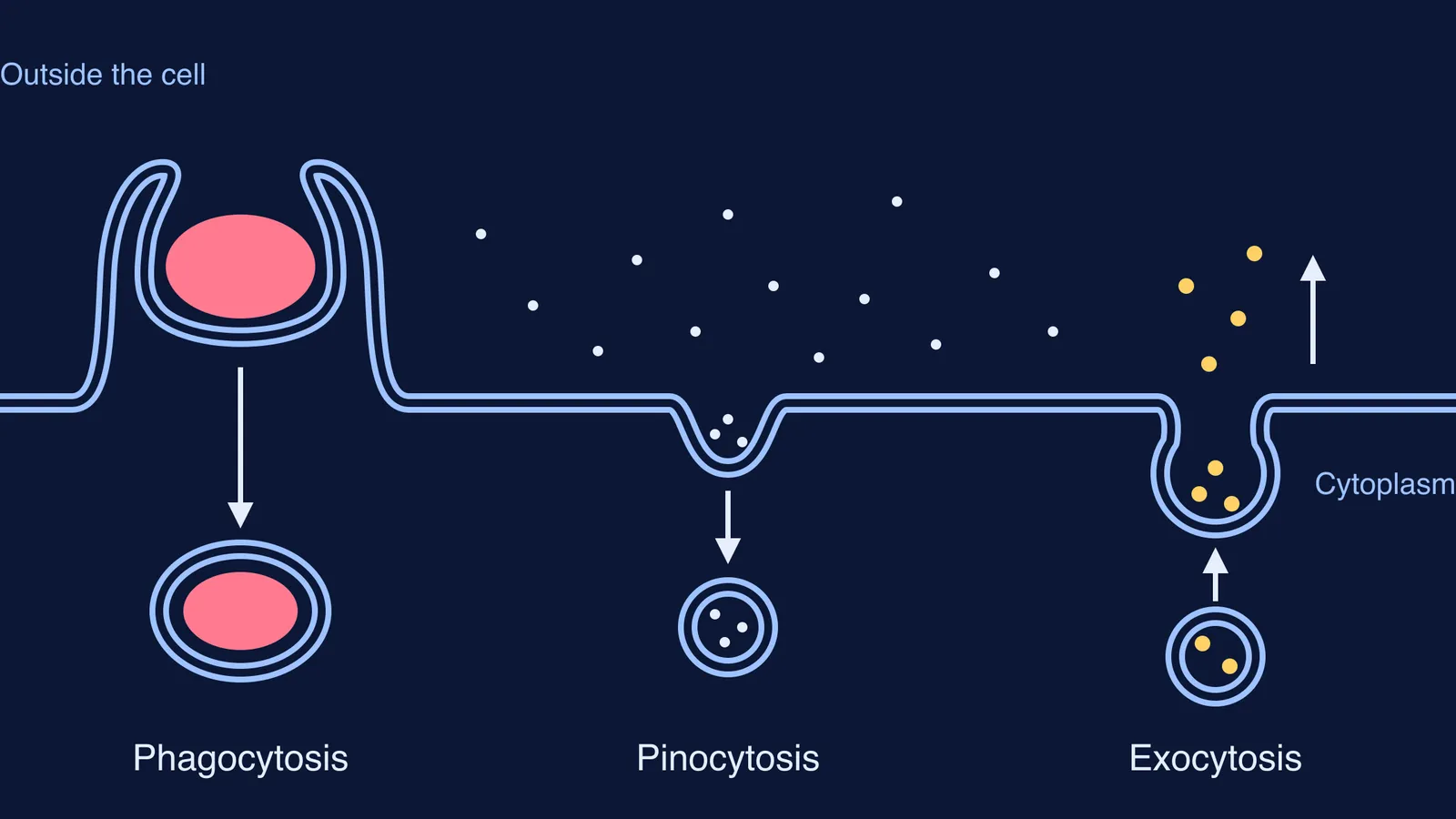
Endocytosis is "a type of active transport that moves particles, such as large molecules, parts of cells, and even whole cells, into a cell", according to OpenStax Biology 2e, section 5.4. A patch of plasma membrane folds inward around the cargo and pinches off as a vesicle in the cytoplasm.
Exocytosis is the reverse: a vesicle inside the cell fuses with the plasma membrane and empties its contents outside. The same OpenStax section gives two examples: cells secreting the proteins of the extracellular matrix, and nerve cells releasing neurotransmitters into the synaptic cleft. It also notes that moving large particles in or out of a cell requires energy.
The two directions are linked. A 2014 review in the Annual Review of Physiology by Wu and colleagues explains that after exocytosis, endocytosis is initiated to retrieve the exocytosed vesicles "within seconds to minutes". To see where secretory vesicles are packed before they reach the surface, read our guide to which organelles belong to the endomembrane system.
What is the difference between phagocytosis and pinocytosis?
Both are forms of endocytosis. The difference is what goes in.
Phagocytosis, or "cell eating", is the uptake of particles larger than 0.5 µm into a vesicle made from the plasma membrane, as defined in a 2017 review by Carlos Rosales and Eileen Uribe-Querol in BioMed Research International. The cell first recognises the particle, then encloses it in a phagosome, which later fuses with a lysosome to become a phagolysosome. The review lists the professional phagocytes as monocytes, macrophages, neutrophils, dendritic cells, osteoclasts and eosinophils. The idea goes back to Élie Metchnikoff; here is how Metchnikoff found phagocytes in starfish larvae.
Pinocytosis, or "cell drinking", takes in molecules, including water, from the extracellular fluid, according to OpenStax. Its vesicles are much smaller than phagocytic ones and do not need to merge with a lysosome. A larger version, macropinocytosis, takes in solutes non-selectively through big vacuoles formed from membrane ruffles, and is highly active in macrophages and dendritic cells, where it captures antigens, according to a 2011 review by Lim and Gleeson.
Receptor-mediated endocytosis is the selective kind: membrane receptors bind a specific substance, and the protein clathrin helps form the vesicle. OpenStax's example is how cells remove LDL ("bad" cholesterol) from the blood.
How do the four processes compare?
Each line reads: direction; cargo; selective or not; what happens to the vesicle; an example. Sources: OpenStax Biology 2e and Rosales and Uribe-Querol.
Phagocytosis: into the cell; solid particles larger than 0.5 µm; recognises its target first; phagosome fuses with a lysosome; a neutrophil engulfing a bacterium.
Pinocytosis: into the cell; fluid with dissolved molecules; no receptor picks the cargo; small vesicles that need not merge with a lysosome; a cell taking in a droplet of extracellular fluid.
Receptor-mediated endocytosis: into the cell; specific molecules bound to receptors; selective; clathrin-coated vesicle; uptake of LDL from the blood.
Exocytosis: out of the cell; secretions packed in vesicles; depends on what the cell is releasing; vesicle fuses with the plasma membrane; neurotransmitter release at a synapse.
How do you tell which process a question describes?
Ask three questions in order:
Is the cargo leaving the cell? Then it is exocytosis.
If it is entering, is it a solid particle such as a microbe or a dead cell? Then it is phagocytosis.
If it is fluid or dissolved molecules, are receptors choosing a specific molecule? If yes, it is receptor-mediated endocytosis; if not, pinocytosis.
Try it on these five scenarios before reading the answers:
A neutrophil wraps its membrane around a bacterium.
A cell takes in a droplet of extracellular fluid with whatever is dissolved in it.
A nerve ending releases neurotransmitter into the synaptic cleft.
A cell takes in LDL particles that have bound to receptors on its surface.
A cell releases proteins that build the extracellular matrix around it.
Answers: 1 is phagocytosis (a whole cell is the cargo); 2 is pinocytosis (fluid, no receptor choosing); 3 is exocytosis (cargo leaves); 4 is receptor-mediated endocytosis (receptors pick the cargo); 5 is exocytosis (secretion).
If the chain from vesicle to lysosome still feels loose, the Fermi Concept Library gives every biology concept its own lesson and its place in the map. For more practice, the Fermi Problem Library has worked problems with a step-by-step solver that explains the reasoning rather than printing an answer.
Next time you revise this topic, cover the comparison above and try to write all four lines from memory.