

On this page
When you scrape off dried mehendi, the pattern underneath is pale orange. By the third day it is a rich reddish brown, though nothing new touched your hand. The change is chemistry in the top layer of your skin: natural dyes, proteins, bonds and oxidation.
Why does mehendi turn darker after a day?
First, the dye molecule in henna bonds to a protein in your skin. Second, the bonded dye slowly reacts with oxygen and darkens.
The Wikipedia article on henna sums up the usual timeline: henna stains are orange when the paste is first removed, darken over the following three days to a deep reddish brown due to oxidation, and wear off by exfoliation, typically within one to three weeks.
An article in the Journal of Cosmetic Science (volume 68), written about henna on hair, describes the same shift: the red-orange stain "can gradually oxidize to a brownish color by oxidation or contact with minerals commonly dissolved in tap water."
So the first-day orange is dye that has only just bonded. The darker colour on day two or three is largely that same bonded dye after oxygen has had time to change it.
What is lawsone, and how does it bond to skin?
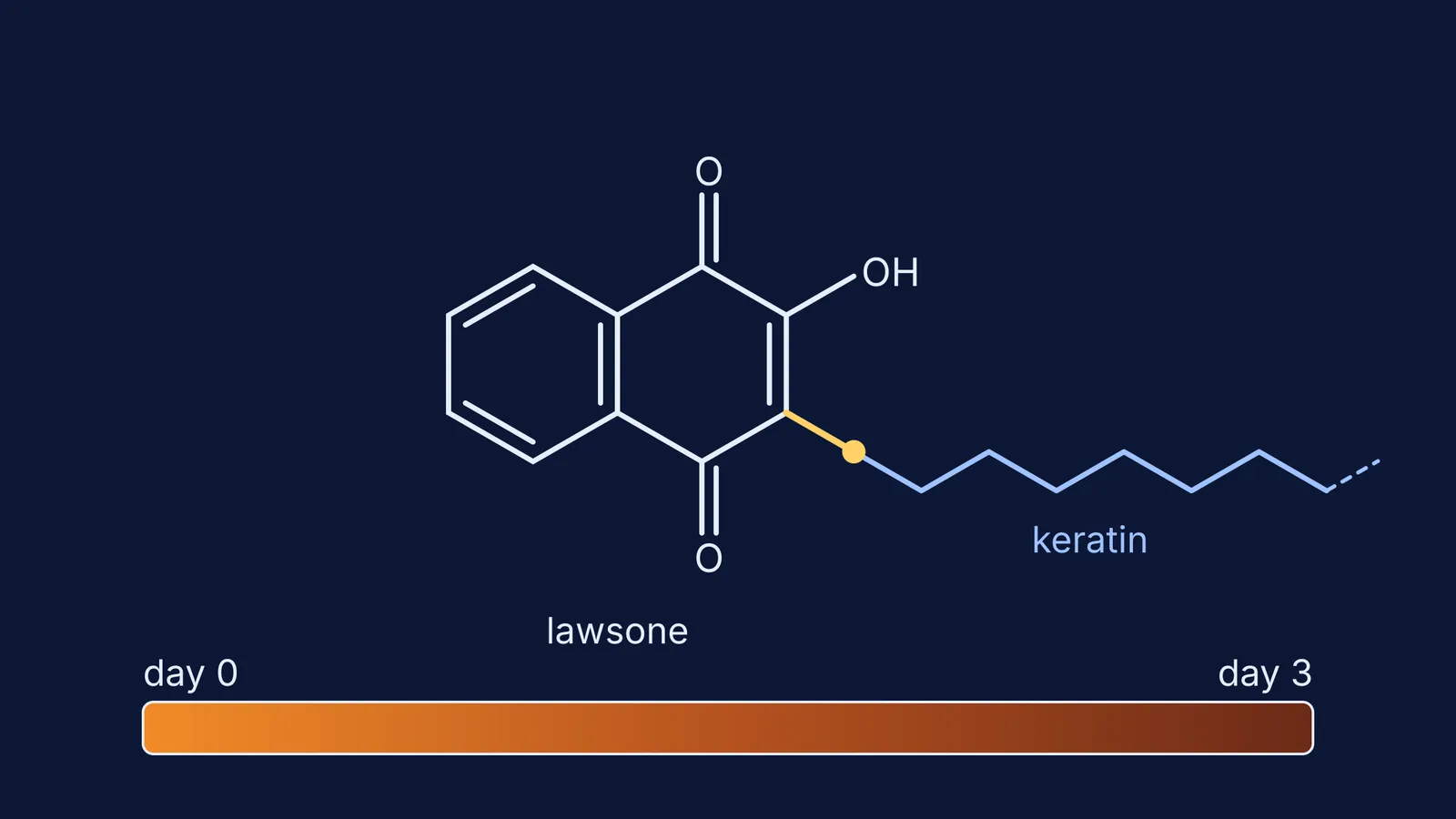
Lawsone is 2-hydroxy-1,4-naphthoquinone, the main colouring compound in henna, and it makes up only 1 to 2% of the dried leaves, according to the European Commission's Scientific Committee on Consumer Safety opinion on henna.
Its formula is C10H6O3, with a molar mass of 174.15 g/mol, as listed on PubChem.
The molecule is built on naphthalene, two fused six-carbon rings. One ring carries two C=O groups, which makes it a quinone. Quinone rings pull electrons towards those oxygens, so electron-rich groups on a protein can attack the ring and form a new covalent bond. The Journal of Cosmetic Science article says a form of lawsone released in the mildly acidic paste binds to keratin "via a Michael Addition creating a nonfading stable bond".
The protein on the other end of that bond is keratin, which fills the dead outer cells of your skin. It is the same tough protein family that makes up hair and nails, which is why cutting your hair and nails does not hurt.
Why are palms and soles the darkest?
The Wikipedia article on henna notes that soles and palms have the thickest layer of skin, so they take up the most lawsone, to the greatest depth. More keratin-filled layers means more bonded dye and a darker, longer-lasting stain.
Timing matters too. The paste has to stay in contact for the dye to move into your skin, which is part of the story in why henna paste cracks as it dries, and why dyeing stops.
Is black henna just darker mehendi?
No. The US FDA's fact sheet on henna and black henna says henna typically produces a brown, orange-brown or reddish-brown tint. The extra ingredient used to blacken it is often a coal-tar hair dye containing p-phenylenediamine (PPD), which can cause dangerous skin reactions in some people.
DermNet reports that high concentrations of PPD in black temporary tattoos may cause intense blistering within 1 to 2 days, and that lifelong sensitisation to PPD is likely afterwards.
A design that comes out jet black straight away is a warning sign, not a better result. If mehendi ever makes your skin itch, swell or blister, show a doctor.
Try it: a three-day stain log
You can watch the oxidation happen with natural mehendi you already trust. Skip this if mehendi has ever irritated your skin.
Put one small dot on your palm and one on the inside of your forearm, from the same cone, at the same time.
Leave both on for the same time, then scrape the paste off without washing.
Photograph both in the same spot and light at 0, 12, 24, 48 and 72 hours.
Score each photo from 1 (pale orange) to 5 (deep reddish brown).
Note when each dot stops changing, and which one ends darker.
What to expect, and why:
At 0 hours both dots are orange: the lawsone has bonded but has had little time to oxidise.
Scores rise and then level off; the henna article puts full colour at about three days.
The palm dot should end darker, because thicker skin holds more keratin and more dye.
Then compare it with why a turmeric stain turns red with soap, where the colour change comes from pH, not from oxygen.
If picturing molecules meeting and bonding is the hard part, the Fermi Simulation Lab has interactive simulations for ideas that are easier to see than to read. For the theory behind covalent bonds and oxidation, the Fermi Concept Library covers every concept in physics, chemistry, biology, mathematics and computing, each with its own lesson.
Next time someone at a wedding asks why their mehendi got darker overnight, you can tell them: a dye bonded to their skin, and the air did the rest.


