

On this page
Henna paste is a dense colloidal suspension of finely ground *Lawsonia inermis* leaves dispersed in water, mild acid, and essential oils. When extruded onto skin, water forms a continuous liquid phase that coats the epidermal surface.
Why does henna paste crack as it dries?
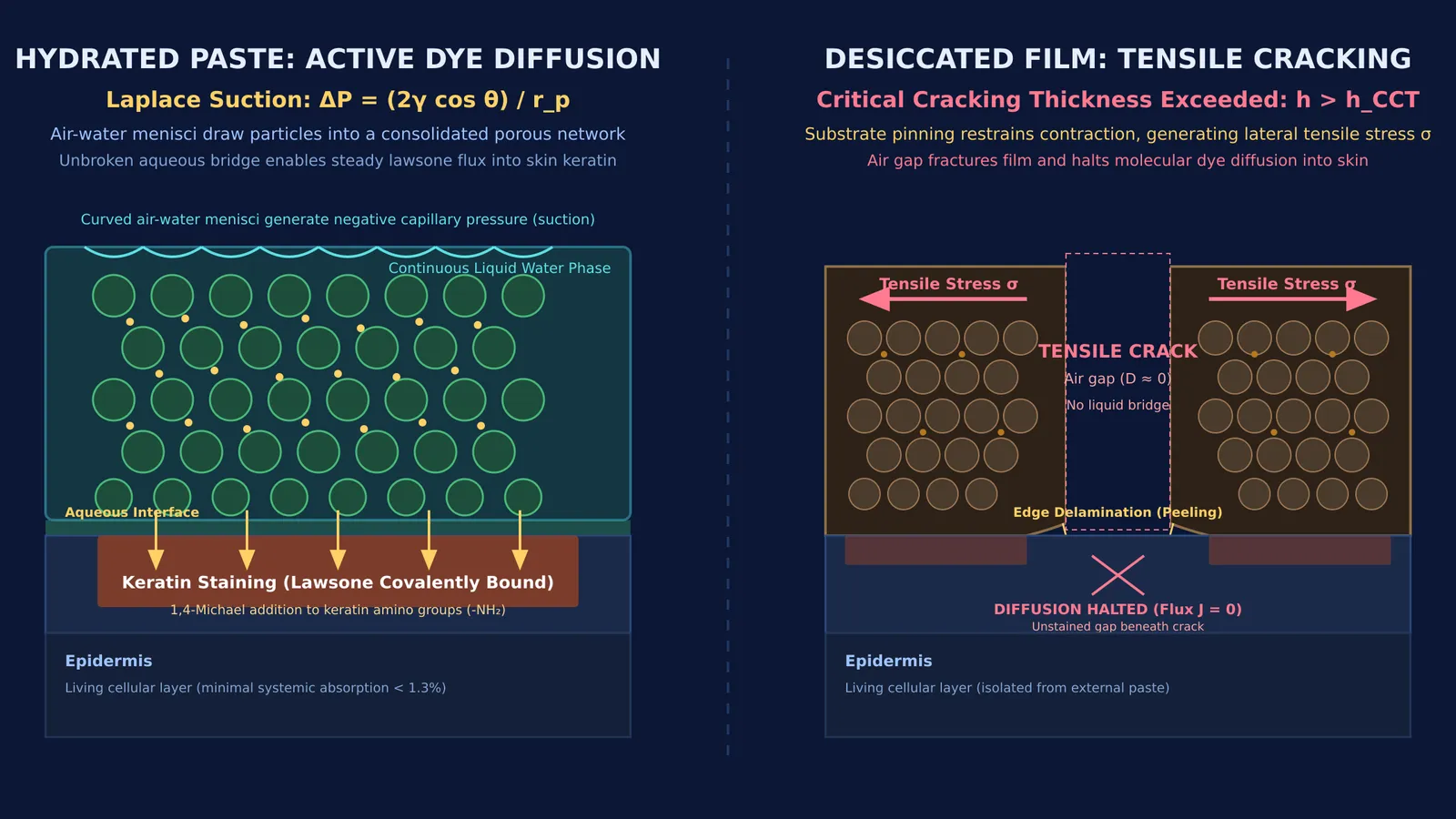
As water evaporates from the exposed surface, the suspended plant particles pack together into a porous matrix. Further evaporation draws the air-liquid interface into the narrow pores between particles, creating curved menisci. By the Young-Laplace equation, this curvature produces capillary suction:
ΔP = (2γ cos θ) / r_p
With water's surface tension γ ≈ 0.072 N/m and submicron pore radii r_p, this suction creates negative pressures exceeding 200 kPa, compressing the solid network as reviewed by Alexander F. Routh in *Reports on Progress in Physics*. This mechanism is directly tied to the principles of capillary action and surface tension.
Because the paste adheres firmly to the stratum corneum, the underlying skin prevents lateral contraction. This constraint transforms volumetric shrinkage into strong in-plane tensile stress. When stored strain energy exceeds the particle network's cohesive strength, the film fractures. In *Physical Review Letters*, Karnail B. Singh and Mahesh S. Tirumkudulu at IIT Bombay proved that colloidal films crack whenever their thickness exceeds a critical cracking thickness, h_CCT. Traditional henna piping (0.5 mm to 1.5 mm thick) easily surpasses this threshold.
Why does cracked mehendi stop dyeing the skin?
Henna's active dye is lawsone (2-hydroxy-1,4-naphthoquinone), released from precursor hennoside glycosides in mildly acidic conditions, as detailed by Nele Dallmann and colleagues in the *International Journal of Cosmetic Science*.
To stain skin, free lawsone must diffuse into the keratinocytes of the stratum corneum. In *Cutaneous and Ocular Toxicology*, Margaret E. K. Kraeling and colleagues showed that 2.2% to 4.0% of applied lawsone binds within human skin over 24 hours (with only 0.3% to 1.3% entering receptor fluid), binding covalently via 1,4-Michael addition to keratin amino groups.
When the paste dries and cracks, dyeing ceases for three physical reasons:
Solvent depletion: Without liquid water, the diffusion coefficient D drops drastically, immobilising lawsone within the dry cellulose cake.
Interface delamination: Crack edges curl upward away from the skin, breaking the physical contact area required for solute transfer.
Exhausted local dye: Unbound keratin sites below cannot access unreleased lawsone trapped in the dried upper layer.
How does sugar prevent cracking and deepen the stain?
Applying a lemon juice and sugar syrup is an established household technique grounded in solution thermodynamics.
Sucrose is a strong humectant that forms extensive hydrogen bonds with water. Under Raoult's law for liquid mixtures, dissolved non-volatile solute molecules lower water's mole fraction, reducing its equilibrium vapour pressure:
p = x_water × p*
This lower vapour pressure retards evaporation, maintaining the liquid bridge for hours of ongoing molecular diffusion across concentration gradients. Furthermore, unevaporated sucrose concentrates between plant particles to act as a plasticizer. It lowers the shear modulus G and increases matrix ductility, allowing the paste to relax capillary stresses rather than fracturing.
In the Fermi Simulation Lab, students can explore interactive simulations for the ideas that are easier to see than to read, visualizing how capillary forces and fluid interfaces behave during drying. For the underlying principles of surface tension, solutions, and mass transport, the Fermi Concept Library covers every concept across physics and chemistry, each with its own lesson and its place in the map.
How can you prevent henna paste from cracking?
Safety evaluations by the European Commission's Scientific Committee on Consumer Safety indicate that natural *Lawsonia inermis* leaf powder typically contains up to 1.4% lawsone. To ensure continuous dye penetration without desiccation cracking, artists rely on practical techniques that manage capillary stresses:
Sift finely: Sifting henna powder through fine mesh removes coarse plant fibers, ensuring uniform particle packing and preventing localized stress concentrations that trigger cracks.
Add sugar to the mix: Dissolving sucrose into the paste provides humectant moisture retention and acts as a plasticizer, increasing ductility so the film relaxes drying stress.
Pipe controlled lines: Extruding ribbons of moderate thickness limits stored elastic strain energy relative to the critical cracking threshold identified by Singh and Tirumkudulu.
Apply a lemon-sugar sealant: Dabbing warm sugar-lemon syrup over the design once it becomes touch-dry renews the external moisture seal before microscopic fissures can nucleate.
Retain ambient warmth and humidity: Wrapping the dry design in breathable tape or medical wrap traps natural skin perspiration, sustaining the aqueous diffusion bridge into the keratin layer.


