On this page
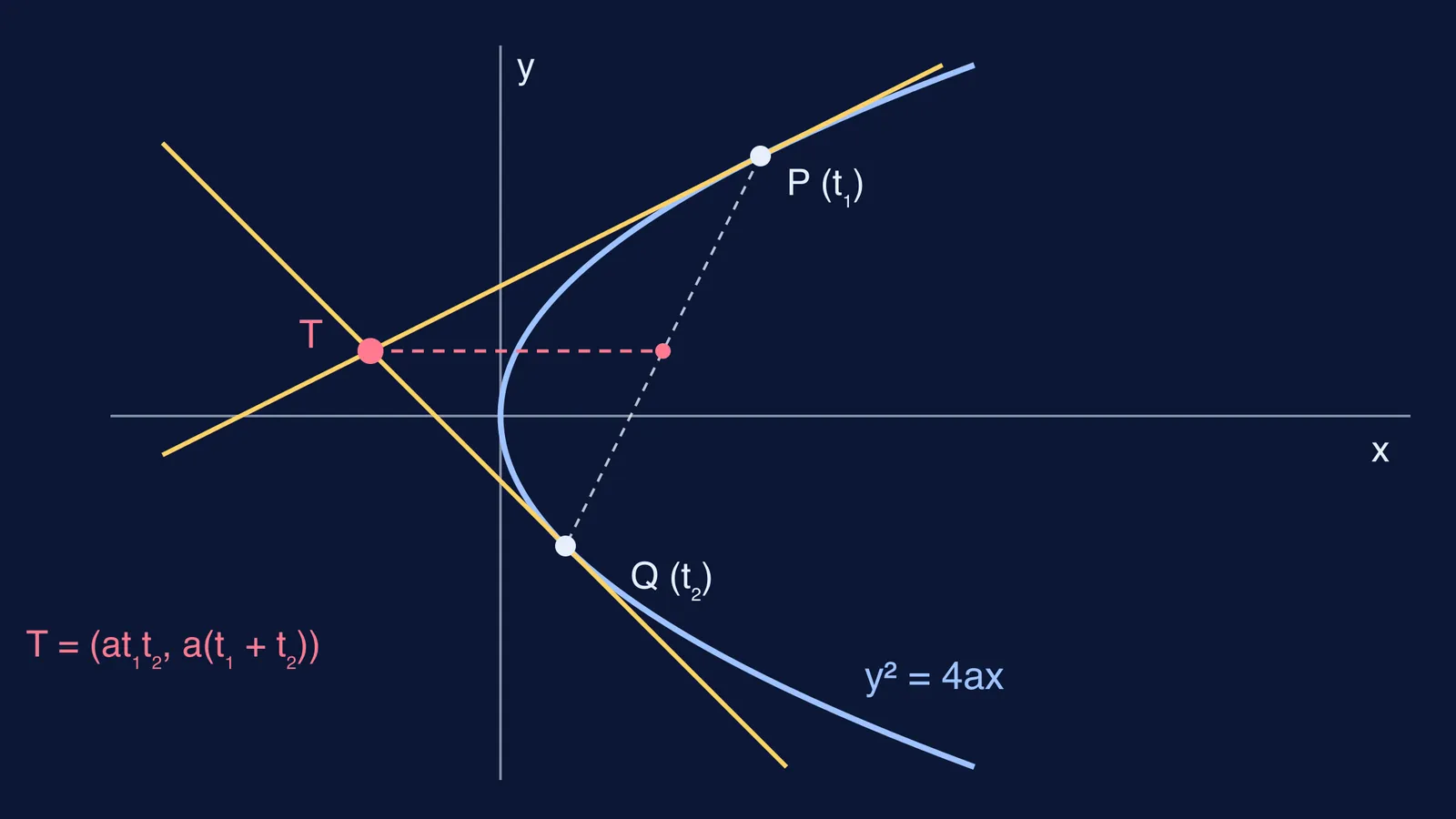
The standard parabola y² = 4ax has its focus at (a, 0) and its directrix along x = −a, as derived in NCERT's Class 11 chapter on conic sections. Any point on it can be written as (at², 2at), because then y² = 4a²t² = 4a · at². One number t fixes the point, so a pair of tangents needs just t₁ and t₂.
The JEE Main 2027 syllabus from NTA lists "locus and its equation" and "equations of conic sections (parabola, ellipse and hyperbola) in standard forms" in its co-ordinate geometry unit. The result below links those two topics.
What is the equation of the tangent at t?
Differentiate y² = 4ax to get 2y · dy/dx = 4a, so the slope is 2a/y. At (at², 2at) this is 2a/(2at) = 1/t. The tangent is y − 2at = (1/t)(x − at²). Multiply by t and tidy up:
ty = x + at²
If you learnt the slope form y = mx + a/m, put m = 1/t and you get the same line. Our guide to the tangent to a parabola in slope form covers that version.
Where do the tangents at t₁ and t₂ intersect?
Write both tangents: t₁y = x + at₁² and t₂y = x + at₂².
Subtract the second from the first: (t₁ − t₂)y = a(t₁² − t₂²) = a(t₁ − t₂)(t₁ + t₂).
The two points are different, so t₁ ≠ t₂, and you can divide: y = a(t₁ + t₂).
Put this back into the first tangent: x = t₁y − at₁² = at₁² + at₁t₂ − at₁² = at₁t₂.
The tangents at t₁ and t₂ meet at (at₁t₂, a(t₁ + t₂)).
To remember it: y = a(t₁ + t₂) is the average of 2at₁ and 2at₂, so the meeting point is level with the midpoint of chord PQ. x = at₁t₂ is a times the product.
Check with a = 1, t₁ = 2, t₂ = −1: P = (4, 4), Q = (1, −2), and the formula gives (−2, 1). It lies on 2y = x + 4 and on −y = x + 1.
How do you find a locus with this point?
Call the meeting point (h, k), so h = at₁t₂ and k = a(t₁ + t₂).
Rewrite the condition using only t₁t₂ and t₁ + t₂.
Replace t₁t₂ with h/a and t₁ + t₂ with k/a, then write x, y for h, k.
The common conditions:
Perpendicular tangents: the slopes are 1/t₁ and 1/t₂, so t₁t₂ = −1 and h = −a. The locus is the directrix x = −a.
PQ is a focal chord: here too t₁t₂ = −1, so the tangents at the ends of a focal chord meet on the directrix at right angles. The same condition drives the locus of the midpoint of a focal chord.
PQ subtends a right angle at the vertex: t₁t₂ = −4, as shown in why such chords pass through (4a, 0). The locus is x = −4a.
The tangents make angles θ₁ and θ₂ with the axis, and cot θ₁ + cot θ₂ = c: since tan θ = 1/t, cot θ = t, so t₁ + t₂ = c. The locus is the line y = ac.
What is the locus when the tangents meet at 45°?
Problem. Find the locus of the point from which the two tangents to y² = 4ax make an angle of 45° with each other.
Solution. Let the tangents touch at t₁ and t₂ and meet at (h, k). With slopes 1/t₁ and 1/t₂:
tan 45° = |(1/t₁ − 1/t₂) / (1 + 1/(t₁t₂))| = |(t₂ − t₁) / (t₁t₂ + 1)| = 1
Square both sides: (t₁ − t₂)² = (t₁t₂ + 1)².
The left side is (t₁ + t₂)² − 4t₁t₂ = k²/a² − 4h/a = (k² − 4ah)/a². The right side is (h/a + 1)² = (h + a)²/a².
So k² − 4ah = (h + a)², and the locus is y² − 4ax = (x + a)², which simplifies to y² = x² + 6ax + a². Rewritten as (x + 3a)² − y² = 8a², it is a hyperbola centred at (−3a, 0).
Check: with a = 1, t₁ = 2, t₂ = −3, the slopes 1/2 and −1/3 give tan = (5/6)/(5/6) = 1. They meet at (−6, −1), and 1 = 36 − 36 + 1.
For any angle α between the tangents, the same steps give y² − 4ax = (x + a)² tan²α.
If your loci keep going wrong, the Fermi Problem Library has worked problems with a step-by-step solver that explains the reasoning rather than printing an answer, so you can see which line went off. If the parametric form itself feels shaky, the Fermi Concept Library gives each concept its own lesson and shows where it sits in the map.
Try one yourself: find the locus of the meeting point when t₂ = 2t₁. You should get y² = 9ax/2.