On this page
If you write the ends of a focal chord in parametric form, one relation, t₁t₂ = −1, does almost all the work. Below is the full elimination, a sketch of the answer, and three checks you can run quickly in an exam.
What is a focal chord, and why is t₁t₂ = −1?
A focal chord is any chord of a parabola that passes through its focus. The best-known one is the latus rectum, the chord through the focus parallel to the directrix (Wikipedia: Parabola). That article writes the right-opening parabola as y² = 2px with focus at (p/2, 0); putting p = 2a gives the familiar y² = 4ax with focus S(a, 0).
Every point of y² = 4ax can be written as (at², 2at), the parametric form given on Wolfram MathWorld's parabola page. So take the chord's ends as P(at₁², 2at₁) and Q(at₂², 2at₂).
The slope of PQ is 2a(t₁ − t₂) / a(t₁² − t₂²) = 2/(t₁ + t₂). The line through P with that slope is y − 2at₁ = [2/(t₁ + t₂)](x − at₁²). Make it pass through S(a, 0):
−2at₁(t₁ + t₂) = 2(a − at₁²)
−t₁² − t₁t₂ = 1 − t₁²
t₁t₂ = −1
That is the whole focal-chord condition: if one end has parameter t, the other has −1/t. Our guide to focal chords, tangents and normals of a parabola uses it for other results.
How do you find the locus of the midpoint of a focal chord?
Follow the routine from our five-step method for locus problems: name the moving point, write its coordinates in the parameters, apply the constraint, eliminate, and rename.
Call the midpoint M(h, k).
Midpoint formula: h = a(t₁² + t₂²)/2 and k = a(t₁ + t₂).
From the second, t₁ + t₂ = k/a.
Rewrite the squares using the constraint: t₁² + t₂² = (t₁ + t₂)² − 2t₁t₂ = k²/a² + 2, because t₁t₂ = −1.
Substitute: h = (a/2)(k²/a² + 2) = k²/(2a) + a.
Rearrange to k² = 2a(h − a), then replace (h, k) by (x, y).
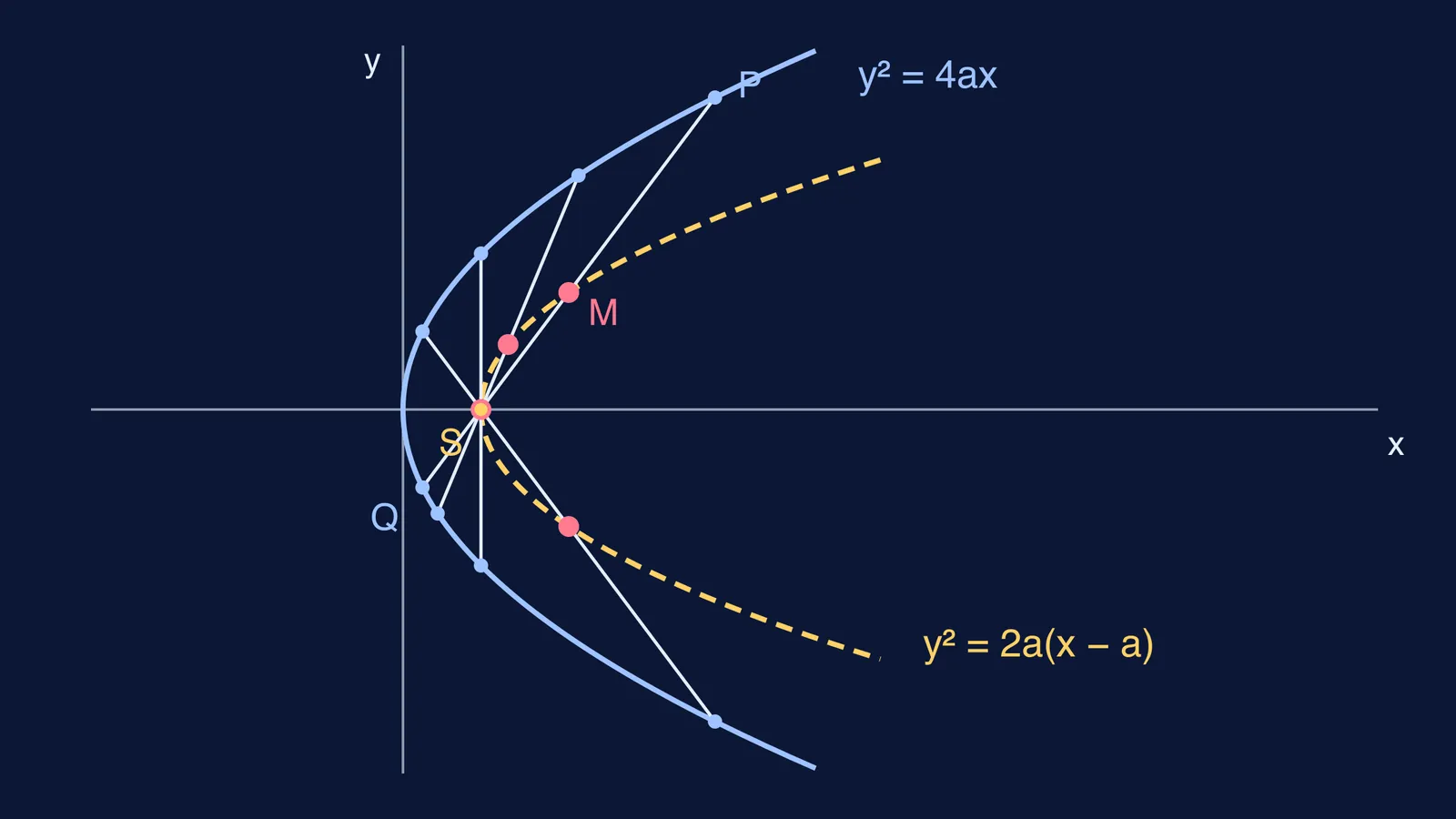
The locus of the midpoint of a focal chord of y² = 4ax is the parabola y² = 2a(x − a).
What does the locus look like?
Compare y² = 2a(x − a) with the standard form Y² = 4AX. Shift X = x − a, and 4A = 2a, so A = a/2.
Vertex: (a, 0), which is the focus of the original parabola.
Axis: the x-axis, the same as the original, opening the same way, to the right.
Latus rectum: 2a, half the original's 4a (Wolfram MathWorld gives 4a for y² = 4ax).
Its own focus: (a + a/2, 0) = (3a/2, 0).
So the sketch is a tighter parabola inside the first one, starting at S. When the chord is the latus rectum, its midpoint is S itself; as the chord tilts towards the axis, one end runs far out and the midpoint follows. The diagram at the top draws this for a = 1.
How do you check the answer?
Check point 1, the latus rectum. Take t₁ = 1 and t₂ = −1. The ends are (a, 2a) and (a, −2a), so the midpoint is (a, 0). Put it in: 0 = 2a(a − a). True.
Check point 2, a tilted chord. Let a = 1 and t₁ = 2, so t₂ = −1/2. The ends are P(4, 4) and Q(1/4, −1), and the midpoint is M(17/8, 3/2). Left side: y² = 9/4. Right side: 2(17/8 − 1) = 9/4. They match. You can also confirm P, S(1, 0) and Q are collinear: slope PS = 4/3 and slope SQ = (−1)/(1/4 − 1) = 4/3.
Check point 3, a second method. Use the chord with a given midpoint, T = S₁. For y² = 4ax that chord is ky − 2a(x + h) = k² − 4ah. Make it pass through (a, 0): −2a(a + h) = k² − 4ah, which simplifies to k² = 2a(h − a). Same locus, and no parameters at all.
Where can you practise locus problems like this?
Most conic locus questions follow this pattern: parameters, one constraint, eliminate. If a step keeps going wrong, the Fermi Problem Library has worked problems with a step-by-step solver that explains the reasoning rather than printing an answer, so you can see the line where your working leaves the track. If the gap is the idea itself, the Fermi Concept Library covers every concept in mathematics, each with its own lesson.
Next, try the locus of the midpoint of a chord of y² = 4ax that subtends a right angle at the vertex. The method is identical; only the constraint changes, to t₁t₂ = −4.