

On this page
This classic "prove that" question on the parabola takes about six lines once you use parametric points. Here is the proof, two numerical checks and the common traps.
What does "subtends a right angle at the vertex" mean?
The parabola y² = 4ax has its vertex at the origin O, its axis along the x-axis and its focus at a distance a from the vertex, as Wolfram MathWorld's parabola entry sets out. For a refresher on focus, directrix and latus rectum, see our guide to the features of the parabola y² = 4ax.
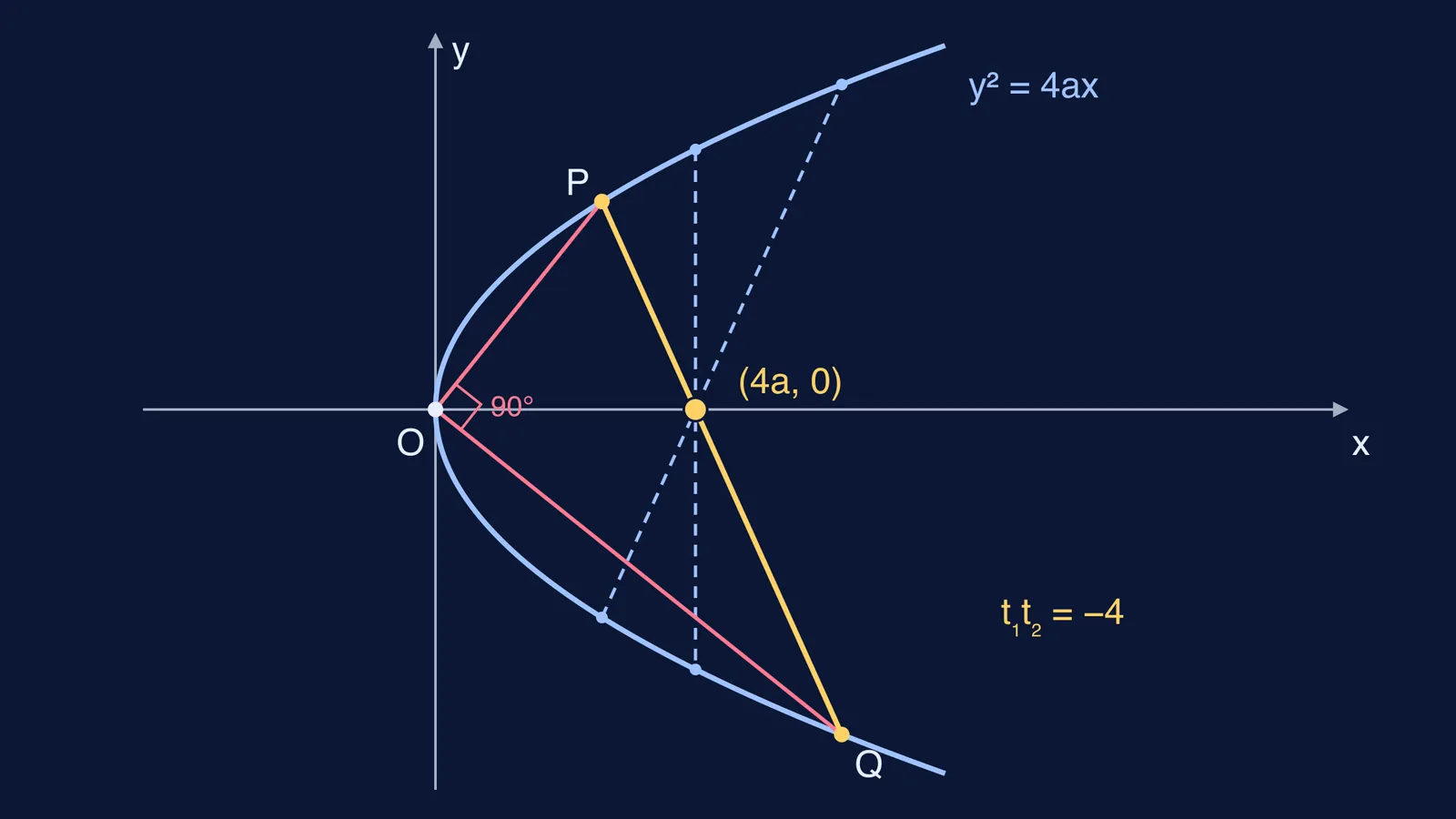
A chord PQ subtends a right angle at the vertex when the lines OP and OQ are perpendicular, so the angle POQ is 90°. The claim is that every such chord crosses the axis at the same point: (4a, 0).
How do parametric points make the proof short?
MathWorld gives the parametric form of y² = 4ax as x = at², y = 2at (source). Our explainer on parametric equations of the parabola, ellipse and hyperbola covers where this form comes from.
Let P = (at₁², 2at₁) and Q = (at₂², 2at₂), with t₁ and t₂ not zero, since neither end can be the vertex itself.
Step 1 turns the right angle into a condition on t. The slope of OP is 2at₁ / at₁² = 2/t₁, and the slope of OQ is 2/t₂. Perpendicular lines have slopes whose product is −1, so 4/(t₁t₂) = −1, which gives t₁t₂ = −4.
Or use the dot product: OP · OQ = a²t₁²t₂² + 4a²t₁t₂ = a²t₁t₂(t₁t₂ + 4). Setting this to zero, with t₁t₂ not zero, gives the same condition.
Step 2 writes the chord PQ. The slope of PQ is (2at₁ − 2at₂) / (at₁² − at₂²) = 2/(t₁ + t₂). Through P, the line is (t₁ + t₂)(y − 2at₁) = 2(x − at₁²). Expand it and the at₁² terms cancel, leaving (t₁ + t₂)y = 2x + 2at₁t₂.
Step 3 substitutes and reads off the point. Put t₁t₂ = −4: the chord becomes (t₁ + t₂)y = 2x − 8a = 2(x − 4a). At y = 0 the left side is zero, so x = 4a, whatever the value of t₁ + t₂.
The one special case is t₁ + t₂ = 0, that is the ends t = 2 and t = −2. The equation then reads 0 = 2(x − 4a), the vertical line x = 4a, which still passes through (4a, 0).
The converse holds too. Put the point (4a, 0) into the chord equation: 0 = 8a + 2at₁t₂, so t₁t₂ = −4. Every chord through (4a, 0) subtends a right angle at the vertex.
The focal-chord version leads to its own classic question, worked through in the locus of the midpoint of a focal chord.
Does it check out with real numbers?
Take a = 1, so the parabola is y² = 4x, and choose t₁ = 1, t₂ = −4. Their product is −4.
P = (1, 2) and Q = (16, −8). Both lie on the curve: 2² = 4 × 1 and (−8)² = 4 × 16.
OP · OQ = 1 × 16 + 2 × (−8) = 0, so the angle POQ is 90°.
The slope of PQ is (−8 − 2)/(16 − 1) = −2/3, which matches 2/(t₁ + t₂) = 2/(−3).
The line is y − 2 = −(2/3)(x − 1). At y = 0, x − 1 = 3, so x = 4, which is 4a.
Now change everything: a = 2, t₁ = 4, t₂ = −1. Then P = (32, 16) and Q = (2, −4), and OP · OQ = 64 − 64 = 0. The slope of PQ is 20/30 = 2/3, and through Q the line meets y = 0 where 4 = (2/3)(x − 2), so x = 8, which is again 4a.
What mistakes cost marks on this question?
Writing t₁t₂ = −1. That is the focal-chord condition, and it gives the focus (a, 0), not (4a, 0).
Checking one chord and calling it a proof. Only the general t₁, t₂ argument proves it.
Mixing up the orientation. For x² = 4ay, use (2at, at²); the same dot-product step gives t₁t₂ = −4 and the fixed point is (0, 4a).
Confusing this with perpendicular tangents. Two perpendicular tangents to a parabola meet on the directrix, a different property described in Wikipedia's parabola article.
If the chord equation keeps slipping in practice, the Fermi Problem Library has worked problems with a step-by-step solver that explains the reasoning rather than printing an answer. To go back over parametric coordinates themselves, the Fermi Concept Library gives each concept its own lesson and its place in the map.
Try the self-test with t₁ = 3 tonight, then do it again for x² = 4ay.


