On this page
Many parabola questions in Class 11 and JEE Main start with the same move: look at an equation such as y² = 12x and read off its focus, directrix, axis and latus rectum.
What do the focus and directrix of a parabola mean?
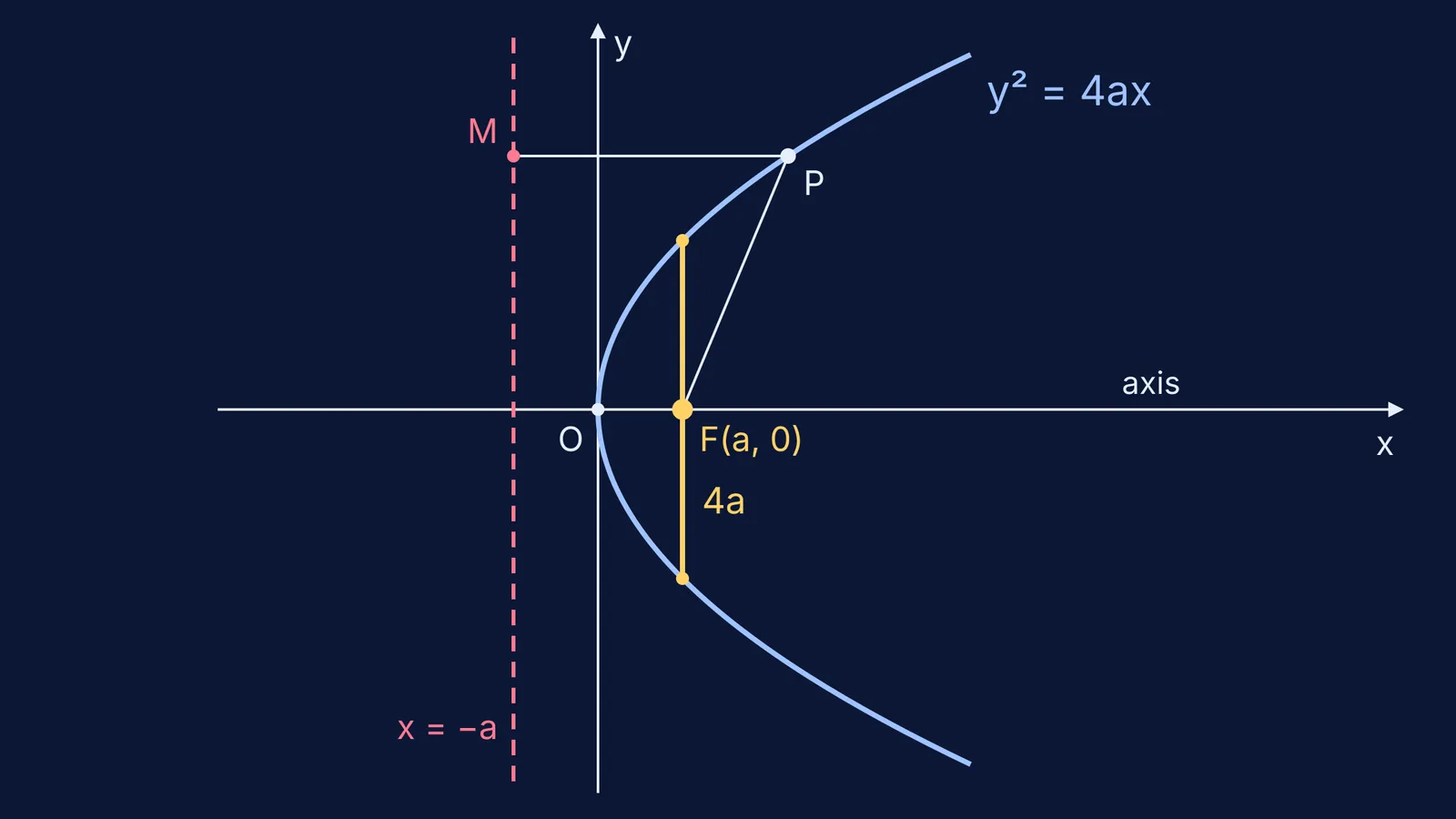
NCERT defines a parabola as the set of all points in a plane that are the same distance from a fixed line and a fixed point that is not on that line (NCERT Class 11 Mathematics, Chapter 10). The fixed point is the focus and the fixed line is the directrix.
The axis is the line through the focus perpendicular to the directrix. The vertex is where the parabola meets its axis. The latus rectum is the line segment through the focus, perpendicular to the axis, with both end points on the parabola.
Why is the focus of y² = 4ax at (a, 0)?
NCERT places the focus at F(a, 0) and the directrix at x = −a, so the focus is 2a from the directrix and the vertex sits halfway between them, at the origin (NCERT, Section 10.4.1). Take any point P(x, y) on the curve. Its distance to the focus is √((x − a)² + y²), and its distance to the directrix is x + a. Set these equal and square both sides:
(x − a)² + y² = (x + a)², which simplifies to y² = 4ax.
The derivation also shows that any point on the parabola is x + a from the focus; see the focal distance of a point on a parabola.
To find the latus rectum, put x = a into y² = 4ax. You get y² = 4a², so y = ±2a. The end points are (a, 2a) and (a, −2a), and the length is 4a, which matches NCERT's result (NCERT, Section 10.4.2). The comparison with the ellipse is in latus rectum lengths for a parabola and an ellipse.
How do you find the focus, directrix and latus rectum from an equation?
Use this four-step routine on any of the four standard forms:
Which variable is squared? If y is squared, the axis is the x-axis. If x is squared, the axis is the y-axis.
What is the sign? For y² forms, a positive coefficient of x means the parabola opens right and a negative one means it opens left. For x² forms, a positive coefficient of y means it opens up and a negative one means it opens down. This is NCERT's rule (NCERT, Chapter 10).
Find a. Divide the size of the coefficient by 4.
Place the features. The focus is a units from the vertex, on the side the parabola opens towards. The directrix is a units on the other side. The latus rectum is 4a long.
NCERT lists the four standard forms as y² = 4ax, y² = −4ax, x² = 4ay and x² = −4ay, all with the vertex at the origin (NCERT, Chapter 10).
Worked example 1, y² = 12x (NCERT Exercise 10.2, Question 1):
y is squared, so the axis is the x-axis (y = 0).
The coefficient of x is +12, so the parabola opens to the right.
4a = 12, so a = 3.
Focus (3, 0). Directrix x = −3. Latus rectum length 12, with end points (3, 6) and (3, −6).
Check: (3, 6) is 6 from the focus and 3 + 3 = 6 from the directrix. Equal, so it is right.
Worked example 2, y² = −8x (the same exercise, Question 3):
y is squared, so the axis is the x-axis.
The coefficient of x is negative, so the parabola opens to the left.
4a = 8, so a = 2.
Focus (−2, 0). Directrix x = 2. Latus rectum length 8. This is the mirror image of NCERT's Example 5, y² = 8x.
What mistakes do students make with y² = 4ax?
Taking a as the whole coefficient. In y² = 12x, a is 3, not 12.
Giving the directrix as a point. The directrix is a line, so the answer is x = −3, not (−3, 0).
Writing a negative length. For y² = −8x the latus rectum is 8, not −8.
Applying these formulas to a shifted parabola. They only hold when the vertex is at the origin. For something like (y − 2)² = 8(x + 1), follow finding the focus and directrix of a shifted parabola.
If you keep getting the same steps wrong, the Fermi Problem Library has worked problems with a step-by-step solver that explains the reasoning rather than printing an answer. If the definition itself is shaky, the Fermi Concept Library gives each concept in mathematics its own lesson and shows its place in the map.
For practice, run the routine on Questions 2 to 6 of NCERT Exercise 10.2.