

On this page
Your sunscreen says SPF 50 and your friend's says SPF 30. Is yours far better? Not really, and the reason is school maths about fractions.
What does SPF actually measure?
SPF stands for sun protection factor. The US Food and Drug Administration says the SPF value "indicates the level of sunburn protection provided by the sunscreen product" and that SPF values primarily indicate protection from UVB (FDA). UVB is the shorter-wavelength ultraviolet light behind sunburn; we worked through why its photons do damage that infrared cannot in why UV causes sunburn but infrared doesn't.
The number comes from a lab test. Under US rules, sunscreen is applied to volunteers' skin at 2 milligrams per square centimetre, and a solar simulator (a lamp that mimics sunlight) finds the smallest dose that just reddens the skin, called the minimal erythema dose or MED (21 CFR 201.327).
SPF is the ratio of two doses: the MED on protected skin divided by the MED on unprotected skin (21 CFR 201.327).
So SPF 30, applied as tested, means your skin needs about 30 times the UVB dose that reddens bare skin before it reddens.
Why is SPF 30 not twice as strong as SPF 15?
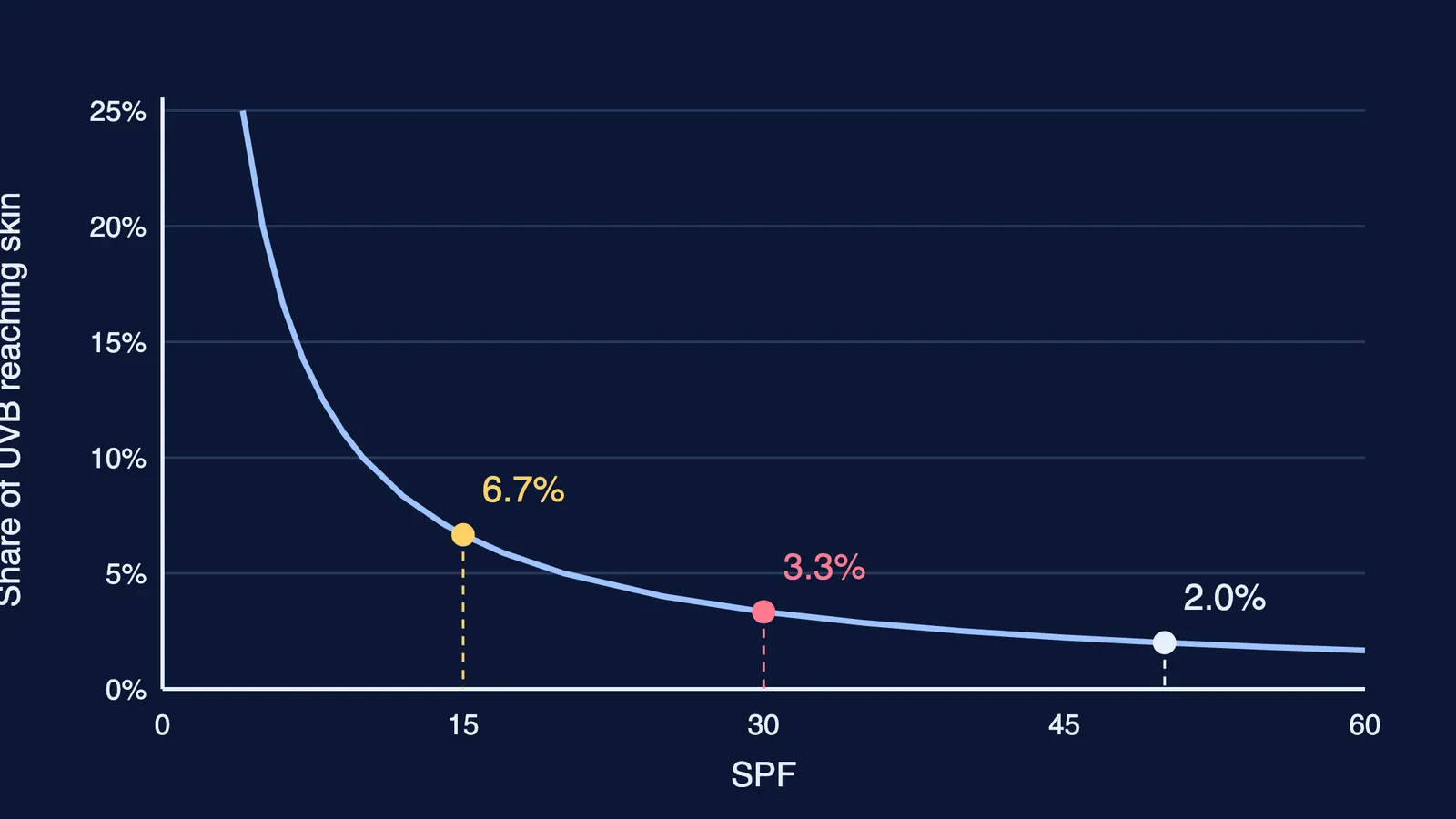
Flip the ratio and you get the fraction of burning UVB that still reaches your skin: 1/SPF (21 CFR 201.327):
SPF 15: 1/15 gets through, about 6.7%, so about 93% is filtered.
SPF 30: 1/30 gets through, about 3.3%, so about 97% is filtered.
SPF 50: 1/50 gets through, 2%, so 98% is filtered.
The American Academy of Dermatology gives the same first two figures: SPF 15 "filters out 93%" and SPF 30 "filters out 97%" of the sun's UVB rays (AAD).
Going from SPF 15 to SPF 30 blocks only about 4 more percentage points of UVB, from 93% to 97% (AAD). But the UVB that reaches your skin halves, from about 6.7% to about 3.3%. Twice the SPF means half the UVB getting through, not twice the blocking.
If inverse proportion like this still feels slippery, the Fermi Concept Library has its own lesson for every concept in physics, chemistry, biology and mathematics, so you can revise the idea rather than memorise the label.
Does SPF tell you how long you can stay in the sun?
No. The FDA says "SPF is not directly related to time of solar exposure but to amount of solar exposure", and notes that the sun is stronger in the middle of the day than in the early morning and early evening (FDA). So the same time outdoors delivers more UVB at midday, which is what the UV index on your weather app tracks.
Two real-world gaps matter more than the number on the tube:
Too little cream. The test uses 2 mg/cm². King's College London researchers tested thinner layers, down to 0.75 mg/cm², on 16 fair-skinned volunteers and concluded that SPF 50 "applied in a typical way, would at best provide 40% of the expected protection" (King's College London). The FDA says an average-sized adult or child needs at least one ounce, "about the amount it takes to fill a shot glass", to cover the body (FDA).
It wears off. The FDA advises reapplying "at least every two hours, and more often if you're sweating or swimming". Water-resistant labels must say whether protection lasts 40 or 80 minutes of swimming or sweating, and there is no such thing as waterproof sunscreen (FDA).
What is the difference between physical and chemical sunscreen?
The American Academy of Dermatology draws the line by ingredient: if the active ingredient is titanium dioxide, zinc oxide or both, it is a physical (mineral) sunscreen; if it contains neither, it is a chemical sunscreen (AAD).
Mineral filters are often pictured as tiny mirrors. The AAD is more careful: all sunscreens form a layer on the skin that absorbs the sun's rays, and physical sunscreens also reflect them (AAD).
Either type can protect you well, the AAD says, if it has the right label features. SPF says little about UVA, the longer-wavelength ultraviolet, so look for "broad spectrum". Under US rules a product earns that label only if its mean critical wavelength, where it reaches 90% of its total absorbance between 290 and 400 nm, is 370 nm or longer (21 CFR 201.327).
How to read a sunscreen label: a 30-second checklist
Find "broad spectrum", which means protection from both UVA and UVB (FDA).
Check the SPF. The FDA's sun safety tips say SPF 15 or higher (FDA); the AAD recommends SPF 30 or higher (AAD).
Plan the amount: a shot glass for the body, not a thin smear.
Note the water-resistance time, 40 or 80 minutes, and set a phone reminder to reapply (FDA).
Mineral or chemical? Pick the one you will actually wear, and whichever you choose, apply enough of it.
This is everyday guidance, not medical advice. If a burn blisters, a rash appears or a mole changes, see a doctor or dermatologist. And to see what happens inside skin after a burn, read why skin peels after sunburn.


