On this page
The question looks impossible on a first read. Expanding (1 + x − 3x²)²¹⁶³ by hand would give a polynomial of degree 2 × 2163 = 4326, with 4327 coefficients. You never need them one by one. One substitution gives their total, and a second splits that total into two parts.
What is the sum of coefficients of (1 + x − 3x²)²¹⁶³?
Write the expansion as p(x) = a₀ + a₁x + a₂x² + … + a₄₃₂₆x⁴³²⁶. The sum you want is a₀ + a₁ + a₂ + … + a₄₃₂₆.
Put x = 1 on both sides:
Left side: (1 + 1 − 3)²¹⁶³ = (−1)²¹⁶³.
2163 is odd, so (−1)²¹⁶³ = −1.
Right side: a₀ + a₁ + a₂ + … + a₄₃₂₆.
So the sum of all the coefficients is −1.
Why does putting x = 1 give the sum of coefficients?
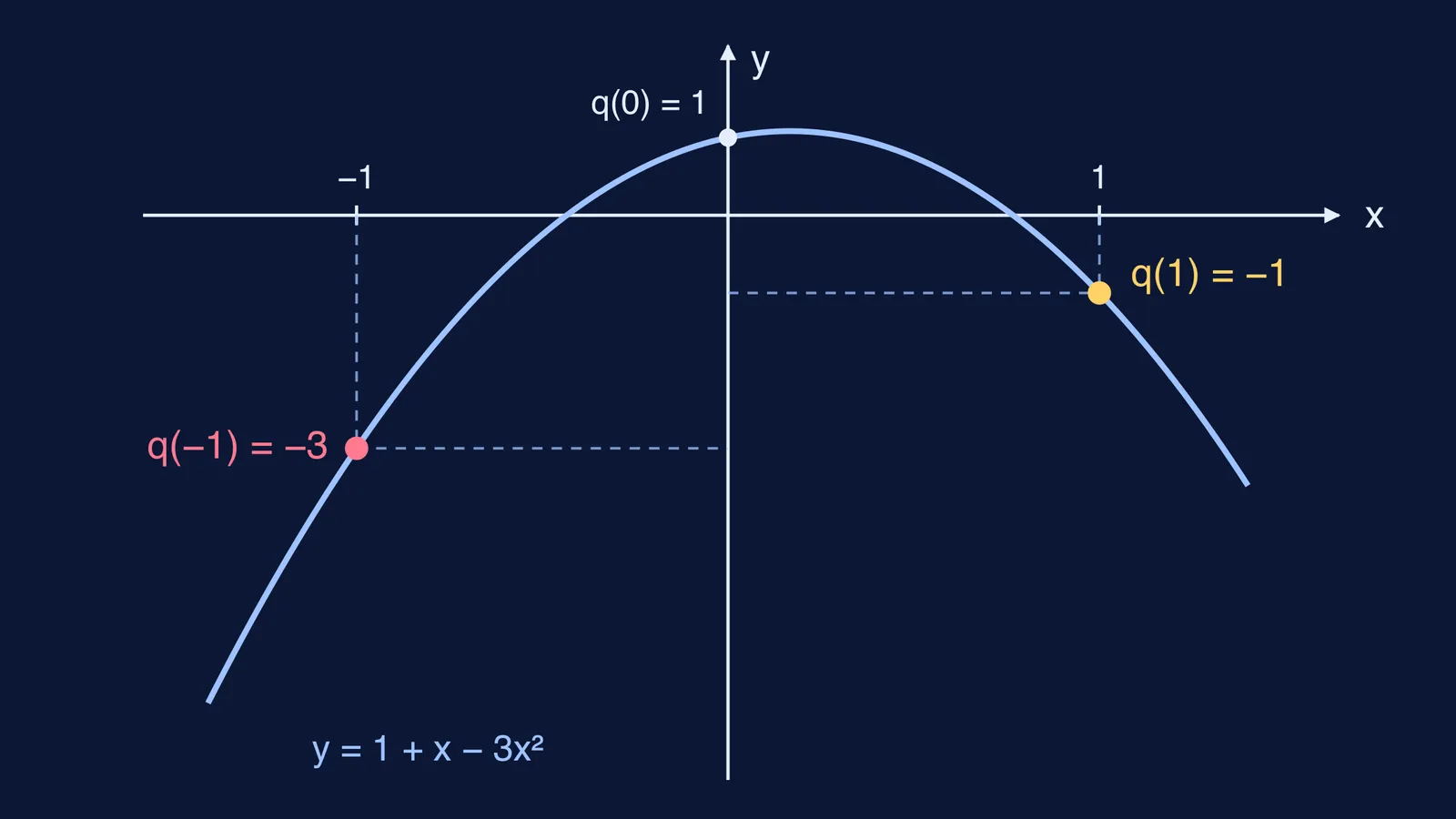
Every power of 1 is 1. So at x = 1, each term aₖxᵏ becomes aₖ × 1 = aₖ, and the polynomial turns into the plain sum of its coefficients. This is just finding the value of a polynomial p(x) at a point, applied to a polynomial too long to write out.
The NCERT Exemplar chapter on the binomial theorem uses this idea for (a + b)ⁿ: putting a = b = 1 gives ⁿC₀ + ⁿC₁ + … + ⁿCₙ = 2ⁿ. A trinomial like ours needs no extra theory, because p(1) is the sum of coefficients of any polynomial. For the binomial version and its variations, see sums of binomial coefficients, including alternating sums.
The same move explains a familiar quadratic shortcut: if a + b + c = 0, then p(1) = 0, so 1 is a root. We worked through that in why a + b + c = 0 means one root is 1.
How does x = −1 separate even and odd coefficients?
Now put x = −1. Even powers of −1 are +1 and odd powers are −1, so p(−1) = a₀ − a₁ + a₂ − a₃ + … + a₄₃₂₆.
Call E the sum of the even-power coefficients (a₀ + a₂ + a₄ + …) and O the sum of the odd-power ones (a₁ + a₃ + a₅ + …). Then:
p(1) = E + O
p(−1) = E − O
Add the two: E = [p(1) + p(−1)] / 2
Subtract them: O = [p(1) − p(−1)] / 2
For our bracket, p(−1) = (1 − 1 − 3)²¹⁶³ = (−3)²¹⁶³ = −3²¹⁶³, because the power is odd. So:
E = (−1 − 3²¹⁶³) / 2
O = (3²¹⁶³ − 1) / 2
Example 18 in the same NCERT Exemplar chapter does this with (1 − x + x²)ⁿ: it puts x = 1 and x = −1, adds the two equations and gets a₀ + a₂ + a₄ + … + a₂ₙ = (3ⁿ + 1)/2.
Can you check it on a small power?
Try the power 3; like 2163 it is odd, so the signs behave the same way.
First, (1 + x − 3x²)² = 1 + 2x − 5x² − 6x³ + 9x⁴. Multiply by (1 + x − 3x²) once more:
(1 + x − 3x²)³ = 1 + 3x − 6x² − 17x³ + 18x⁴ + 27x⁵ − 27x⁶
Here p(1) = (−1)³ = −1 and p(−1) = (−3)³ = −27. Now compare:
All coefficients: 1 + 3 − 6 − 17 + 18 + 27 − 27 = −1, which matches p(1).
Even powers: 1 − 6 + 18 − 27 = −14, which matches (−1 + (−27))/2 = −14.
Odd powers: 3 − 17 + 27 = 13, which matches (−1 − (−27))/2 = 13.
Constant term: 1, which matches p(0) = 1.
Where do students slip on this question?
Check these before you write the answer:
Sign of the power. (−1)ⁿ is −1 for odd n and +1 for even n. 2163 is odd.
Brackets at x = −1. 1 + (−1) − 3(−1)² = 1 − 1 − 3 = −3. Square −1 first, then multiply by 3.
Not every sum is 2ⁿ. The coefficients of (1 + x − 3x²)ⁿ are not ⁿCᵣ, so the binomial answer 2ⁿ does not apply here.
Places versus powers. The NCERT Exemplar calls ⁿC₀, ⁿC₂, ⁿC₄ … the terms at odd places, because the first term holds x⁰. Even powers sit at odd places. Read which one the question means.
If a sign slips somewhere in a longer expansion, the Fermi Problem Library has worked problems with a step-by-step solver that explains the reasoning rather than printing an answer. To revise polynomials and the binomial theorem as connected ideas, the Fermi Concept Library gives each concept its own lesson and its place in the map.
Next time you see a huge power, ask what x = 1, x = −1 and x = 0 would give before you expand anything.