

On this page
Sudoku looks like a number puzzle, but you never add or multiply anything. The digits are just nine labels: swap them for nine colours or nine letters and the puzzle is unchanged. What you really use is logic and counting, the same tools behind permutations and combinations in Class 11 and JEE Main. Here is the maths, then three techniques to try on today's puzzle.
What is a Latin square, and how is Sudoku one?
A Latin square of order n is an n×n grid filled with n symbols so that each symbol appears exactly once in every row and every column (MathWorld: Latin Square). The same page lists Leonhard Euler's work on them from 1782.
A completed Sudoku is a Latin square of order 9 with one extra rule: each of the nine 3×3 boxes must also contain 1 to 9 exactly once (OEIS A107739, number of Sudoku grids).
That extra rule cuts the possibilities hard. There are 5,524,751,496,156,892,842,531,225,600 Latin squares of order 9 (OEIS A002860, number of Latin squares). Only 6,670,903,752,021,072,936,960 of them are valid Sudoku grids (Felgenhauer and Jarvis, Sudoku enumeration). Divide the first number by the second and you find that only about one 9×9 Latin square in 828,000 survives the box rule.
How many Sudoku grids are there?
The count above, roughly 6.7 × 10²¹, comes from Bertram Felgenhauer and Frazer Jarvis, who split the problem using symmetry and finished it by computer (Felgenhauer and Jarvis). Their page also credits a 2003 post on the newsgroup rec.puzzles that reached the same number first.
Many of those grids are one grid in disguise. Relabel the digits, rotate or reflect the grid, or swap whole bands of three rows, and you get a grid that looks new but is not. Counting each family once, Ed Russell and Frazer Jarvis found 5,472,730,538 essentially different Sudoku grids (Russell and Jarvis, the Sudoku symmetry group).
You can feel this counting on a 4×4 Sudoku with 2×2 boxes, which has 288 completed grids (OEIS A107739). The argument on that page uses the multiplication principle: the first row can be any of the 4! = 24 orderings of 1 to 4, and every ordering leads to the same number of completions, so 288 ÷ 24 = 12 grids start with the row 1 2 3 4. Try listing all 12 yourself. It is a good warm-up, and our guide to getting started with olympiad combinatorics has more problems in this style.
What is the fewest clues a Sudoku can have?
A proper Sudoku has exactly one solution. In 2014, Gary McGuire, Bastian Tugemann and Gilles Civario published an exhaustive computer search that found no 16-clue Sudoku with a unique solution, proving that the minimum is 17 (Experimental Mathematics, 2014). Their abstract explains that the search rests on the hitting set problem, one of Karp's 21 classic NP-complete problems, and that they designed a new algorithm to make the search possible.
What are three logic techniques for solving Sudoku?
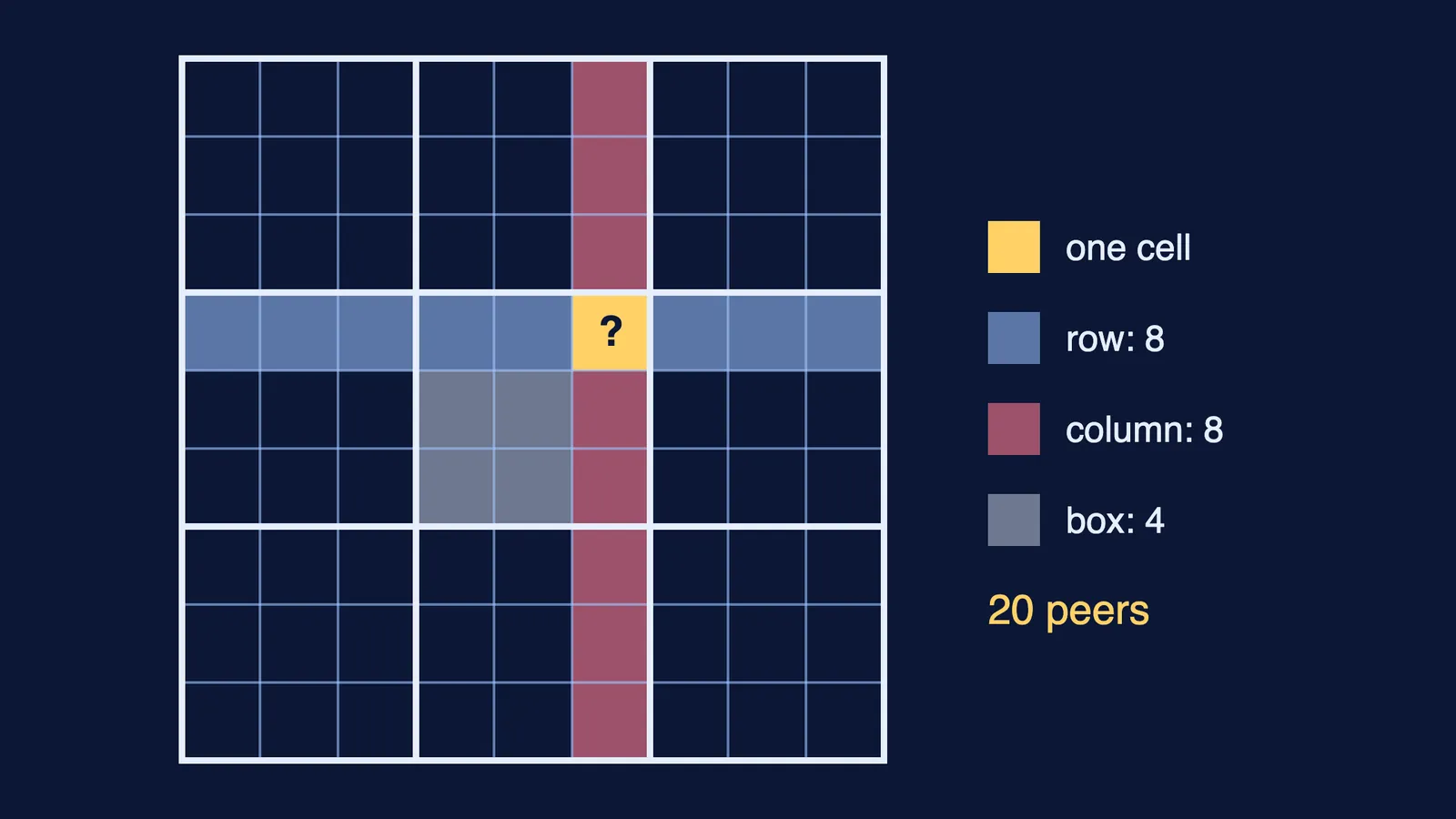
Every cell has 20 peers: 8 other cells in its row, 8 in its column, and 4 more in its box that share neither. Each technique below is a short proof about those peers.
Naked single (elimination). List what the peers already hold. If the row has 1, 2, 3 and 5, the column has 4, 6 and 8, and the box adds 7, eight digits are ruled out, so the cell must be 9.
Hidden single (only one place). Flip the question from "what goes here?" to "where can the 5 go in this box?" If 5s in nearby rows and columns block every cell of the box but one, the 5 goes there, even if that cell still has other candidates.
Naked pair (pigeonhole). Suppose two cells in a row can each only be 3 or 7. Two digits must fill two cells, so 3 and 7 are used up there, and you can erase both from every other cell in that row. This is the pigeonhole principle in action.
A routine for your next puzzle:
Scan each digit from 1 to 9 across the grid for hidden singles first; they need no pencil marks.
Pencil in candidates only for cells with three or fewer options.
Look for naked singles among those cells, then for pairs.
When stuck, write one line on why each remaining candidate survives. Explaining the step is where the logic training happens.
That habit of saying why each step follows carries straight into proofs and long JEE problems. If the pigeonhole or multiplication principle feels shaky, the Fermi Concept Library gives each concept its own lesson. And when a counting problem stalls you, the Fermi Problem Library has a step-by-step solver that explains the reasoning rather than printing an answer.
For the people who turned puzzles like this into mathematics, read our profile of Martin Gardner and recreational mathematics. If you have a younger brother or sister, start them on these logic puzzles for children.


