On this page
Martin Gardner was not a professional mathematician. "I took no math courses in college," he wrote in a 1998 essay that Scientific American republished after his death, calling himself "little more than a journalist who loves mathematics." Even so, his monthly column turned paper strips, squares and dots on a grid into puzzles that readers could try for themselves.
What was Martin Gardner's Mathematical Games column?
Gardner dated the column from his article on hexaflexagons in the December 1956 issue of Scientific American, and he wrote it from 1956 to 1981 (Scientific American). The "Mathematical Games" columns appeared monthly from January 1957 to December 1980, and then sporadically until June 1986, according to Colm Mulcahy's Scientific American guest blog. Gardner wrote roughly 300 articles for the magazine, most of them columns, according to the same source.
Gardner (1914 to 2010) wrote or edited more than 100 books (Wikipedia).
Which puzzles did Gardner make famous?
Flexagons. A hexaflexagon is a hexagon folded from a strip of paper that you can "flex" to show faces that were hidden a moment ago (Wikipedia: Flexagon). The simplest one, the trihexaflexagon, is made from a strip divided into nine equilateral triangles and has three faces, according to the same page. In 1939 Arthur Stone, an English graduate student at Princeton, discovered flexagons by accident. He and fellow students John Tukey, Bryant Tuckerman and Richard Feynman then explored them mathematically (Scientific American guest blog).
Polyominoes. These are shapes made by joining identical squares along their edges, and Gardner introduced Solomon Golomb's work on them in the May 1957 issue (Scientific American). "My first column on Golomb's twelve pentominoes was an instant hit," Gardner later recalled (Scientific American guest blog).
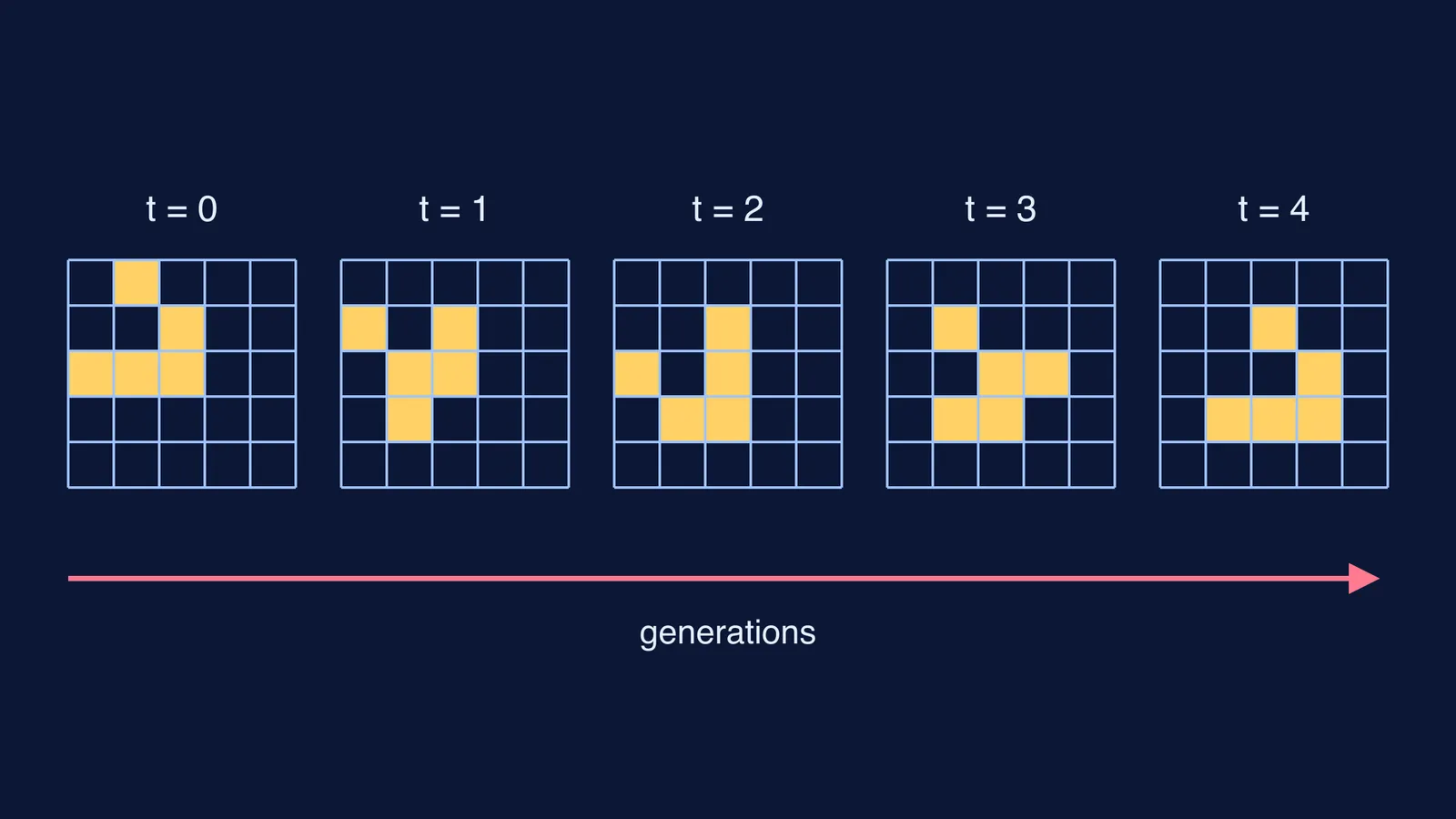
The Game of Life. John Conway's Game of Life first appeared in public in Gardner's column in October 1970 (Wikipedia: Conway's Game of Life). It is played on a grid of cells that are either alive or dead. At every step, a live cell with two or three live neighbours survives, any other live cell dies, and a dead cell with exactly three live neighbours comes alive. Conway offered 50 dollars to anyone who could prove or disprove his guess that no pattern can grow forever. A team at MIT led by Bill Gosper won the prize in November 1970 with a "glider gun", a pattern that keeps producing gliders (same source). Gardner later wrote that for many weeks "business firms and research laboratories were almost shut down while Life enthusiasts experimented with Life forms" (Scientific American).
Why did Gardner's column inspire so many mathematicians?
The mathematician Ian Stewart has said Gardner's column was "one of the two things that, above all others, convinced me I wanted to be a mathematician" (Wikipedia). Fields Medallist Manjul Bhargava told Colm Mulcahy that he discovered Gardner's works when he was around 12, and that "They inspired me a huge amount, and gave me something far more enjoyable to do than go to math class!" (Gathering 4 Gardner).
Gardner himself argued that recreational maths "should be regularly introduced as a way to interest young students in the wonders of mathematics," before adding, "So far, though, movement in this direction has been glacial" (Scientific American).
All three puzzles have you fold, arrange or tick cells before anyone hands you a theorem, so the questions come from you.
How can you try Gardner's puzzles at home this week?
All you need is graph paper, scissors and a pencil. Draw three live cells in a row, which we'll call left, middle and right.
Middle has two live neighbours (left and right), so it survives.
Left and right each have one live neighbour (middle), so both die.
The empty cells directly above and below middle each touch all three live cells, so both come alive.
The result is three cells in a column. Do it again and you are back to a row. This flipping pattern is called a blinker.
Now try a four-day plan.
Day 1: Draw the five-cell glider and work out four generations by hand. You should find the same shape again, shifted one cell diagonally (Wikipedia: Conway's Game of Life).
Day 2: Find all 12 pentominoes. Count a shape and its mirror image as the same piece; that is how you get 12.
Day 3: Fold a trihexaflexagon from a strip of nine equilateral triangles (Wikipedia: Flexagon). Colour each face and write down the order in which they appear.
Day 4: Explain one result in three sentences, for example why the blinker never grows.
For ideas in your syllabus that are easier to see than to read, the Fermi Simulation Lab has interactive simulations. If a puzzle leads you to a new topic, such as symmetry or counting arrangements, the Fermi Concept Library covers every concept in mathematics, each with its own lesson.
Pick one puzzle tonight, and leave the answer key closed until you have a guess of your own.