On this page
In school you prove that the angles of a triangle add up to 180°. That proof assumes the triangle lies on a flat page. Draw the same triangle on a globe and the rule breaks, so badly that all three angles can be right angles. It is the easiest way to see what Euclid's parallel postulate actually does.
How can a triangle have three right angles?
On a sphere, the straight lines are great circles: circles whose centre is the centre of the sphere, like the equator or any line of longitude. A great circle is a geodesic, the shortest path between two nearby points on the sphere (Wikipedia: Spherical geometry).
Now take a walk on a globe:
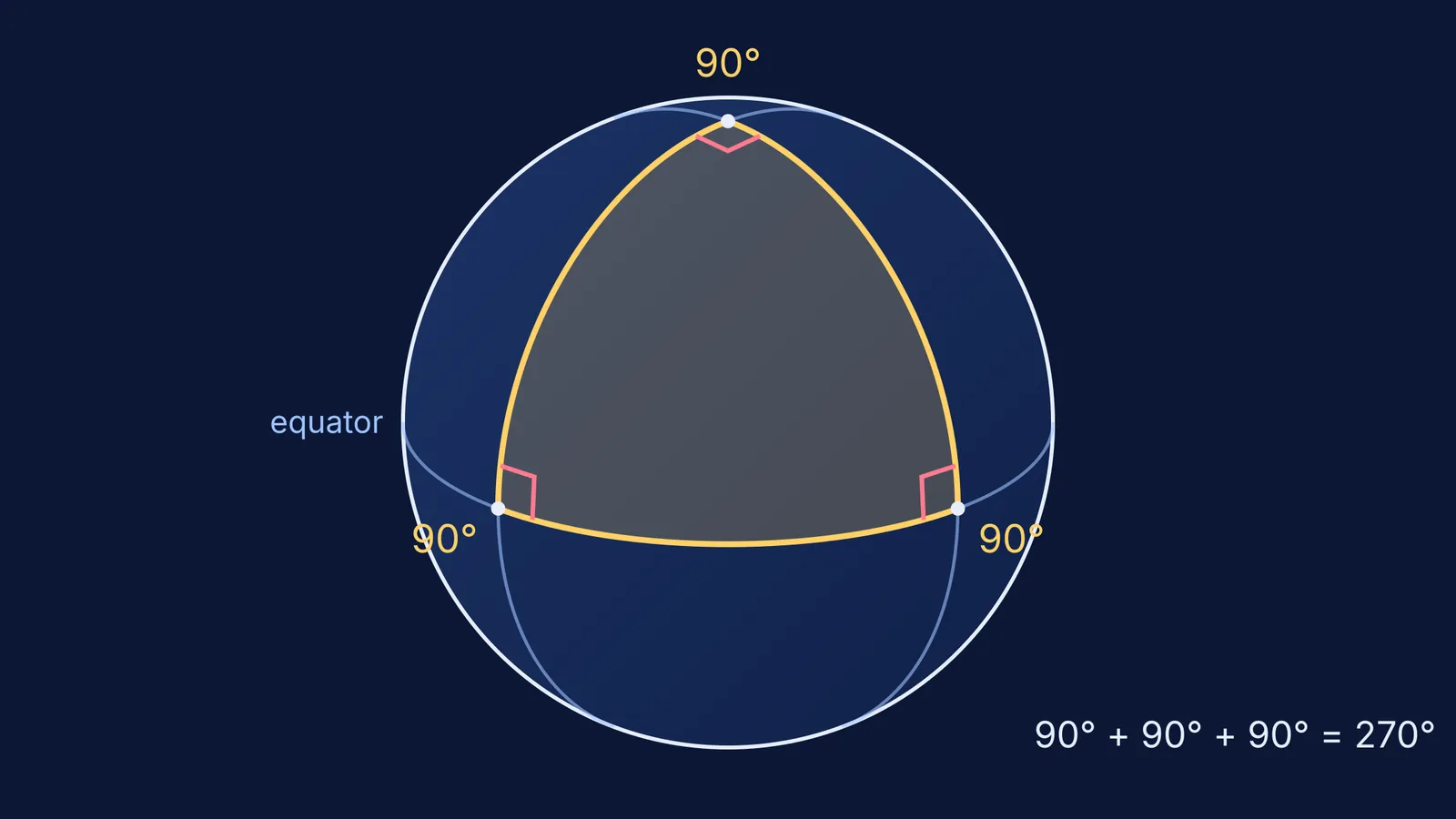
Start at the North Pole and walk due south along the 0° meridian until you reach the equator.
Turn left through 90° and walk east along the equator until you reach 90°E.
Turn left through 90° again and walk due north along the 90°E meridian, back to the pole.
Every meridian crosses the equator at a right angle, and at the pole the two meridians leave 90° apart. The sum is 270°. This triangle is an octant, one eighth of the sphere: "The octant of a sphere is a spherical triangle with three right angles" (Wikipedia: Spherical trigonometry).
Why do the angles add up to more than 180°?
Spherical excess is the difference between the sum of a spherical triangle's angles and 180° (π radians) (Wolfram MathWorld).
Girard's theorem links that excess to area: on a sphere of radius R, a triangle's area equals R² × (A + B + C − π), with the angles in radians (Wikipedia: Spherical trigonometry).
Check it with the octant. Its angles are each π/2, so the excess is 3π/2 − π = π/2. Its area is therefore πR²/2, exactly one eighth of the sphere's total area of 4πR². Earth's mean radius is 6,371 km (NASA Earth Fact Sheet), so the octant triangle covers about 63.8 million km².
Now try smaller equilateral triangles on Earth (flat area as an estimate, with the same 6,371 km radius):
1,000 km sides: area about 433,000 km², angle sum about 180.6°
100 km sides: area about 4,330 km², angle sum about 180.006°, an excess of roughly 22 arcseconds
Does Euclid's parallel postulate hold on a sphere?
Euclid's fifth postulate says that if a line falling on two lines makes the interior angles on one side less than two right angles, the two lines, "if produced indefinitely, meet on that side" (Euclid's Elements, Book I, D. E. Joyce, Clark University). In the same book, parallel lines are lines in one plane that never meet, however far they are extended. For a refresher on why this is a postulate, read our explainer on the difference between Euclid's axioms and postulates.
On a sphere, any two great circles intersect in two diametrically opposite points (Wikipedia: Spherical geometry). So a sphere has no parallel lines at all, and the flat-plane rule of exactly one parallel through a point fails. The sphere also breaks Euclid's second postulate, since its lines close up instead of extending indefinitely (Wikipedia: Parallel postulate).
Look at the octant again. Both meridians cross the equator at 90°, so the interior angles on the northern side make exactly two right angles. On a flat page they would be parallel. On the globe they meet at both poles.
This matters for the 180° rule. Euclid proves the angle sum in Book I, Proposition 32, and that proof uses Proposition 29 (Joyce, Prop. I.32), which is "the first proposition which depends on the parallel postulate" (Joyce, Prop. I.29). Without the postulate, Euclid's proof of the 180° rule does not go through. Our post on why a polygon's angle sum is (n − 2) × 180° builds on the same flat-plane fact.
In hyperbolic geometry, a triangle's angles always add up to less than 180° (Wikipedia: Hyperbolic geometry). Nikolai Lobachevsky published an account of this geometry in 1829, and János Bolyai, working independently, described it in 1831 (Wikipedia: Parallel postulate).
How can you test this yourself?
You need an orange or a ball, a marker, a rubber band and a protractor.
Mark a North Pole. Stretch the band around the ball through it (a great circle) and trace it.
Trace a second great circle through the pole, a quarter-turn round from the first.
Trace an equator, a great circle midway between your pole and the opposite point.
Estimate each corner of your triangle with the protractor.
Draw a tiny triangle and measure again. Its sum should be close to 180°.
If a step in Euclid's chain feels shaky, the Fermi Concept Library gives every concept in mathematics its own lesson and its place in the map, so you can revisit each idea on its own.