
On this page
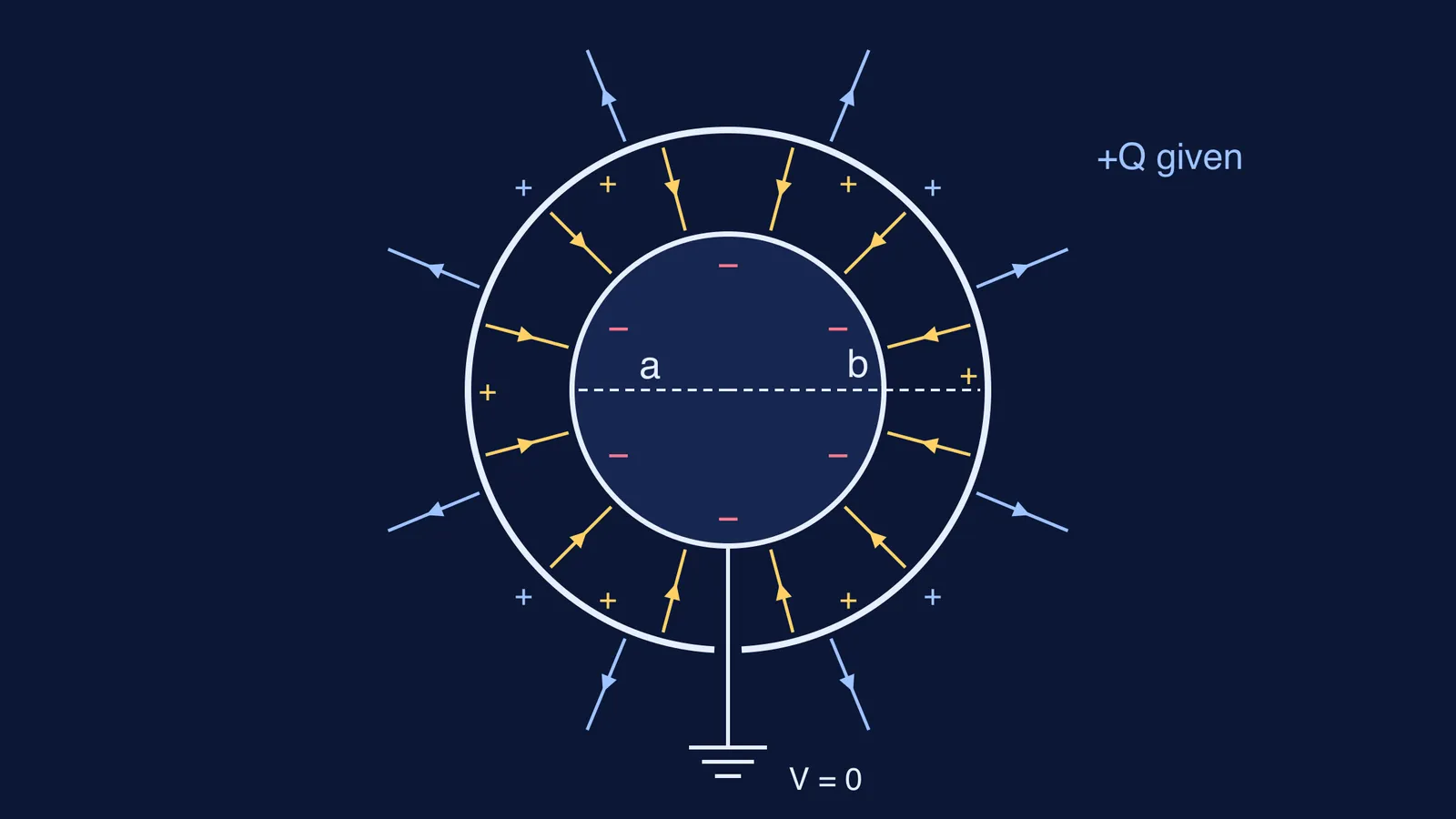
Most spherical capacitor problems earth the outer sphere and charge the inner one. A common exam variation flips it: the inner sphere is connected to earth through a small hole in the outer sphere, and charge Q is put on the outer sphere. The textbook formula no longer works, and the reason gives you a general rule: earthing a conductor fixes its potential at zero, not its charge.
What is the usual spherical capacitor formula?
For two concentric conducting spheres with inner radius a and outer radius b, the capacitance is C = 4πε₀ab/(b − a), as derived in OpenStax University Physics Volume 2, section 8.1. The same section shows that a single isolated sphere of radius R has C = 4πε₀R, which is the limit of that formula as the outer sphere moves off to infinity. HyperPhysics gives the same two results. For the full derivation of the standard case, read our derivation of the spherical and cylindrical capacitor formulas.
In the standard set-up, all the field sits in the gap between the spheres. Earth the inner sphere and charge the outer one instead, and the outer sphere has field on both sides of it: inward across the gap, and outward to infinity.
How do you find the induced charge on the earthed inner sphere?
Use this five-step method. It works for any earthed conductor in a set of concentric shells.
Call the unknown charge on the inner sphere q. Do not assume it is zero.
Write the inner sphere's potential as the sum of each sphere's contribution: V_inner = q/(4πε₀a) + Q/(4πε₀b). A charged shell gives the same potential everywhere inside it as on its surface, so the outer sphere contributes Q/(4πε₀b).
Earthing means V_inner = 0, so q = −Qa/b.
Write the outer sphere's potential. Outside the inner sphere, its charge acts as if it were at the centre, so V_outer = (Q + q)/(4πε₀b) = Q(b − a)/(4πε₀b²).
Divide: C = Q/V_outer = 4πε₀b²/(b − a).
The charges settle like this: −Qa/b on the inner sphere, +Qa/b on the inner surface of the outer sphere, and the rest, Q(b − a)/b, on its outer surface. Our post on concentric shells, their potentials and earthing one of them uses the same steps for other set-ups.
Why is the answer two capacitors in parallel?
The outer sphere stores charge in two places. Both stores sit between the same two potentials: V on the outer sphere, and zero on the earthed inner sphere and at infinity. Capacitors that share both terminals add:
Gap: 4πε₀ab/(b − a), holding Qa/b.
Outside: 4πε₀b, the outer sphere's own isolated capacitance, holding Q(b − a)/b.
Total: 4πε₀ab/(b − a) + 4πε₀b = 4πε₀b²/(b − a).
The algebra checks out, because ab + b(b − a) = b². That gives you a second route to the answer, and a way to check the first one in an exam.
Worked example: how big is the difference?
Take a = 9 cm and b = 10 cm. The NIST CODATA value of the vacuum permittivity is ε₀ = 8.8541878188 × 10⁻¹² F/m, so 4πε₀ ≈ 1.113 × 10⁻¹⁰ F/m.
Gap part: 1.113 × 10⁻¹⁰ × (0.09 × 0.10)/0.01 ≈ 100.1 pF.
Outer sphere alone: 1.113 × 10⁻¹⁰ × 0.10 ≈ 11.1 pF.
Full formula: 1.113 × 10⁻¹⁰ × 0.10²/0.01 ≈ 111.3 pF, which matches the sum.
Now put Q = 1 nC on the outer sphere. The inner sphere draws q = −Qa/b = −0.9 nC from earth, the outer surface keeps +0.1 nC, and the outer sphere sits at V = Q/C ≈ 9.0 V. With these radii, the outer sphere's own term adds about 11% to the standard value of 100.1 pF. The narrower the gap, the smaller that share gets.
If the hard part is working out which surface holds which charge, the Fermi Problem Library has worked problems with a step-by-step solver that explains the reasoning rather than just printing an answer.
Which spherical capacitor formula does the question want?
Read the set-up before you reach for a formula:
Outer sphere earthed, charge on the inner sphere: C = 4πε₀ab/(b − a).
Inner sphere earthed, charge on the outer sphere: C = 4πε₀b²/(b − a).
One sphere on its own, nothing around it: C = 4πε₀R. See our post on the capacitance of an isolated sphere, including Earth's.
Neither sphere earthed, with charges given on both: skip capacitance and write each sphere's potential directly.
Step 2 depends on the potential inside a charged shell. If that idea feels shaky, the Fermi Concept Library covers every concept in physics, chemistry, biology, mathematics and computing, each with its own lesson.