On this page
A standard gravitation question goes like this: a body is released from rest at a height equal to Earth's radius R. Ignoring air resistance, how fast is it moving when it hits the ground? The answer is v = √(gR). Writing √(2gR) instead, by using mgh, is not slightly off. It cannot be right.
Why can't you use mgh for a fall from height R?
The formula mgh assumes g is the same at every point of the fall. OpenStax University Physics says the form ΔU = mg(y₂ − y₁) "works very well if g does not change significantly between y₁ and y₂" (OpenStax University Physics, section 13.3). Over a fall of one Earth radius, g changes a lot.
Earth's mean radius is 6,371 km, according to NASA's Earth fact sheet. Gravity weakens with the square of the distance from Earth's centre, so a body at height R, which is 2R from the centre, feels only a quarter of the surface value of g. It spends most of its fall in weaker gravity than mgh assumes, so it picks up less speed.
The general formula is U = −GMm/r, where r is measured from Earth's centre, not from the ground (OpenStax). If the minus sign bothers you, we explain it in why gravitational potential energy is negative.
How do you find the impact speed with −GMm/r?
Use conservation of energy between the moment of release and the moment of impact.
Release: the body is at rest at r = R + R = 2R. Kinetic energy is 0 and potential energy is −GMm/(2R).
Impact: the body is at the surface, r = R. Kinetic energy is ½mv² and potential energy is −GMm/R.
Set the totals equal: −GMm/(2R) = ½mv² − GMm/R.
Rearrange: ½mv² = GMm/R − GMm/(2R) = GMm/(2R), so v² = GM/R. The mass m cancels.
Replace GM with gR², because g = GM/R² at the surface: v² = gR, so v = √(gR).
Now put in numbers. NASA's fact sheet gives GM = 3.986 × 10¹⁴ m³/s² and a mean surface gravity of 9.82 m/s². Then GM/R = 3.986 × 10¹⁴ ÷ 6.371 × 10⁶ ≈ 6.26 × 10⁷ m²/s², and v ≈ 7.91 km/s.
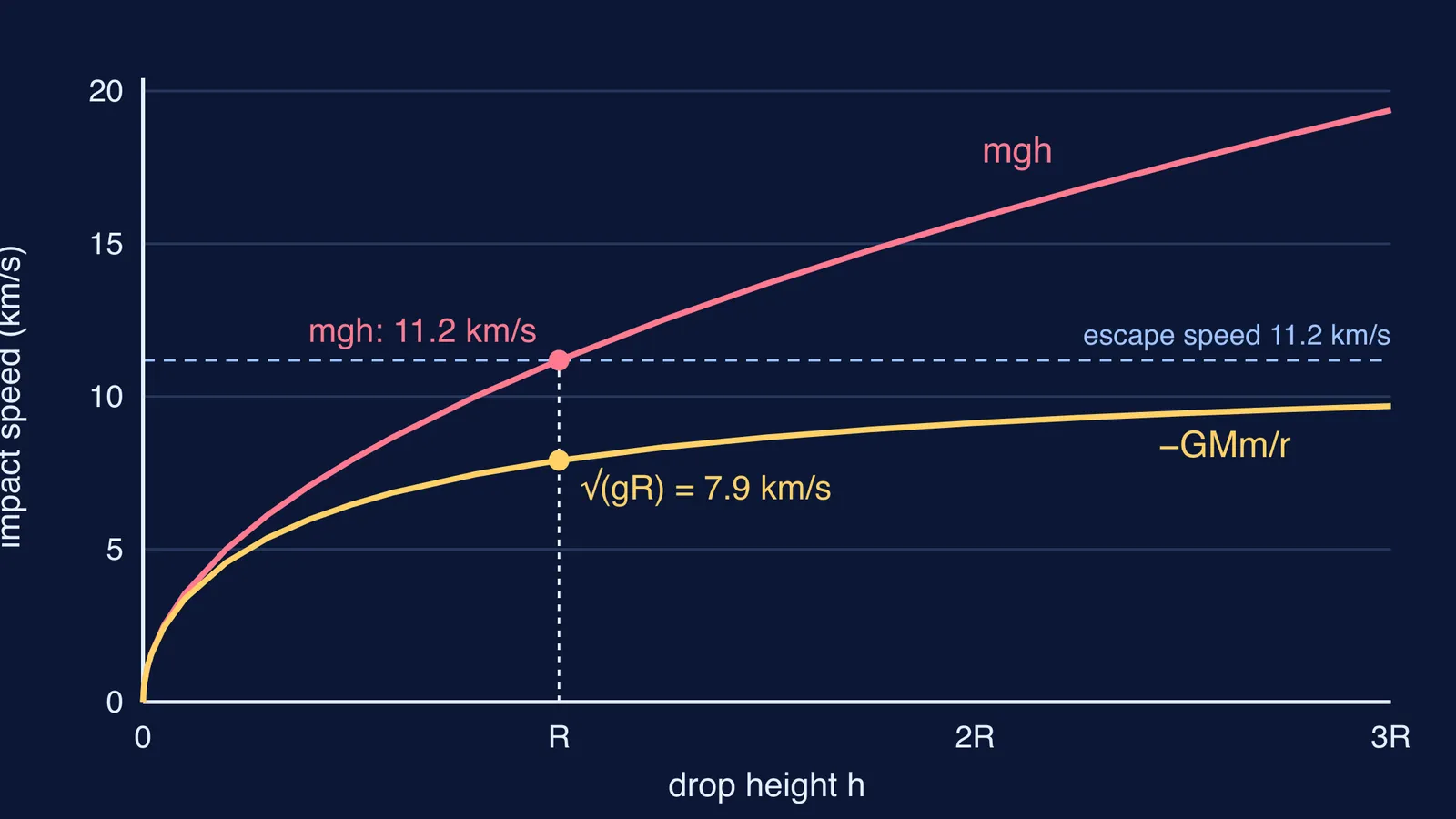
The mgh shortcut gives v = √(2gh) = √(2gR) ≈ 11.19 km/s. That is 41% too fast, and the kinetic energy it predicts is twice the real value.
How big is the mgh error at different heights?
For a drop from any height h, the same energy steps give v² = 2gh × R/(R + h). The mgh shortcut leaves out the factor R/(R + h), so it overestimates the speed by a factor of √(1 + h/R). With g = 9.82 m/s² and R = 6,371 km from NASA's Earth fact sheet:
h = 1 km: both methods give about 140 m/s; they differ by less than 0.01%.
h = R/10, about 637 km: the exact speed is 3.37 km/s; mgh gives 3.54 km/s, about 5% too high.
h = R, 6,371 km: the exact speed is 7.91 km/s; mgh gives 11.19 km/s, 41% too high.
h = 3R: the exact speed is 9.69 km/s; mgh gives 19.4 km/s, double the real value.
A useful rule: mgh stays within about 1% of the true speed while h is under about 2% of R, roughly 130 km. Every school-lab drop and building height is safely inside that.
As h grows without limit, the exact speed levels off at √(2gR), the escape speed, while the mgh speed keeps climbing. The reverse question, how high a body thrown upward at a given speed will rise, uses the same equation; see maximum height reached when projected below escape velocity.
If the inverse-square idea behind that quarter-strength g still feels shaky, the Fermi Concept Library covers every concept in physics, chemistry, biology, mathematics and computing, each with its own lesson and its place in the map.
Where do students lose marks on this question?
Before you write the final answer, run through this list:
Did you measure r from Earth's centre? The starting distance is 2R, not R.
Did you keep the minus sign in −GMm/r? Dropping it gives v² = −gR, which has no real solution.
Did you avoid using surface g for the whole fall? At height R, g is g/4; see how g changes with height and depth.
Did you convert GM to gR² if the options are written in g and R?
Is your answer below the escape speed, 11.2 km/s in NASA's Earth fact sheet? If not, recheck.
For practice, try a drop from height R/2. The same five steps give v² = 2gR/3, so v = √(2gR/3), about 6.46 km/s, while mgh would give √(gR), about 7.91 km/s.
For more drops, throws and orbits worked the same way, the Fermi Problem Library has worked problems with a step-by-step solver that explains the reasoning rather than printing an answer.