On this page
"If sin θ + cos θ = 7/5, find sin θ cos θ." It looks like you need the angle, but you don't. One line of algebra turns the sum into the product.
The CBSE Mathematics syllabus for 2025-26 lists "Proof and applications of the identity sin²A + cos²A = 1" under Trigonometry. That unit carries 12 of the 80 marks in the Class 10 theory paper.
What is the value of (sin θ + cos θ)²?
Treat sin θ as a and cos θ as b, and use (a + b)² = a² + 2ab + b²:
(sin θ + cos θ)² = sin²θ + 2 sin θ cos θ + cos²θ
Section 8.4 of the NCERT Class 10 chapter Introduction to Trigonometry proves that cos²A + sin²A = 1 for every angle A from 0° to 90°. Replace the two squares with 1:
(sin θ + cos θ)² = 1 + 2 sin θ cos θ
The minus version works the same way: (sin θ − cos θ)² = 1 − 2 sin θ cos θ. Add the two and the product cancels, so (sin θ + cos θ)² + (sin θ − cos θ)² = 2.
How do you find sin θ cos θ if sin θ + cos θ is given?
Take sin θ + cos θ = 7/5, with θ acute.
Square both sides: 1 + 2 sin θ cos θ = 49/25.
Subtract 1: 2 sin θ cos θ = 24/25.
Halve it: sin θ cos θ = 12/25.
Once you have the product, the follow-up parts fall out quickly:
(sin θ − cos θ)² = 1 − 24/25 = 1/25, so sin θ − cos θ = ±1/5.
Add this to the sum: sin θ = 4/5 and cos θ = 3/5, or the other way round. It's the 3-4-5 triangle in disguise.
tan θ + cot θ = (sin²θ + cos²θ)/(sin θ cos θ) = 1/(sin θ cos θ) = 25/12.
sin³θ + cos³θ = (sin θ + cos θ)(1 − sin θ cos θ) = 7/5 × 13/25 = 91/125.
Check with the triangle: 64/125 + 27/125 = 91/125.
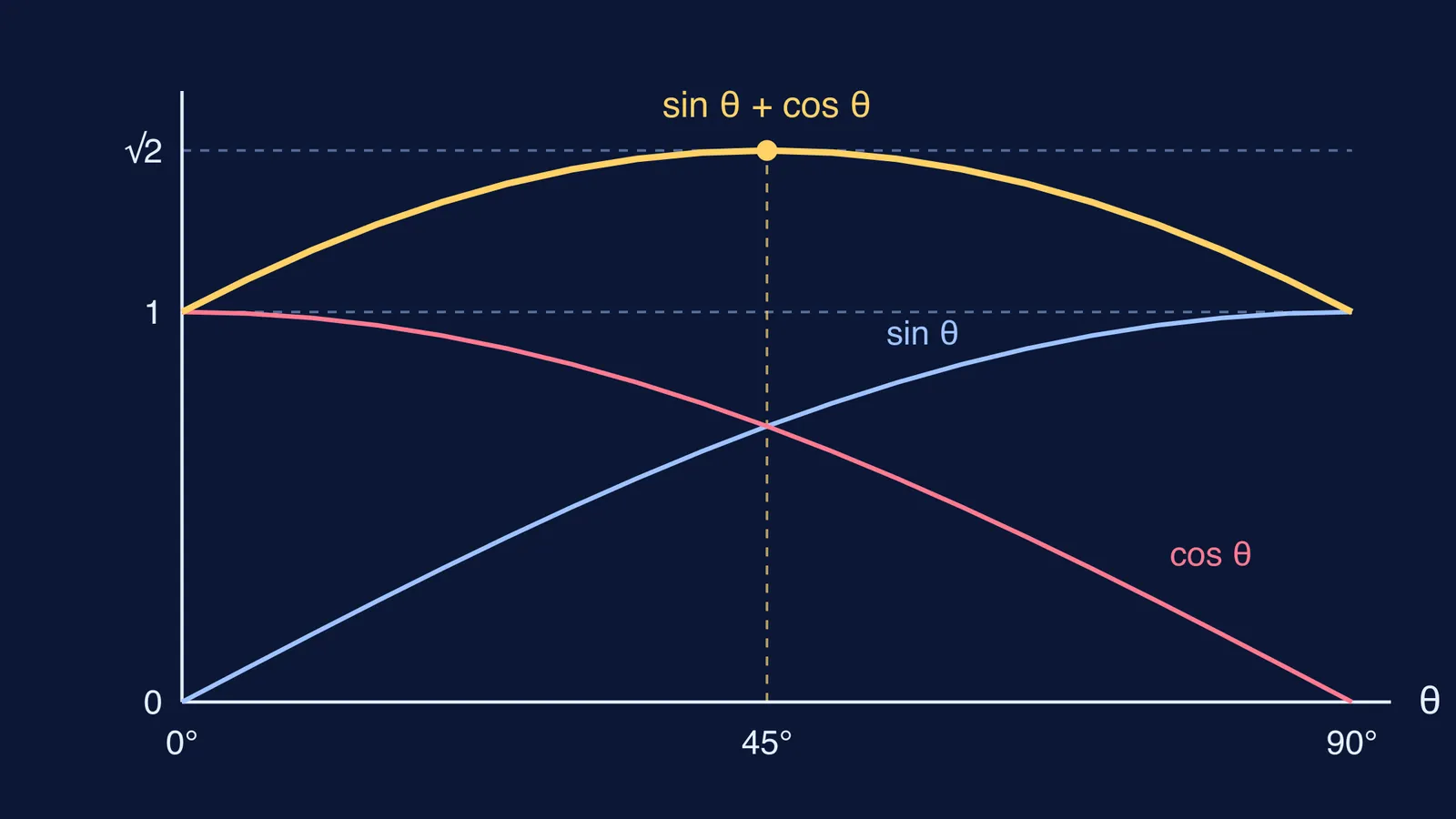
Watch the ± sign: the question has to tell you which root to keep. NCERT's remark after Table 8.1 in the same chapter helps here: as A goes from 0° to 90°, sin A rises from 0 to 1 and cos A falls from 1 to 0. So if θ is more than 45°, sin θ is the bigger one and sin θ − cos θ is positive.
The same squaring trick drives harder questions too, such as when sin θ and cos θ can be the roots of a quadratic.
What is the maximum value of sin θ + cos θ?
A square can never be negative, so (sin θ − cos θ)² ≥ 0. That means 1 − 2 sin θ cos θ ≥ 0, so sin θ cos θ ≤ 1/2. Put that into the main identity: (sin θ + cos θ)² ≤ 1 + 1 = 2, so sin θ + cos θ ≤ √2.
The sum equals √2 only when sin θ = cos θ, which happens at 45°, where both are 1/√2 according to NCERT's Table 8.1 in Introduction to Trigonometry. Between 0° and 90°, sin θ cos θ is never negative, so the sum is at least 1. It equals 1 at 0° and at 90°. The graph above shows all three curves.
This gives you a quick check on any question. If a paper says sin θ + cos θ = 1.5, something is off, because √2 is about 1.414. It's the same kind of reasoning as why sin θ can never be more than 1.
Which mistakes cost marks on this question?
Writing (sin θ + cos θ)² = sin²θ + cos²θ = 1, which drops the 2 sin θ cos θ term.
Forgetting to halve after subtracting 1.
Keeping only the + root of (sin θ − cos θ)² without checking which ratio is bigger.
Accepting a given sum larger than √2 without noticing it's impossible.
A 10-minute practice plan
On blank paper, derive (sin θ + cos θ)² = 1 + 2 sin θ cos θ twice, without looking.
Solve for p = 7/5, p = 17/13 and p = 1. You should get 12/25, 60/169 and 0.
For p = 17/13, find sin θ and cos θ (12/13 and 5/13, in either order) and check them with a triangle.
Finish with mixed identity questions from our trigonometric identities practice plan.
If you get stuck halfway through a problem, the Fermi Problem Library has worked problems with a step-by-step solver that explains the reasoning rather than just printing an answer. If the identity itself still feels shaky, the Fermi Concept Library gives each mathematics concept its own lesson, so you can go back to sin²θ + cos²θ = 1 before you try this again.