

On this page
Soap and shampoo do the same basic job: they pull oily dirt into water so it can be rinsed away. The difference is in the molecule doing the pulling, and it shows up in three ways you can see at home: scum in hard water, pH, and how tangled your hair feels afterwards.
What is the difference between shampoo and soap?
Both are surfactants, molecules with a water-loving (hydrophilic) head and an oil-loving (hydrophobic) tail. The NCERT Class 10 science chapter on carbon compounds defines soaps as sodium or potassium salts of long-chain carboxylic acids, made by saponification. In water they cluster into micelles: tails inward around the oil, ionic heads facing the water, so the dirt leaves with the rinse.
Detergents work the same way with a different head. NCERT describes them as generally sodium salts of sulphonic acids or ammonium salts with chloride or bromide ions, and says detergents are usually used to make shampoos. A review of hair cosmetics in the International Journal of Trichology says the main cleansing agents in shampoo are anionic surfactants, such as sodium lauryl sulfate, sodium laureth sulfate and ammonium lauryl sulfate. Our explainer on the difference between soap and detergent goes further.
Why does soap leave scum in hard water?
Hard water carries calcium and magnesium ions. Soap's carboxylate head binds them into an insoluble solid, the scum on a bucket or bathroom tile. For sodium stearate, a typical soap:
2 C17H35COONa + Ca2+ → (C17H35COO)2Ca (solid) + 2 Na+
Soap locked up as scum no longer cleans, which is why NCERT notes you need more soap in hard water. The charged ends of detergents do not form these precipitates, so they keep working. On hair, the same review says soap's calcium salts can build up on the strands and leave them dull and tangled. If your home runs on borewell or tanker water, the fixes for the water itself are in our post on removing permanent hardness with washing soda, Calgon and ion exchange.
Does the pH of shampoo matter for hair?
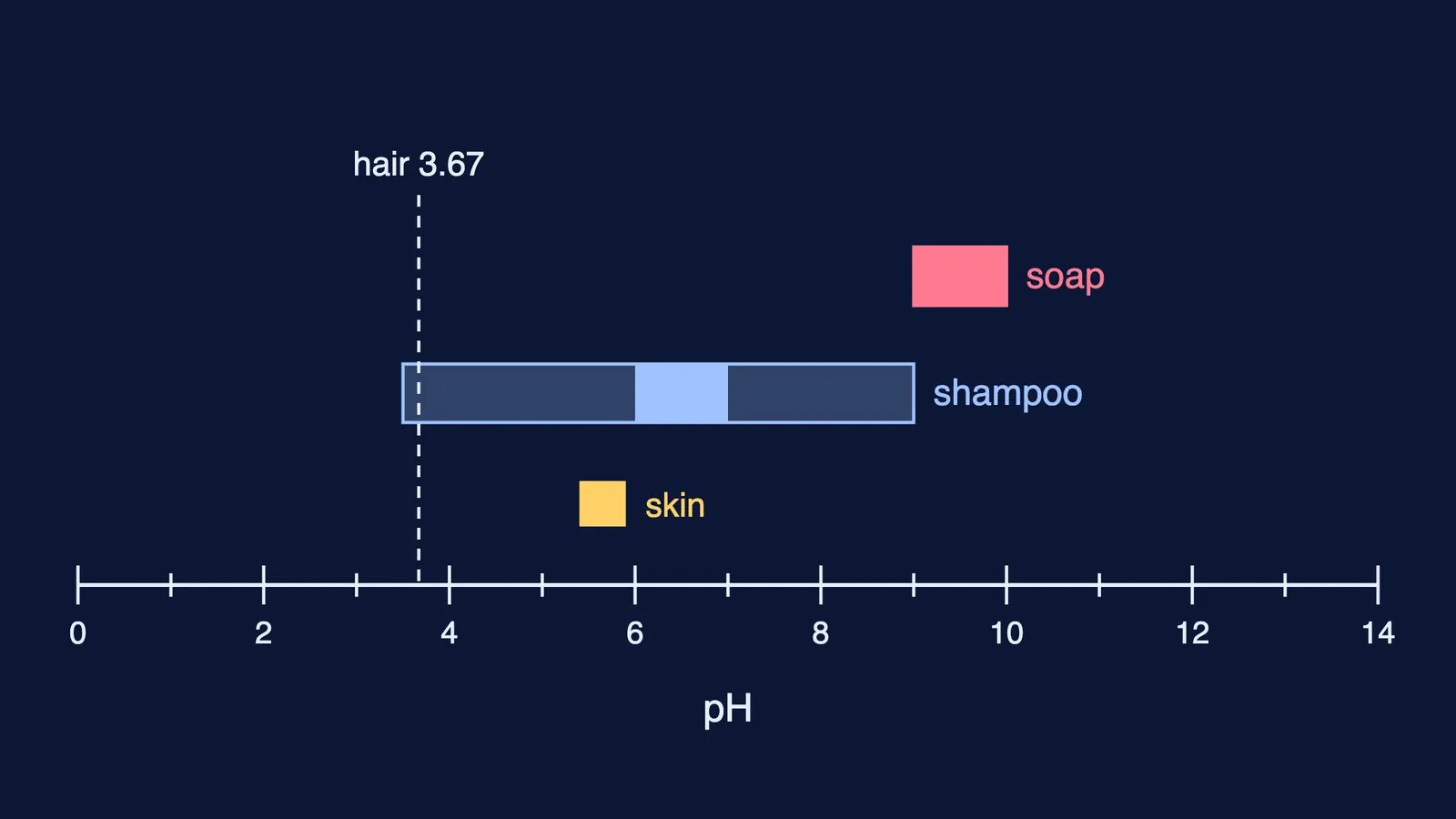
pH is the second big difference. Dermatologists in Thrissur, writing in the Indian Journal of Dermatology, tested bathing soaps and shampoos bought from local shops and found most soaps at pH 9 to 10 and most shampoos at pH 6 to 7. The same paper gives healthy skin a pH of 5.4 to 5.9.
A 2014 study by Gavazzoni Dias and colleagues measured 123 shampoos and found pH values from 3.5 to 9.0, with 38.21% at pH 5.5 or below. They wrote that an alkaline pH may increase the negative charge on the hair surface and the friction between fibres, which may lead to frizz and breakage. They also note there is no standard for a shampoo's final pH, and it is not printed on labels.
The reason is electrostatics. Hair is protein, and its isoelectric point, the pH at which its surface charges balance, is about 3.67, according to the 2015 review. Above that pH the surface carries a net negative charge, so strands repel each other and static and friction rise.
What does conditioner actually do?
Conditioner fixes the charge with opposite charges. Its key ingredients are cationic surfactants, often quaternary ammonium compounds ("quats"), whose heads are positive. The hair cosmetics review explains that conditioners neutralise the hair fibre's negative charge by adding positive charges and lubricate the cuticle. Because washed hair is negative, these molecules cling on after rinsing, so hair combs more easily.
That is the attraction between opposite charges from your textbook, working on one strand. If charge, polarity or micelles still feel shaky, the Fermi Concept Library has a lesson for every concept in chemistry, each with its place in the map.
How do you test it at home and answer it in an exam?
Try a version of NCERT's hard-water activity with a soap bar and your shampoo:
Fill two glasses with the same amount of tap water.
Add a little dissolved soap to one and the same amount of shampoo to the other.
Stir each for the same time.
Compare the foam and look for a white curdy solid. Scum in the soap glass means your water is hard.
If you have pH paper from a school kit, dip it in each and note the colour.
For a three-mark answer to "Why is shampoo preferred to soap for washing hair?", make these points:
Soap reacts with calcium and magnesium ions in hard water to form insoluble scum; the detergents in shampoo do not.
Soap is alkaline; most shampoos are nearer neutral.
Alkaline conditions raise the negative charge on hair, increasing friction and tangling.
If you lose marks for missing steps, the Fermi Problem Library has worked problems with a step-by-step solver that explains the reasoning. And if your shampoo foams more on the second wash, here is why shampoo lathers more the second time.
This is chemistry, not skin or scalp advice. For an itchy scalp, hair fall or a skin reaction, see a dermatologist.


