

On this page
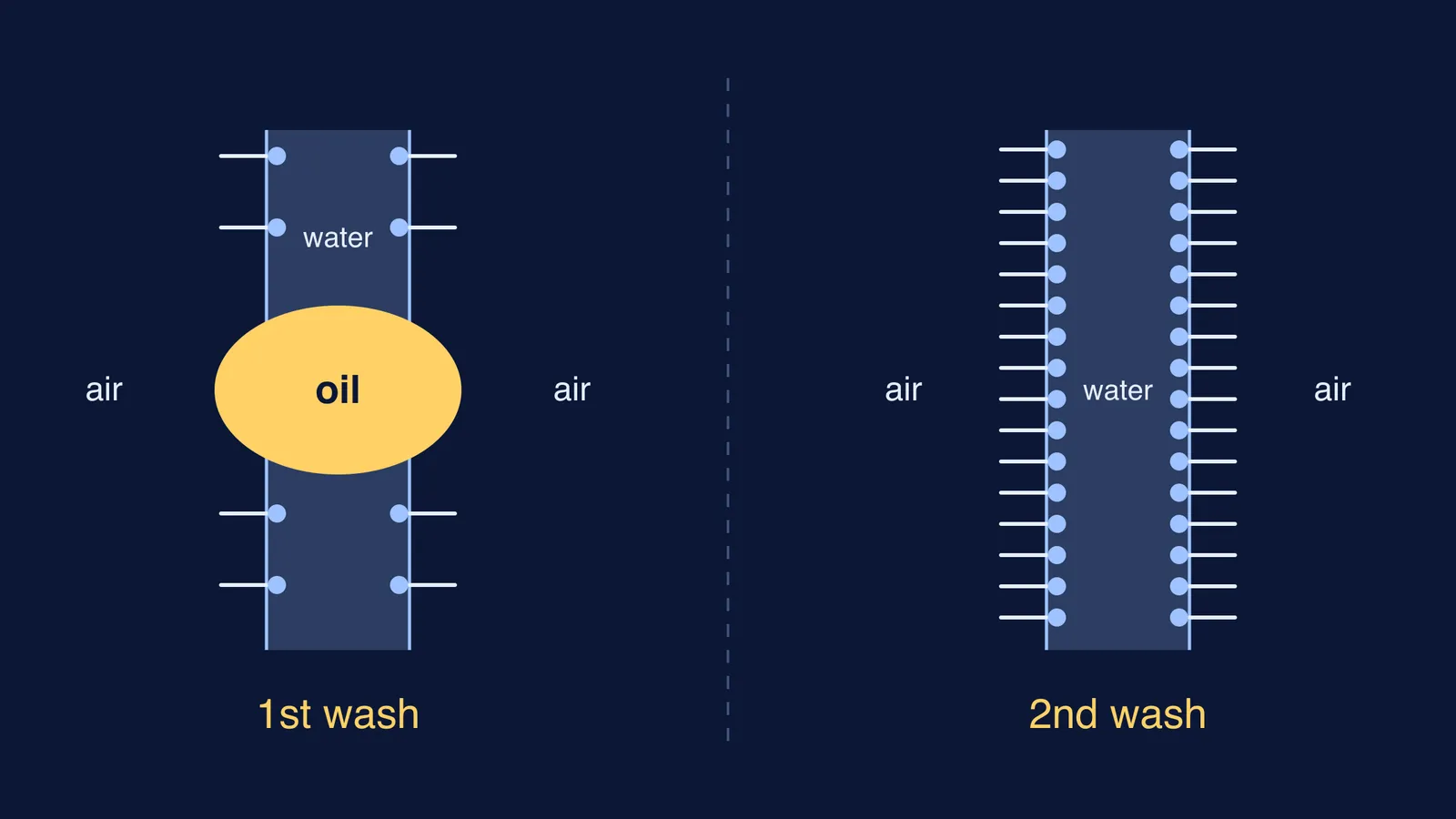
You squeeze out shampoo, rub it in, and get a thin, patchy lather. You rinse, use the same amount again, and this time it piles up into thick foam. Nothing changed in the bottle. What changed is your hair: the first wash carried away much of the oil that was popping the bubbles.
Why does shampoo foam more the second time?
Dermatologist Zoe Draelos answers it directly in a 2010 review of hair cleansing in the International Journal of Trichology. A shampoo applied to dirty hair does not foam as much as the same shampoo on clean hair, she writes, "due to the sebum inhibiting bubble formation", so it foams less on the first shampooing and more on the second.
Sebum is the natural oil on your scalp. The same review lists what shampoo is meant to remove: sebum, sweat, shed skin cells, styling products and everyday dirt.
On the first wash, the shampoo meets all of that at once, and the oil keeps breaking the bubbles. Rinse much of it away, and the second dose meets far less oil, so its bubbles last.
Cosmetic chemists saw a similar effect in the lab more than 50 years ago. A 1969 study in the Journal of the Society of Cosmetic Chemists found that adding synthetic sebum at 45 °C caused a general reduction in specific foam volume in the shampoos it tested.
What are surfactants and micelles doing?
The cleaning ingredients in shampoo are surfactants. Each surfactant molecule has a water-loving (hydrophilic) head and a water-repelling (hydrophobic) tail, as Scientific American's shampoo foam activity explains, which is why it can work with both oil and water.
A micelle is a tiny sphere of surfactant molecules with a water-loving outside and a water-repelling core that holds fats and residues, according to a review of hair cosmetics by Maria Fernanda Reis Gavazzoni Dias. Because the outside of the micelle likes water, the oil trapped inside rinses away.
Foam uses those molecules in a second way. Every bubble wall is a thin film of water, and surfactants "facilitate the formation of foam and stabilize the gas bubbles", in the words of the Scientific American activity. In that activity, water with no surfactant makes no foam at all.
How does oil pop the bubbles?
Oil breaks foam so reliably that oils are widely used in technologies and consumer products to control foam. Chemist Nikolai Denkov of Sofia University reviewed how these oil-based antifoams work in Langmuir in 2004.
Fast antifoams rupture foam films by "bridging": oil bridges form between the two surfaces of the film. In a typical foam test, fast antifoams destroy the foam in less than a minute, while slow ones take minutes or tens of minutes, according to the same review. A key factor is the entry barrier, which controls whether oil drops can emerge onto the liquid surface in the first place.
Should you shampoo twice?
Think of the second lather as a signal, not a goal. It tells you roughly how much oil was on your scalp, not how clean you are. Draelos also notes that hair stripped of all sebum is harsh, rough, dull and prone to static, so more washing is not always better.
A simple way to read your lather:
If the first lather was thin and your hair was oily or had gel or hair oil in it, much of the shampoo went on that oil. A second wash will usually foam more.
If the first lather was already thick, there was probably little oil left to break the bubbles, and a second wash adds less.
Try it: the two-bottle foam test
You can see the effect at home in ten minutes. This follows the shake-and-measure idea in the Scientific American activity, with oil added to one bottle.
Take two identical clear bottles with lids. Fill each about one-third with tap water.
Add the same small squeeze of shampoo to both.
Add a few drops of cooking oil to bottle B only. This stands in for sebum.
Close both and shake each the same number of times, as hard as each other.
Mark the foam height on each bottle straight away, then again after five minutes.
Write down your prediction before you shake, and compare it with what you see.
If the bottle with oil ends up with less or shorter-lived foam, you have just watched oil act as an antifoam. Then try a version two: add a second squeeze of shampoo to bottle B and shake again. Does the extra surfactant win back the foam?
Predict, test, explain beats memorising a definition. If the definitions behind this are shaky, the Fermi Concept Library covers every concept in physics, chemistry and biology, each with its own lesson. And for ideas that are easier to see than to read, browse the interactive simulations in the Fermi Simulation Lab.


