On this page
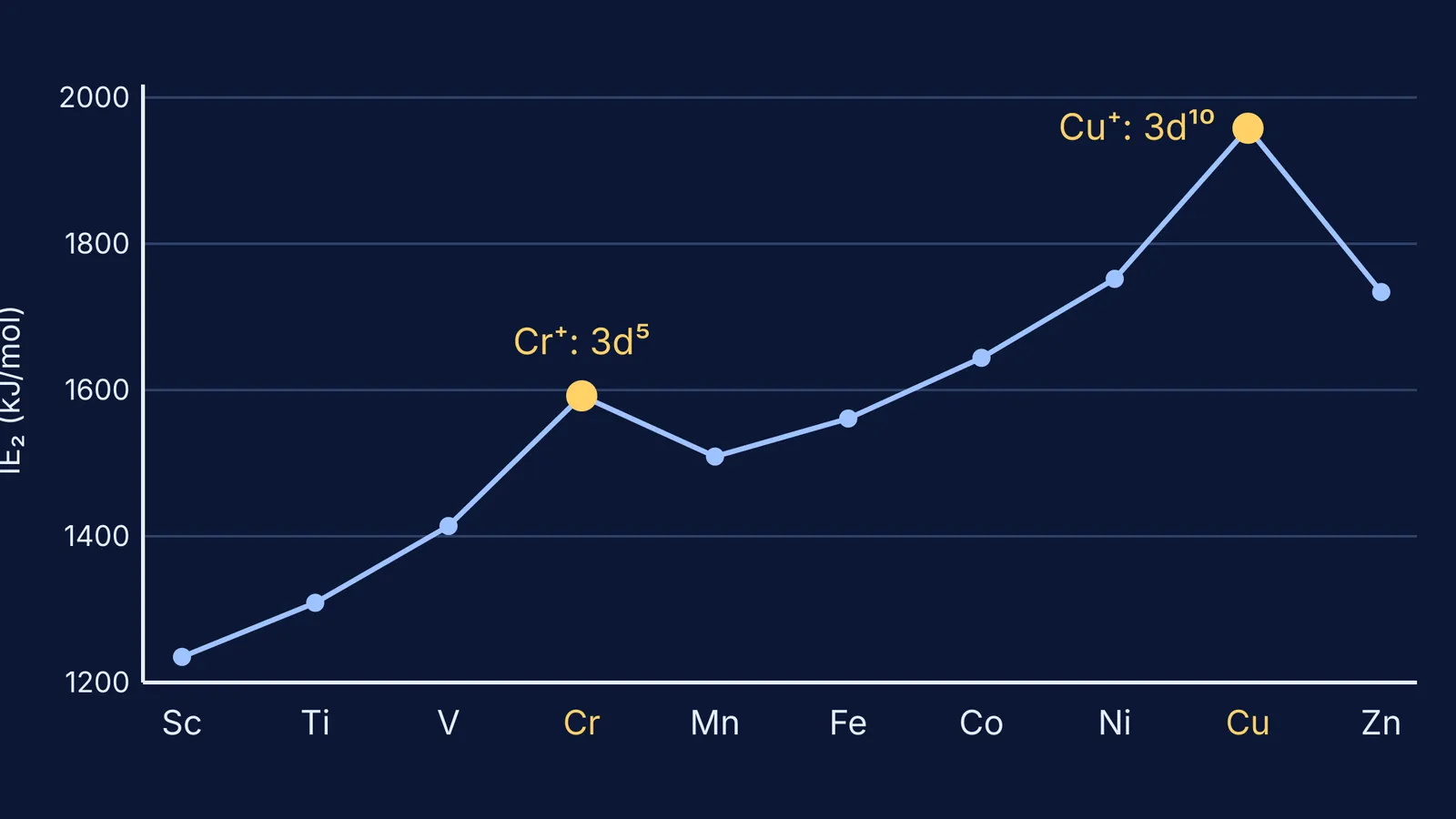
Look down the second ionisation enthalpy row for the 3d series and two numbers stand out: chromium and copper. Both are higher than the element that comes after them, even though nuclear charge keeps rising. It is a classic "give reasons" question in Class 12 chemistry. The explanation is short once you see what the first ionisation leaves behind.
Why is the second ionisation enthalpy of Cr and Cu so high?
The NCERT Class 12 chapter The d- and f-Block Elements (Table 4.2) lists the second ionisation enthalpy of chromium as 1592 kJ/mol and of copper as 1958 kJ/mol. Manganese, the element after chromium, is lower at 1509 kJ/mol. Zinc, the element after copper, is lower at 1734 kJ/mol. Across the series the general trend is upward, so an element beating its right-hand neighbour needs a reason.
The reason is the ion formed after the first ionisation. Chromium is [Ar] 3d⁵ 4s¹ and copper is [Ar] 3d¹⁰ 4s¹, the two famous exceptions explained in our post on why chromium and copper break the aufbau order. The 4s electron leaves first, so Cr⁺ is 3d⁵ (half-filled) and Cu⁺ is 3d¹⁰ (completely filled).
The NIST Atomic Spectra Database ionisation energy tables list the ground state of Cr⁺ as 3d⁵ and of Cu⁺ as 3d¹⁰, with 3d⁴ and 3d⁹ as the ions left after the next electron is removed.
So for Cr and Cu, the second electron has to be pulled out of a stable d subshell. NCERT says the second ionisation enthalpy "shows unusually high values for Cr and Cu where M⁺ ions have the d⁵ and d¹⁰ configurations respectively".
The neighbours behave differently. Mn⁺ is 3d⁵ 4s¹, so its second electron comes from 4s and the d⁵ set is untouched. Zn⁺ is 3d¹⁰ 4s¹, and NCERT calls zinc's value "correspondingly low" because removing that 4s electron produces a stable d¹⁰ ion.
What makes d⁵ and d¹⁰ so stable?
NCERT names three terms behind any ionisation enthalpy: the attraction of each electron to the nucleus, the repulsion between electrons, and exchange energy. In the same NCERT chapter, exchange energy is described as "approximately proportional to the total number of possible pairs of parallel spins in the degenerate orbitals". Losing exchange energy makes ionisation harder.
A half-filled or full d subshell has the largest possible number of parallel-spin pairs for its electron count. Our explainer on exchange energy and half-filled stability goes deeper; for this question, counting is enough.
Worked example: count the parallel-spin pairs
Among n electrons with the same spin, the number of pairs is n(n − 1)/2. Count only the d electrons, spin-up and spin-down separately.
Cr⁺ to Cr²⁺: 3d⁵ has 5 up, so 10 pairs. 3d⁴ has 4 up, so 6 pairs. Four pairs lost.
Mn⁺ to Mn²⁺: 3d⁵ 4s¹ to 3d⁵. The d set keeps its 10 pairs. None lost.
Cu⁺ to Cu²⁺: 3d¹⁰ has 5 up and 5 down, so 10 + 10 = 20 pairs. 3d⁹ has 10 + 6 = 16. Four pairs lost.
Zn⁺ to Zn²⁺: 3d¹⁰ 4s¹ to 3d¹⁰. Still 20 pairs. None lost.
Cr and Cu pay an exchange-energy penalty that Mn and Zn avoid, and that penalty is what makes their second ionisation enthalpies peak.
How do you write this as a three-mark answer?
Use this order, which mirrors the NCERT reasoning:
Write both configurations: Cr [Ar] 3d⁵ 4s¹ to Cr⁺ 3d⁵; Cu [Ar] 3d¹⁰ 4s¹ to Cu⁺ 3d¹⁰.
State the stability: d⁵ is half-filled and d¹⁰ is completely filled, with maximum exchange energy.
Conclude: the second electron must come from this stable d subshell, so exchange energy is lost and the second ionisation enthalpy is unusually high.
The same logic answers the follow-up examiners like. In NCERT Table 4.2, the third ionisation enthalpy of Mn (3260 kJ/mol) is higher than that of Fe (2962 kJ/mol), because Mn²⁺ is d⁵ while Fe²⁺ is d⁶ and loses no exchange energy on ionising.
Which mistakes cost marks here?
Removing a 3d electron before 4s when forming M⁺. Transition metals lose ns electrons first.
Saying "Cr has a stable configuration" without naming the ion. The stability that matters is in Cr⁺, not Cr.
Mixing up the first and second ionisation enthalpies. Our guide to successive ionisation enthalpies shows how to keep them apart.
Forgetting zinc. Its low second value comes from the same rule seen from the other side.
If you keep losing marks on reasoning questions like this, the Fermi Problem Library has worked problems with a step-by-step solver that explains the reasoning rather than printing an answer. For a gap further back, such as exchange energy itself, the Fermi Concept Library gives each chemistry concept its own lesson.
Next time you revise the d-block, write Cr⁺ and Cu⁺ before you write anything else. The answer follows from those two lines.