

On this page
Ask why chromium is 3d⁵ 4s¹ and the usual textbook answer is two words: exchange energy. Here is how to count exchanges yourself, and where that story stops being the full truth.
What is exchange energy?
Exchange energy is the stabilisation an atom gains when electrons with the same spin sit in degenerate orbitals (orbitals of equal energy) and can, in quantum terms, swap places. As the LibreTexts case study on manganese and copper/Electronic_Structure_of_Atoms_and_Molecules/Electronic_Configurations/Case_Study%3A_Electron_Configuration_of_Mn_vs._Cu) puts it, "when electrons can exchange between orbitals, the energy of the atom is lowered," and this happens only between electrons of the same spin.
Two counting rules follow:
Only parallel-spin electrons count. An up electron and a down electron never form an exchange pair.
Every pair counts once. A swap between electron 1 and electron 2 is the same swap as between 2 and 1.
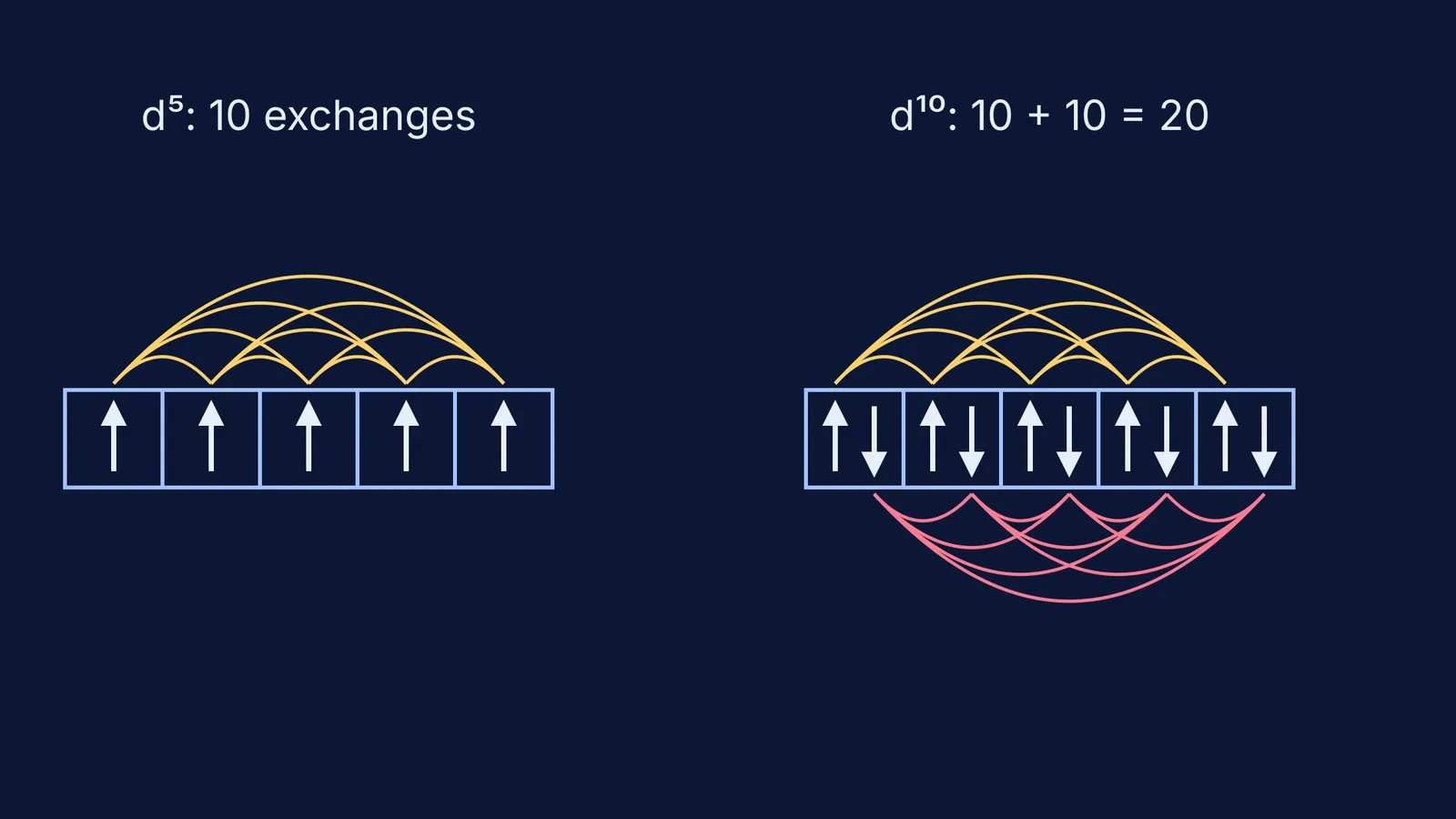
So for n parallel electrons, the number of exchanges is the number of ways to choose 2 from n: n(n−1)/2. Aakash's concept note on half-filled and filled orbitals uses the same nC2 counting and gets 10 exchanges for d⁵ and 20 for d¹⁰.
How do you count exchanges for d5 and d10?
Draw five boxes and fill them by Hund's rule (our post on counting unpaired electrons with Hund's rule covers this). Then count up spins and down spins separately and add the two.
d⁴: four up arrows, so 4 × 3 / 2 = 6 exchanges.
d⁵: five up arrows, so 5 × 4 / 2 = 10 exchanges.
d⁹: five up and four down, so 10 + 6 = 16 exchanges.
d¹⁰: five up and five down, so 10 + 10 = 20 exchanges.
Look at the jumps. Going from d⁴ to d⁵ adds 4 exchanges, and going from d⁹ to d¹⁰ also adds 4. Either way, the electron that completes the set gains four new exchange partners.
Why are half-filled and filled orbitals more stable?
Exchange. A set with more exchange pairs has more exchange energy lowering it. Five parallel electrons is the most one spin can have in a d set, so d⁵ and d¹⁰ sit at the maximum. The LibreTexts page/Electronic_Structure_of_Atoms_and_Molecules/Electronic_Configurations/Case_Study%3A_Electron_Configuration_of_Mn_vs._Cu) says the summed exchange interaction "is maximized when the electronic shells are either completely filled or half-filled."
Symmetry. In a half-filled or filled set every orbital holds the same number of electrons, so no direction is favoured. Unsöld's theorem, as summarised on Albrecht Unsöld's Wikipedia page, states that "the square of the total electron wavefunction for a filled or half-filled sub-shell is spherically symmetric." A d⁴ or d⁹ cloud, by contrast, is not spherically symmetric.
Does the real data match?
Largely, yes. The NIST atomic ionisation energy database lists chromium's ground state as [Ar]3d⁵4s¹ and copper's as [Ar]3d¹⁰4s¹, not the 3d⁴4s² and 3d⁹4s² the filling order predicts. Counting only within the d set, chromium goes from 6 to 10 exchanges and copper from 16 to 20 by borrowing one 4s electron. In this simple count, the 4s pair they break had opposite spins, so it had no exchanges to lose. Our post on chromium and copper as Aufbau exceptions walks through both configurations.
Manganese shows the same preference without breaking anything: NIST lists it as [Ar]3d⁵4s², already half-filled.
The p block gives a cleaner test. In the same NIST table, nitrogen's first ionisation energy is 14.534 eV and oxygen's is 13.618 eV, even though oxygen has one more proton. Nitrogen has to give up an electron from a half-filled 2p³ set. Oxygen's fourth p electron is paired, and removing it leaves the half-filled 2p³ ion that NIST lists as oxygen's ionised state.
Is exchange energy the whole story?
Not quite. Exchange counting is bookkeeping; the physics underneath is subtler. The Wikipedia article on Hund's rules notes that accurate calculations since the 1970s point to a different main cause for the parallel-spin preference: electrons in singly occupied orbitals are "less effectively screened or shielded from the nucleus," so those orbitals contract and are held more tightly. The older picture, that parallel-spin electrons just keep apart and repel less, is not the dominant effect.
Treat the half-filled preference as a rule of thumb for explaining known exceptions, such as gadolinium's 4f⁷ 5d¹ configuration, not a law that predicts every element.
What should you write in an exam answer?
For a "give reason" question on chromium or copper, use four lines:
State the observed configuration: Cr is [Ar]3d⁵4s¹.
Name the two reasons: greater exchange energy and a symmetrical half-filled (or filled) set.
Show the count: 3d⁴ allows 6 exchanges, 3d⁵ allows 10.
Conclude: the extra stability outweighs the energy needed to move one electron from 4s to 3d.
If your counts keep coming out wrong, the Fermi Problem Library has worked problems with a step-by-step solver that explains the reasoning rather than printing an answer. If the idea of degenerate orbitals itself feels shaky, the Fermi Concept Library gives each chemistry concept its own lesson and shows where it sits in the map.
Next time you see an exception, draw the boxes, count the arrows, and check whether the count goes up.


