

On this page
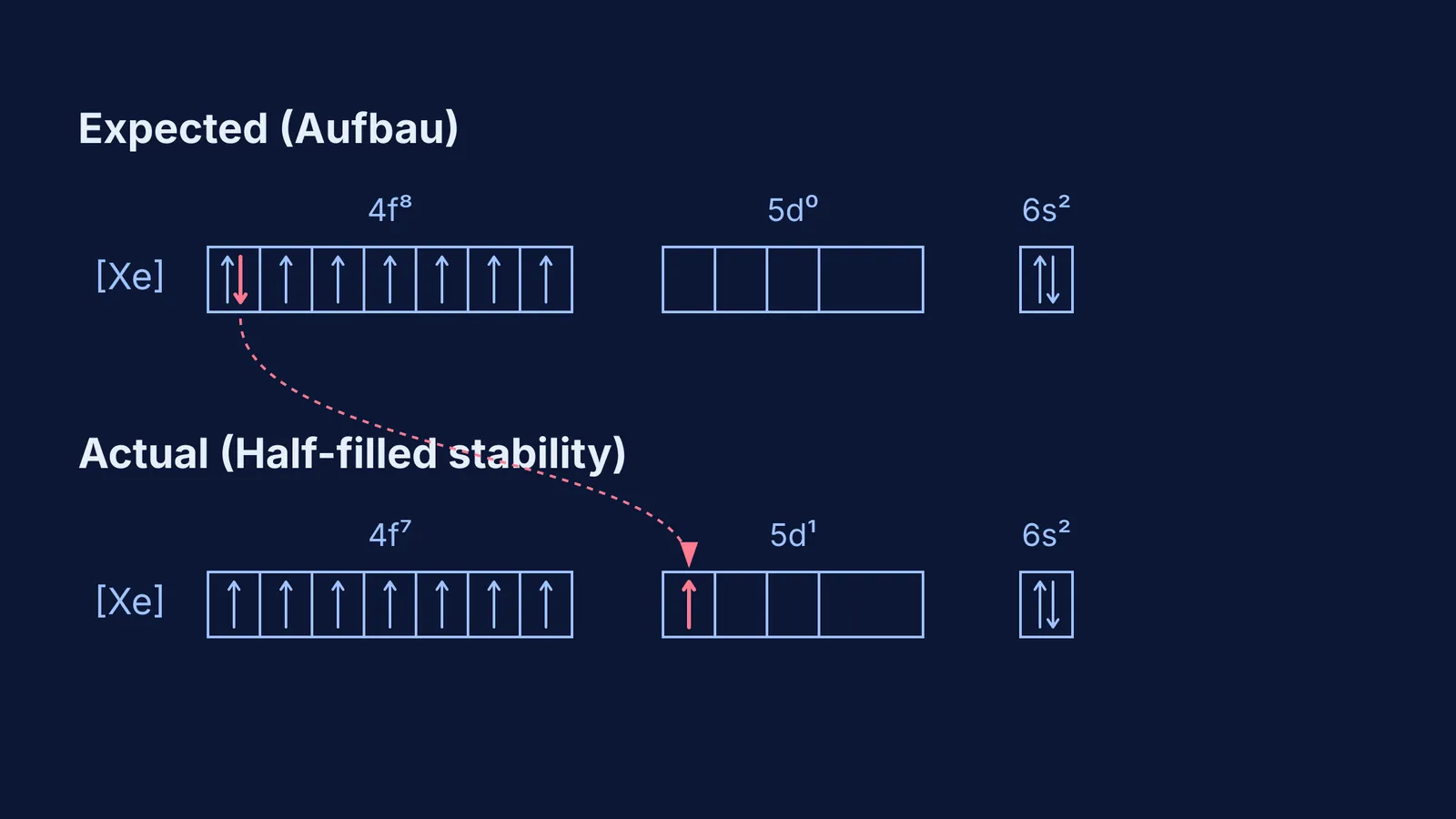
Gadolinium (atomic number 64) is a lanthanoid in the f-block of the periodic table (Wikipedia). If you follow the standard Aufbau principle, you would predict its electron configuration to be [Xe] 4f⁸ 6s².
However, the actual ground-state electron configuration of a neutral gadolinium atom is [Xe] 4f⁷ 5d¹ 6s². This is a classic exception taught in chemistry, and it appears frequently in JEE and NEET exams because it tests your understanding of orbital stability rules. If you are confused about how electrons fill these shells, review how quantum numbers and electron configuration work rule by rule.
Why is gadolinium an exception to the Aufbau principle?
The deviation happens because an exactly half-filled subshell is energetically more stable than a partially filled one.
To understand this, we need to look at how orbitals fill. The Aufbau principle states that electrons fill lower-energy orbitals first. Following the n+l rule, the 6s orbital fills before the 4f orbital, which in turn usually fills before the 5d orbital. For gadolinium, the first 54 electrons form the xenon core ([Xe]) (Wikipedia). The next two electrons fill the 6s orbital. This leaves eight electrons to place in the 4f and 5d subshells.
The 4f subshell can hold a maximum of 14 electrons (Wikipedia). A configuration of 4f⁷ means the subshell is exactly half-filled, with one unpaired electron in each of its seven orbitals. This arrangement provides extra stability due to a highly symmetrical electron distribution and maximum exchange energy.
Exchange energy is the energy released when two or more electrons with the same spin exchange their positions in the degenerate orbitals of a subshell. When a subshell is exactly half-filled, the number of possible exchanges is maximised, which releases the maximum amount of energy and brings the system to a lower, more stable energy state. Additionally, a symmetrical distribution of electrons reduces mutual shielding, which means the nucleus can pull the electrons closer and bind them more tightly.
Because the energy gap between the 4f and 5d orbitals in lanthanoids is very small, it costs less energy to put the 64th electron into the 5d orbital than to pair it up in the 4f orbital and lose that half-filled stability. As a result, the electron shifts, giving gadolinium its signature [Xe] 4f⁷ 5d¹ 6s² arrangement. When dealing with other elements in this region, you can check the patterns for d- and f-block elements to see similar behaviours.
What is the electron configuration of the Gd³⁺ ion?
When gadolinium forms its most common and chemically stable ion, Gd³⁺, it loses three electrons (Wikipedia). As with the electron configuration of ions, electrons are always removed from the outermost shell first. It loses the two 6s electrons and the single 5d electron, leaving the core configuration as [Xe] 4f⁷.
It might seem strange that the 6s electrons are removed before the 4f or 5d electrons, given that 4f fills after 6s in the Aufbau sequence. However, once the orbitals are populated, the 6s orbital is physically furthest from the nucleus and experiences the weakest effective nuclear charge. Therefore, it is the easiest to ionise. Once the 6s and 5d electrons are gone, the resulting Gd³⁺ ion retains the highly stable, half-filled 4f⁷ core.
How do gadolinium's unpaired electrons help in MRI scans?
This leaves the Gd³⁺ ion with 7 unpaired electrons in the 4f subshell (Wikipedia). Because it has so many unpaired electrons, the ion is strongly paramagnetic. In fact, it has the maximum number of unpaired electrons possible for a stable lanthanoid ion, giving it an intensely strong magnetic moment.
This intense magnetic property is the reason gadolinium compounds are widely used as contrast agents in MRI scans to make tissues show up clearly. In an MRI machine, the paramagnetic gadolinium ions interact with the magnetic moments of the protons in nearby water molecules in the human body. This interaction significantly shortens the T1 relaxation time of the water protons, which creates a brighter, clearer signal on the final MRI image. By making certain tissues or blood vessels stand out against the background, doctors can identify tumours and other anomalies much more easily.
Because free gadolinium ions are toxic, they are firmly wrapped in organic molecules called chelates before being injected into a patient. This stops the ions from binding to human tissues while still allowing them to enhance the MRI signal, before being safely cleared from the body.
If you find orbital rules and exceptions hard to remember, the Fermi Concept Library maps out every atomic structure concept, each with its own lesson and its place in the map.


