On this page
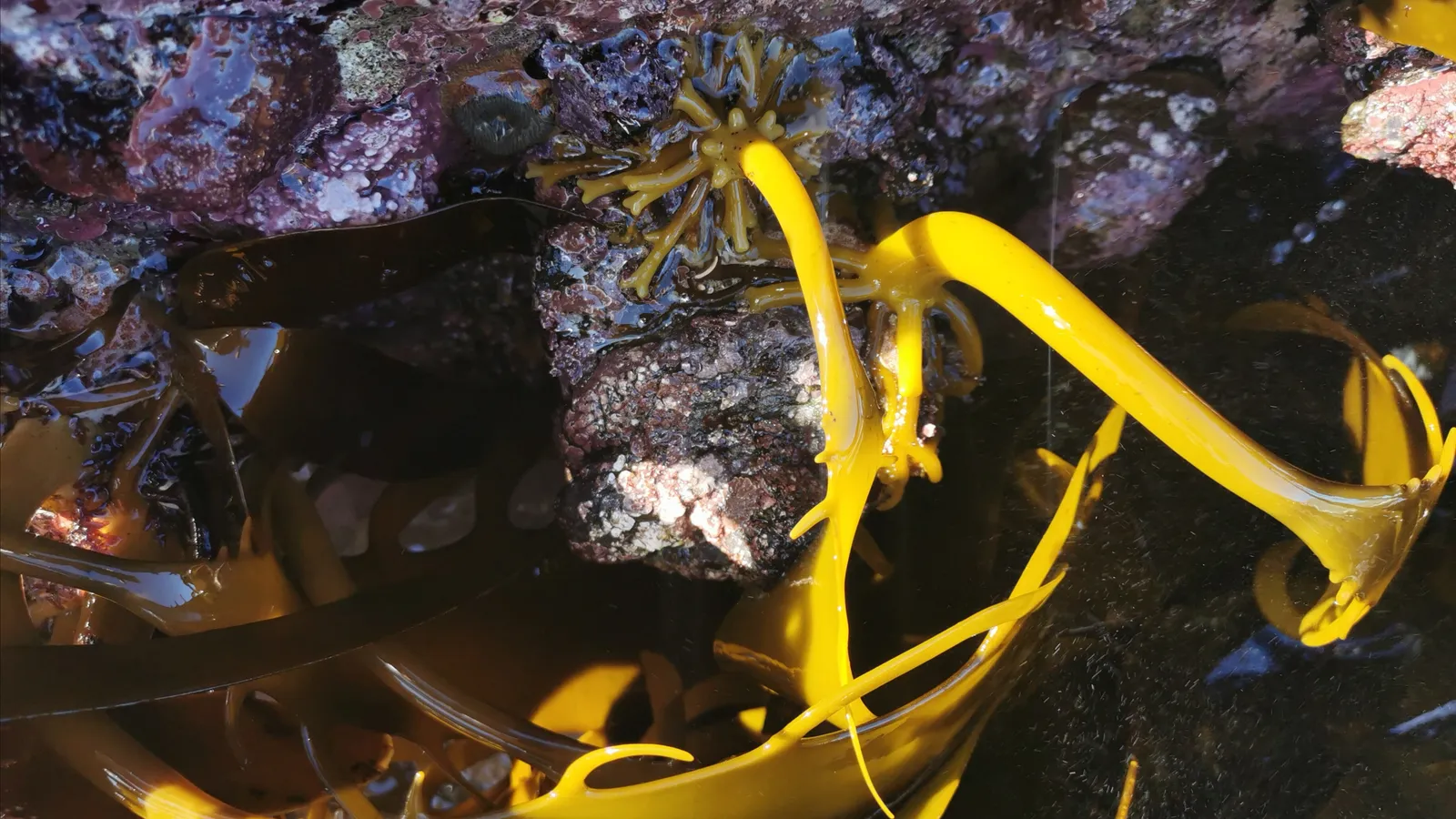
At the base of a kelp, something grips the rock. It looks like a root, the stalk above looks like a stem and the flat parts look like leaves. Yet none of them is a true root, stem or leaf. Here is what each part does and how to write the difference in an exam.
What are the holdfast, stipe and blade of a seaweed?
NCERT's Class 11 Plant Kingdom chapter describes brown algae (Phaeophyceae) in one line: the plant body is usually attached to the substratum by a holdfast, and has a stalk, the stipe, and a leaf-like photosynthetic organ, the frond. The same chapter says kelps can reach a height of 100 metres, and lists Ectocarpus, Dictyota, Laminaria, Sargassum and Fucus as common brown algae.
The University of Hawaii's Exploring Our Fluid Earth guide to algal structure defines the parts in plain terms:
Thallus: the main body of the alga.
Holdfast: the part of the thallus that anchors it to the bottom, such as rock, sand, coral rubble, other plants or animals.
Stipe: a stem-like structure that, unlike a land plant's stem, has no true vascular tissue.
Blade: a large, flattened branch of the thallus. NCERT calls it the frond.
Pneumatocyst: an air bladder that holds the alga upright in the water. NCERT's figure of Fucus labels these as air bladders.
Kelp are large brown algae that live in cool, relatively shallow water close to the shore, and in ideal conditions kelp can grow up to 18 inches (about 46 cm) a day, according to NOAA's kelp forest facts.
How does a holdfast grip a rock?
A kelp holdfast attaches through strands called haptera. A 2017 study in the Journal of Phycology on giant kelp (Macrocystis pyrifera) found swellings growing out of the stipes, especially on ageing or creeping plants. When the researchers fastened these swellings to solid surfaces by hand, they lengthened into haptera that were strongly attached after one month, and within four months the new thalli had grown and formed reproductive fronds. The authors suggest these extra holdfasts could act as a backup when the main holdfast is weak.
Why are seaweeds not true roots, stems and leaves?
The Hawaii guide puts the root comparison in a single sentence: holdfasts and roots both anchor the organism, but unlike holdfasts, plant roots are specialised to store food and absorb nutrients for transport throughout the plant (source). The same guide says algae lack vascular tissue, so the stipe is only stem-like.
If the holdfast does not feed the kelp, what does? A LibreTexts oceanography chapter on kelp forests/12%3A_Marine_Environments/12.5_Kelp_Forest_Ecosystems) states that holdfasts do not transport water or nutrients through the stipe, and that the blades serve as the photosynthetic and nutrient uptake centre. So the blades, not the holdfast, take in what the kelp needs.
There is one twist worth knowing. A 2016 study of bull kelp in Plant, Cell and Environment reports that kelps have sieve tubes for long-distance transport of sugars, and that these tubes are evolutionarily unrelated to, though structurally similar to, the phloem of vascular plants. So kelp can move food along its body, but with tubes that evolved separately from the phloem of land plants.
How do you write this in a NEET-UG or board answer?
Whether it comes as a labelling question, an assertion-reason pair or a short answer, use this three-step frame.
Name the parts with NCERT's words: holdfast, stipe, frond (blade), and air bladders where shown.
Give each part its job: anchoring, support, photosynthesis, buoyancy.
Add the reason they are not true organs: no true vascular tissue, and the holdfast anchors without absorbing nutrients for transport.
A worked example for a 3-mark question, "Kelp has root-like, stem-like and leaf-like parts. Why are these not true roots, stems and leaves?":
Kelp is a brown alga with a thalloid body: a holdfast, a stipe and fronds (1 mark).
The holdfast only anchors the alga to rock; unlike a root, it does not absorb water and minerals for transport through the body (1 mark).
The stipe and fronds have no true vascular tissue (xylem and phloem), so they are not a true stem and leaves (1 mark).
Common slips to avoid: calling the holdfast a root, writing that kelp is a flowering plant, or mixing up brown algae with red algae. Our post comparing green, brown and red algae lays out pigments, stored food and cell walls side by side, and the NEET-UG guide to the plant kingdom places algae next to bryophytes and ferns. To see what a true root does that a holdfast cannot, read how root hairs absorb water and minerals.
If the words thallus, vascular tissue or phloem still feel shaky, the Fermi Concept Library gives every concept in biology its own lesson and its place in the map, so you can fill the gap before you revise algae. When you want practice, the Fermi Problem Library has worked problems with a step-by-step solver that explains the reasoning rather than printing an answer.