On this page
A root hair looks like fuzz near a root tip, but its shape answers a simple question: how do you get the most absorbing surface from the least amount of cell?
What is a root hair?
A root hair is a unicellular elongation of a root epidermal cell that helps absorb water and minerals from the soil, as the NCERT Class 11 Biology chapter on plant anatomy puts it. Root hairs start in the zone of maturation, just behind the growing tip, according to OpenStax Biology 2e.
In the model plant Arabidopsis, a root hair is about 10 µm wide and can grow longer than 1 mm, at more than 1 µm per minute (Grierson and Schiefelbein, The Arabidopsis Book, 2002).
The University of Vigo Atlas of Plant and Animal Histology gives about 25,000 root hairs per cm² of root in winter rye, against 20 to 500 per cm² in tree roots. In a classic 1937 count, Howard Dittmer estimated that a single rye plant carried more than 14 billion root hairs, as Botany One summarises from his paper in the American Journal of Botany.
Why are root hairs long and thin?
Because absorption happens across a surface, and a long, narrow tube gives a lot of it for very little cell.
Root hairs make up about 61% of the whole root surface area in Arabidopsis seedlings 3 to 5 days old, and about 48% in plants 10 to 14 days old (Choi and Cho, Scientific Reports, 2019).
Length also buys reach: root hairs vastly increase the root surface area and effectively increase the root diameter, note Grierson and Schiefelbein.
How much surface does one root hair add?
Take the Arabidopsis figures from Grierson and Schiefelbein and treat the hair as a cylinder 10 µm wide and 1,000 µm long.
Side surface of the hair = π × d × L = π × 10 × 1,000 ≈ 31,400 µm².
Patch of root surface the hair grows from = π × 5² ≈ 79 µm².
So one hair turns that patch into about 31,400 ÷ 79 ≈ 400 times as much surface. In general the ratio is 4L/d.
Volume = 79 × 1,000 ≈ 78,500 µm³. A cube of that volume (side about 42.8 µm) has about 11,000 µm² of surface, so the tube has about 2.9 times as much.
Doubling the length doubles the surface; doubling the width also doubles the surface but quadruples the volume the cell must fill. Long and thin wins. If surface-to-volume ratios feel abstract, our post on why cells are so small lets you grow a model cell, and the Fermi Simulation Lab has interactive simulations for ideas that are easier to see than to read.
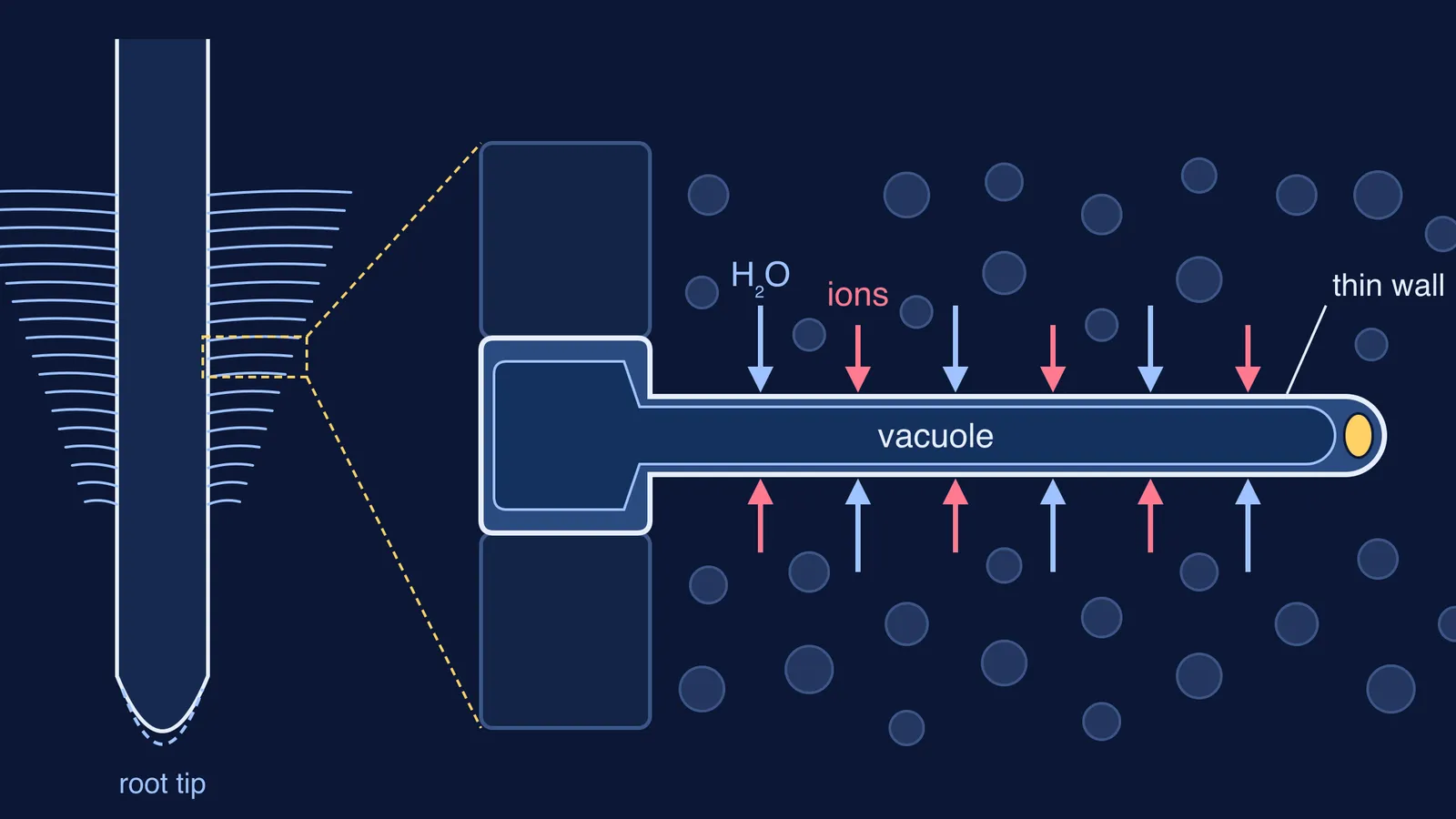
Why does a root hair have a thin wall and a large vacuole?
No waxy cuticle. The cuticle is absent in roots, notes the NCERT anatomy chapter. Near the tip it is very thin or missing, "facilitating in this way an incoming flux of water", says the Vigo atlas.
A large vacuole. Epidermal cells have a small amount of cytoplasm lining the wall and a large vacuole (NCERT); in a grown root hair, "most of the hair is vacuolated" (Grierson and Schiefelbein).
Why does the vacuole help? Its sap holds dissolved substances, and solute potential is negative in a plant cell. Water moves from higher to lower water potential, so it moves from the soil into root cells by osmosis (OpenStax Biology 2e).
How do root hairs absorb minerals?
Actively. "At the roots, cells in contact with the soil actively take up ions", says the NCERT Class 10 Science chapter Life Processes. That creates a difference in ion concentration between root and soil, and water moves into the root to even it out.
Next, follow the path of water from root hair to xylem and see how the Casparian strip in the endodermis controls what gets through.
How do you write this in an exam?
Match each feature to its job:
Long, narrow tube: large surface area for little volume, and more soil within reach.
Thin wall, no cuticle: a short, easy path for water.
Large vacuole of cell sap: lower water potential, so water enters by osmosis.
Active uptake of ions: keeps the concentration difference that draws water in.
A model three-mark answer: "Root hairs are unicellular outgrowths of epidermal cells. Being long and thin, they greatly increase the surface area in contact with soil water. Their thin wall lacks a cuticle and their large vacuole has a low water potential, so water enters by osmosis, while mineral ions are taken up actively."
Check yourself: take the 10 µm width from Grierson and Schiefelbein and let the hair grow to 2 mm. Using 4L/d, it multiplies the surface of its patch 800 times.
If the water potential step is where you lose marks, the Fermi Concept Library gives every biology concept its own lesson and its place in the map, so you can see what osmosis builds on.