

On this page
The journey of water from a damp patch of soil to the highest leaf is a marvel of plant biology. For students of plant physiology, tracing this exact sequence—from root hair to xylem—is a fundamental and highly tested concept. Memorising the order becomes much easier when you understand the biological engineering and the physical forces behind it.
What is the tissue sequence from soil to xylem?
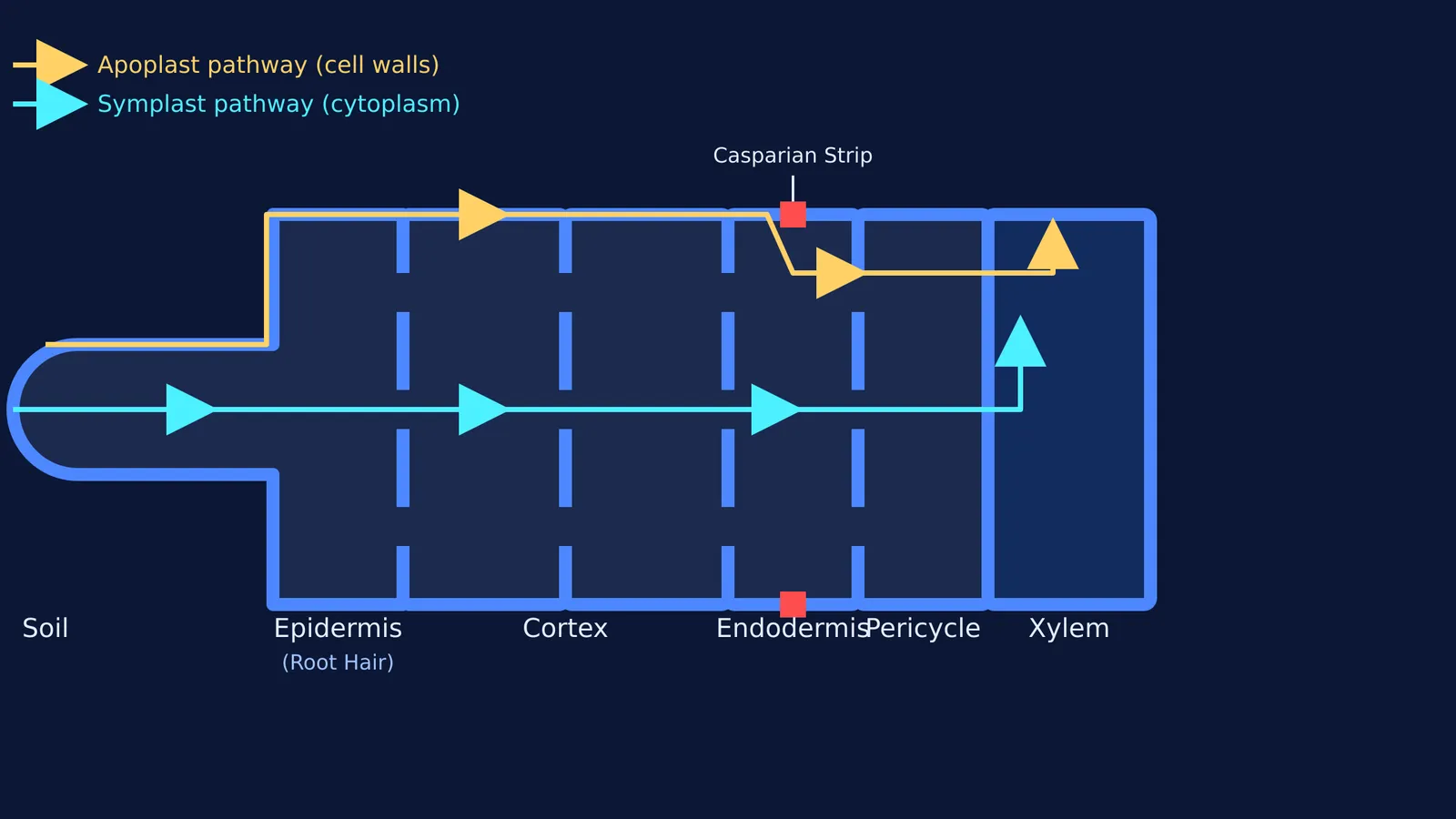
When water enters a root, it moves through several distinct concentric layers before it can be sent up the stem.
Root Hair (Epidermis): The entry point. Root hairs are thin, unicellular extensions of the root's outer layer (the epiblema). They create a massive surface area to draw in water from the surrounding soil by osmosis.
Cortex: The wide transit zone. This is a thick layer of loosely packed parenchyma cells that forms the bulk of the root. Water travels horizontally across the cortex towards the centre.
Endodermis: The border control. This single inner layer of cells acts as a checkpoint. It forces water to cross a selective membrane, allowing the plant to filter out unwanted or toxic minerals.
Pericycle: The final layer. Lying just inside the endodermis, the pericycle is the outermost ring of the root's central vascular cylinder.
Xylem: The water elevator. Water finally reaches the protoxylem and then the larger metaxylem vessels, where it is drawn upwards to the rest of the plant.
If you are studying plant development, you might also be looking at apical, intercalary and lateral meristems to understand how roots grow continuously to reach new water sources in the soil.
How do the apoplast and symplast pathways differ?
According to a foundational 1998 review by plant physiologists E. Steudle and C. A. Peterson (Journal of Experimental Botany), water does not just take one uniform path through the root. It uses a "composite transport model" involving two main parallel routes:
The apoplast pathway: Water flows through the non-living parts of the root, meaning the porous cell walls and the intercellular spaces between cells. This path is fast because it meets very little resistance and does not require water to cross any plasma membranes. However, it offers almost no selective filtration.
The symplast pathway: Water moves from cell to cell directly through the living cytoplasm, crossing between adjacent cells via tiny connecting bridges called plasmodesmata. Because water must enter the cell through the plasma membrane, this path is slower but highly regulated.
A third, less dominant route called the transcellular pathway involves water crossing multiple vacuoles and membranes, often facilitated by water channels known as aquaporins.
Why does the plant switch between pathways?
The composite transport model is vital because it explains how roots adapt to different conditions. Plants essentially "switch" between the apoplast and symplast pathways depending on the time of day and the driving force pulling the water.
During the daytime, when the plant is actively transpiring, strong tension is created in the xylem. You can compare this flow to how leaves pull water up the tallest trees—this intense hydrostatic pressure pulls water rapidly through the low-resistance apoplast pathway to keep up with the water lost to evaporation.
At night, when transpiration largely stops, this tension disappears. Instead, the plant actively pumps ions into the xylem, drawing water in via root pressure (osmosis). Under these conditions, the apoplast pathway is less effective, and water relies more heavily on the highly regulated cell-to-cell symplast pathway.
Why does the Casparian strip matter?
If water could just wash right through the cell walls (the apoplast) straight into the xylem, the plant would have no way to stop toxic heavy metals, soil pathogens or excess salts from entering its sap.
Nature solves this problem at the endodermis. The cell walls of this layer are banded with the Casparian strip—a waterproof ribbon made of a waxy substance called suberin. This strip completely blocks the apoplast pathway. When water travelling through the cell walls hits the Casparian strip, it can go no further.
To proceed, the water and dissolved minerals are forced to cross a cell membrane to enter the symplast pathway inside the endodermal cells. By forcing water through the living cytoplasm, the plant regains control over what enters its central vascular cylinder and, ultimately, the xylem.
When you have trouble picturing how microscopic structures like the Casparian strip interact with cell walls, the Fermi Concept Library breaks down plant anatomy into clear, logical steps. If you are preparing for a biology exam, Fermi's AI tutor can also work out what you already know and build a plan for the session to thoroughly check your understanding of the tissue order and pathways.


