

On this page
On water, a seaplane's floats or hull feel water forces along their entire length, not at a few wheels. To get airborne it must beat a peak of water drag called the hump. Here is how, using the US Federal Aviation Administration's Seaplane, Skiplane, and Float/Ski Equipped Helicopter Operations Handbook.
What keeps a seaplane afloat?
A flying boat floats on its own boat-shaped hull, while a floatplane is a landplane fitted with separate floats instead of wheels, according to chapter 2 of the FAA handbook. At rest, the floats sink until the water they push aside weighs as much as the plane.
Floats are rated by the fresh water they displace, because sea water is about 3 percent denser and holds up more weight (FAA handbook, chapter 2). Seaplanes must carry 80 percent more buoyancy than they need at maximum weight in fresh water. Every float has at least four watertight compartments and must hold the plane up with any two of them flooded.
For example, say each of two floats displaces 1,000 kg of fresh water when pushed fully under: 2,000 kg in total. A 2,000 kg plane would sit with both floats completely submerged. The 80 percent rule means you divide by 1.8, so 2,000 ÷ 1.8 ≈ 1,111 kg is the heaviest plane these floats may carry. The FAA's own example, two floats of 2,500 pounds each, gives 2,778 pounds (chapter 2). The same idea of displaced weight explains how container ships float and stay stable.
What are the four phases of a seaplane takeoff?
The FAA divides a seaplane takeoff into four phases (chapter 4):
Displacement. At idle taxi, buoyancy carries nearly all the weight. The float area below the waterline, the wetted area, is a major source of drag.
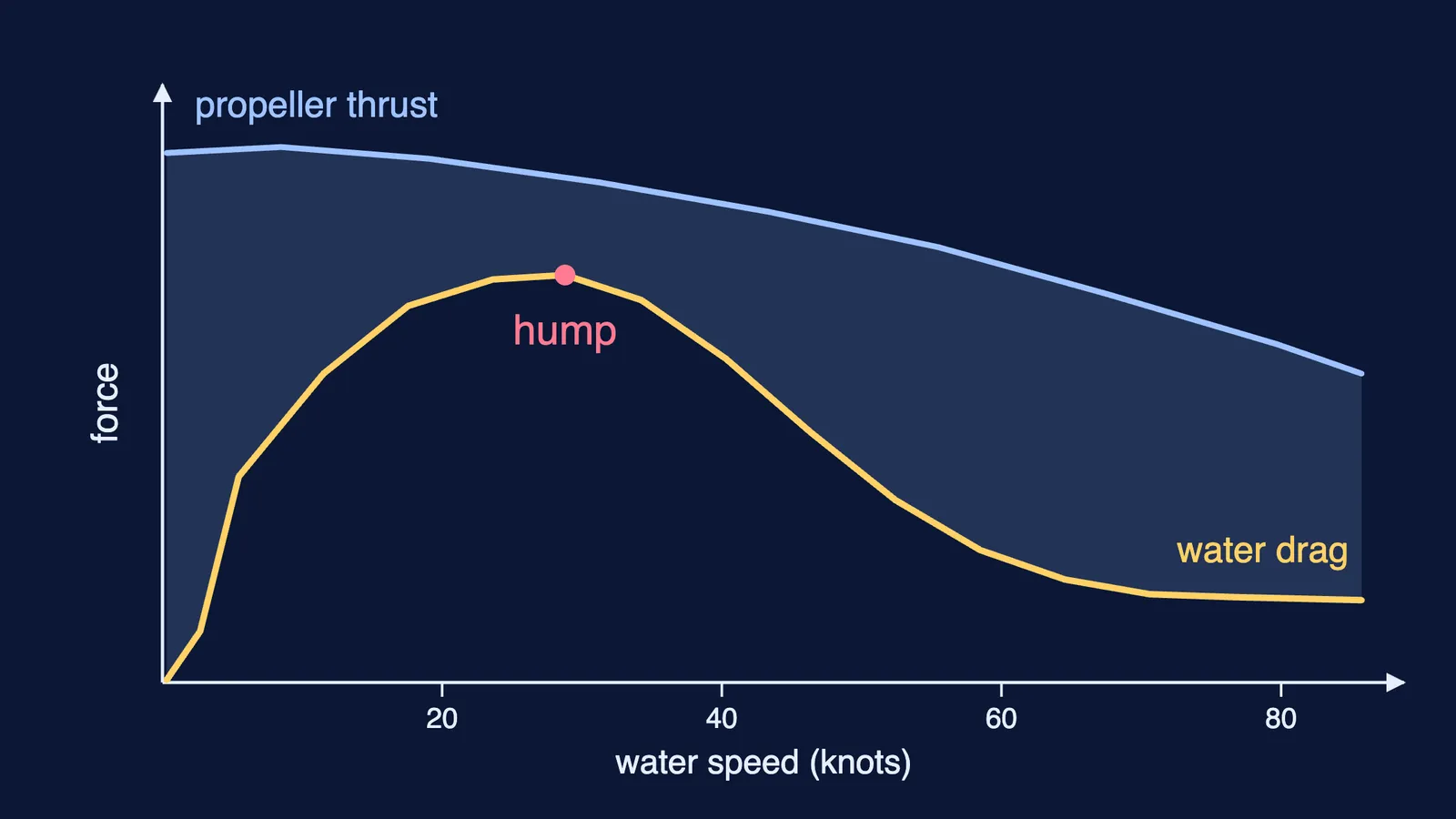
Plowing, or the hump. With full power and the elevator held back, the nose rises and the rear of the floats digs deeper. Wetted area grows, the plane accelerates slowly, and resistance peaks just before the floats reach a planing attitude.
On the step. The float bottoms push water down, and by Newton's third law the water pushes them up: hydrodynamic lift. Past the hump it can carry the whole weight, the pilot eases the back pressure, and the floats rock up onto the step.
Lift-off. As speed builds, the wings carry more and more of the weight. When they carry all of it, the seaplane is airborne.
Why does a seaplane float need a step?
The step is a sudden break in the lengthwise lines of each float's underside that reduces water drag during takeoff and high-speed taxi (FAA handbook, chapter 2). Without it, water flowing aft would tend to stay attached all the way to the rear of the float. The step sits slightly behind the centre of gravity, roughly where a tricycle-gear landplane has its main wheels, so the pilot can still rotate the nose up.
Water drag varies with the square of speed, so doubling the speed across the water gives four times the drag (chapter 3). Without a step, drag would eventually balance the engine's output and the plane would run along the surface without accelerating further; the step makes further acceleration possible without extra power (chapter 4). For the basics of drag, see why fish, birds and planes are streamlined.
What makes a seaplane takeoff longer?
The FAA names several things that lengthen a takeoff (chapter 4):
Heavy loading, which sinks the floats deeper and wets more surface area.
Glassy water, where smoothness increases drag and can feel like suction on the floats.
High, hot and humid conditions, where the engine loses power and the plane needs a higher water speed.
Current: with calm wind, a plane that lifts off at 50 knots in a 3-knot current needs 47 knots of water speed going downstream but 53 knots going upstream.
How do you explain a seaplane takeoff in an exam answer?
Use this frame:
List the forces: weight, buoyancy, hydrodynamic lift, wing lift, water drag and thrust.
For each phase, say what carries the weight: buoyancy, then buoyancy plus hydrodynamic lift, then mostly hydrodynamic lift with a growing share from the wings, then the wings alone.
Explain the hump: wetted area grows while the nose is high, then shrinks as the floats rise onto the step.
Sketch thrust above a drag curve that rises, peaks and falls. The gap between them is the force left to accelerate the plane (ignoring air drag).
Test yourself: why is a takeoff from a mirror-calm lake longer than one into a light breeze? Compare the wing's airspeed with its water speed.
For the wings, read how Zhukovsky explained lift on a wing. To watch forces change as speed changes, the Fermi Simulation Lab has interactive simulations for ideas that are easier to see than read. And if buoyancy or Newton's third law is the shaky part, Fermi's AI tutor can work out what you already know and build a plan for the session.


