

On this page
Satellite internet is a radio link that runs through space. Your dish sends a request up to a satellite, the satellite relays it down to a ground station (a gateway) wired into the internet, and the reply comes back the same way. Distance decides the wait, and one number from school physics, the speed of light, lets you work it out.
How does satellite internet work?
Every request and its reply make four legs:
Your dish up to the satellite.
The satellite down to the gateway.
The gateway back up to the satellite with the reply.
The satellite down to your dish.
Radio waves are electromagnetic waves, so between the ground and the satellite they travel at (almost exactly) the speed of light. The speed of light in vacuum is exactly 299,792,458 metres per second, according to NIST's CODATA values. That is about 300,000 km every second: fast, but not instant.
How high are internet satellites?
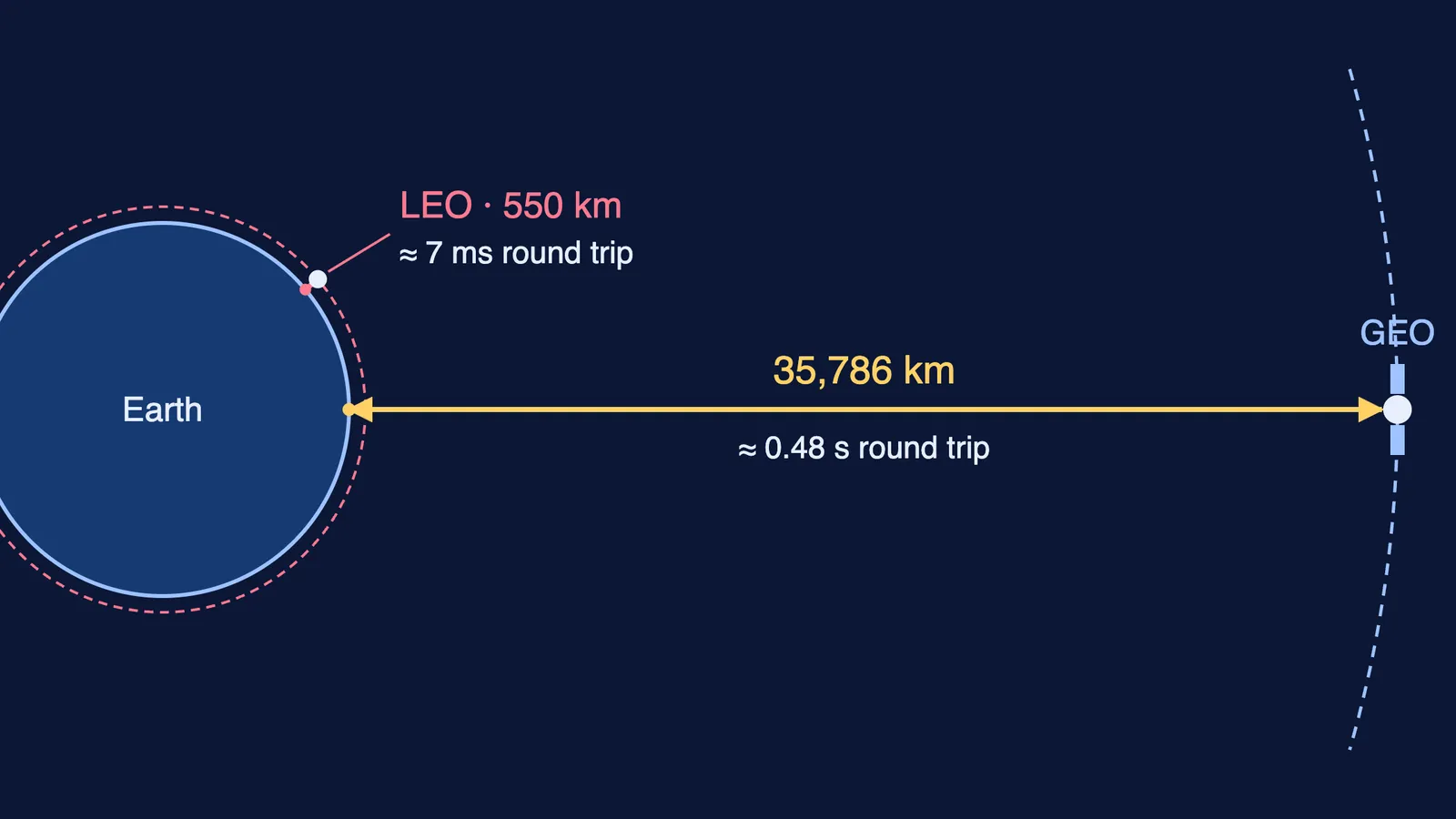
A geostationary satellite orbits 35,786 km above the equator and takes 23 hours 56 minutes and 4 seconds to go round once, so it stays over one spot, which is why telecommunication satellites use it, according to ESA. Our post on why a geostationary orbit sits at that height works out the height from gravity, and Arthur C. Clarke's geostationary satellite idea shows where it started.
Low Earth orbit is roughly 160 to 2,000 km above Earth, according to NASA Earthdata. Most of SpaceX's Starlink satellites fly about 550 km up: the eoPortal mission directory puts the majority at 559 km and says many were moved down to around 550 km. A satellite that low moves across your sky quickly, so the system needs many of them and hands your connection from one to the next. (Here is why newly launched Starlink satellites look like a train.)
How long does the signal take? A worked example
Use time = distance ÷ speed, with c = 299,792 km/s from NIST. Take the best case: the satellite is directly overhead and the gateway is right next to you, so each leg equals the orbit height.
Geostationary, 35,786 km up (ESA):
One leg: 35,786 ÷ 299,792 = 0.119 s, about 119 milliseconds.
Four legs: 143,144 ÷ 299,792 = 0.477 s, nearly half a second.
Low Earth orbit, about 550 km up (eoPortal):
One leg: 550 ÷ 299,792 = 0.0018 s, about 1.8 milliseconds.
Four legs: 2,200 ÷ 299,792 = 0.0073 s, about 7.3 milliseconds.
The geostationary satellite is about 65 times farther away (35,786 ÷ 550), so the signal takes about 65 times longer to get there and back.
Try one yourself: a satellite 1,200 km up. Four legs make 4,800 km, and 4,800 ÷ 299,792 = 0.016 s, or 16 milliseconds. Keep units matched: kilometres with km/s, never metres with km/s.
Why is real satellite internet slower than the physics?
Those numbers are the floor. Real satellites are rarely straight overhead, so the slanted path is longer. Your data still crosses the ground internet to reach the website, and every router adds a little time.
Researchers from UCLouvain, the University of Trieste and the Politecnico di Torino measured Starlink in a paper at the 2022 ACM Internet Measurement Conference (DOI 10.1145/3517745.3561416). The notes with their open dataset say Starlink's minimum latency is in the order of 20 ms for close destinations and can rise to a few hundred milliseconds under traffic load.
Ookla, the speed-test company, found a median latency of 45 ms for Starlink in the first quarter of 2025, against 683 ms for HughesNet and 684 ms for Viasat, two geostationary services, as reported by Light Reading. No engineering can take a geostationary link below its 477 ms floor. For a low orbit the floor is so small that the ground network becomes most of the wait.
What does satellite delay mean for online classes?
Delay (latency) is not the same as speed (bandwidth). Bandwidth is how much data arrives each second; latency is how long the first bit takes. A recorded lecture streams well over a geostationary link because the video player buffers ahead. Anything with back-and-forth feels the lag:
Live classes and video calls: a half-second lag makes people talk over each other.
Timed online tests: submit a minute early, not in the last seconds.
Before choosing a connection for online study, ask the provider three things: which orbit its satellites use, its typical latency in milliseconds, and where the nearest gateway is. Then run a speed test, read the ping (latency) figure as well as the Mbps, and compare it with the floor you worked out above.
The Fermi Simulation Lab has interactive simulations for ideas easier to see than read, and Fermi's AI tutor can draw the figure and check your understanding as you work through a problem like the 1,200 km one above.
Next time a call lags on a satellite link, you will know where the milliseconds went.


