On this page
If you have looked up at the night sky and seen a straight, evenly spaced line of bright dots moving silently across the stars, you might have wondered what you were seeing. The answer is not extraterrestrial. It is a batch of Starlink satellites, launched by SpaceX to provide global internet coverage.
Why are Starlink satellites in a line?
Unlike most traditional satellites, which are launched one at a time into specific positions, Starlink satellites are deployed in large batches on a single rocket. When the Falcon 9 rocket reaches its destination and releases them into space, they all enter the exact same orbital path, travelling at the same speed.
Because they are released simultaneously, they start their journey as a tight cluster or "train." Over the days immediately following a launch, they use their onboard thrusters to slowly climb to their operational orbit, which is about 550 kilometres above Earth (Space.com).
As they ascend to this higher altitude, they gradually space themselves out to build a continuous web of coverage. The line of lights is a temporary phase; once they reach their final orbit, they disperse and blend into the starry background.
If you are curious about how objects stay in space once they get there, reading about the physics of satellite motion or exploring understanding planetary orbits with a gravity simulation can make the mechanics much clearer.
How do they stay in orbit?
Satellites in low Earth orbit travel at immense speeds to avoid falling back to Earth. At an altitude of a few hundred kilometres, gravity is still strong. The satellites are constantly falling toward the ground, but because they are moving forward so fast—around 28,000 kilometres per hour (Wikipedia)—the Earth curves away beneath them at the same rate they fall.
This delicate balance between forward momentum and gravity is what keeps any satellite in orbit. When the satellites first launch into a lower parking orbit, they experience slightly more atmospheric drag. The sparse air molecules remaining at that altitude bump into the satellites, slowly robbing them of speed. This is why they must actively use their thrusters to push themselves higher, where the air is thinner and their orbits can remain stable for years.
Why do they shine so brightly?
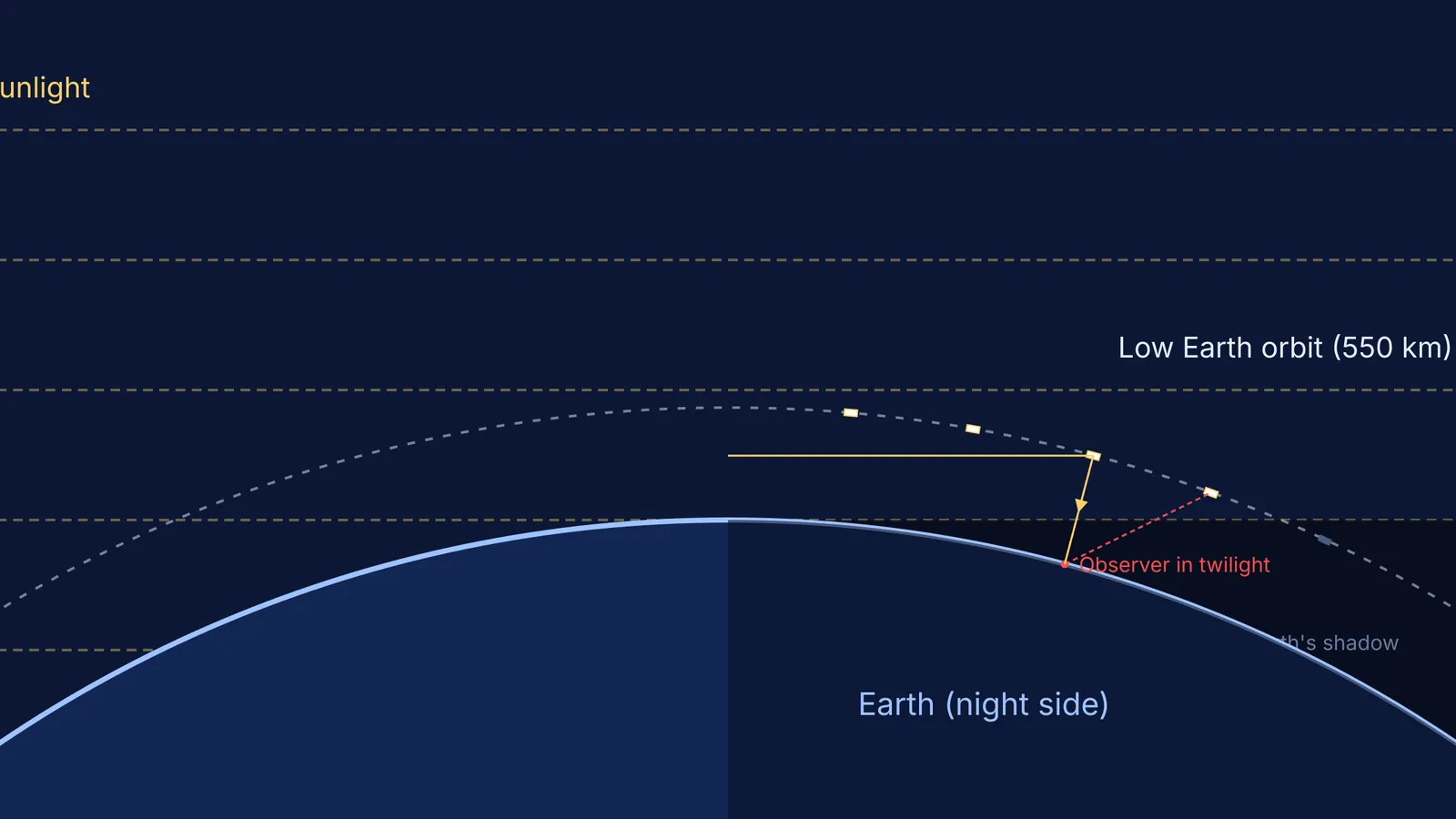
Starlink satellites do not have their own lights. The bright glow you see is simply reflected sunlight.
This visibility happens because of a geometric quirk during twilight—the hour or two just after sunset or just before sunrise. At these times, an observer on the ground is in the Earth's shadow, experiencing darkness. However, because the satellites are hundreds of kilometres up in the sky, they are high enough to peek over the curve of the Earth and remain bathed in direct sunlight.
The flat solar panels and metal surfaces of the satellites act like mirrors, bouncing this light down to you in the dark. It is the same physical principle that explains why a tall mountain peak might still be lit by the sun when the valley below is already dark.
If you want to visualise how angles and light work in physics, the Fermi Simulation Lab provides interactive simulations for the ideas that are easier to see than to read. You can also explore related space physics, such as why a pendulum clock stops in an orbiting satellite.
How do you spot the satellite train?
Because the "train" effect is short-lived, you only have a window of a few days after a launch to see it clearly. Here is a practical checklist for spotting the Starlink train:
Check the launch schedule: Look up recent SpaceX Falcon 9 launches. The train is most visible in the days immediately following a new deployment.
Use a tracker: Websites such as FindStarlink calculate exactly when a batch will pass over your city and provide precise timings.
Time it for twilight: Look up in the hour after sunset or the hour before sunrise. The satellites need to catch the sun's rays while you remain in the dark.
Find a dark spot: Move away from bright city streetlights to let your eyes adjust to the night sky, making the moving dots much easier to spot.