On this page
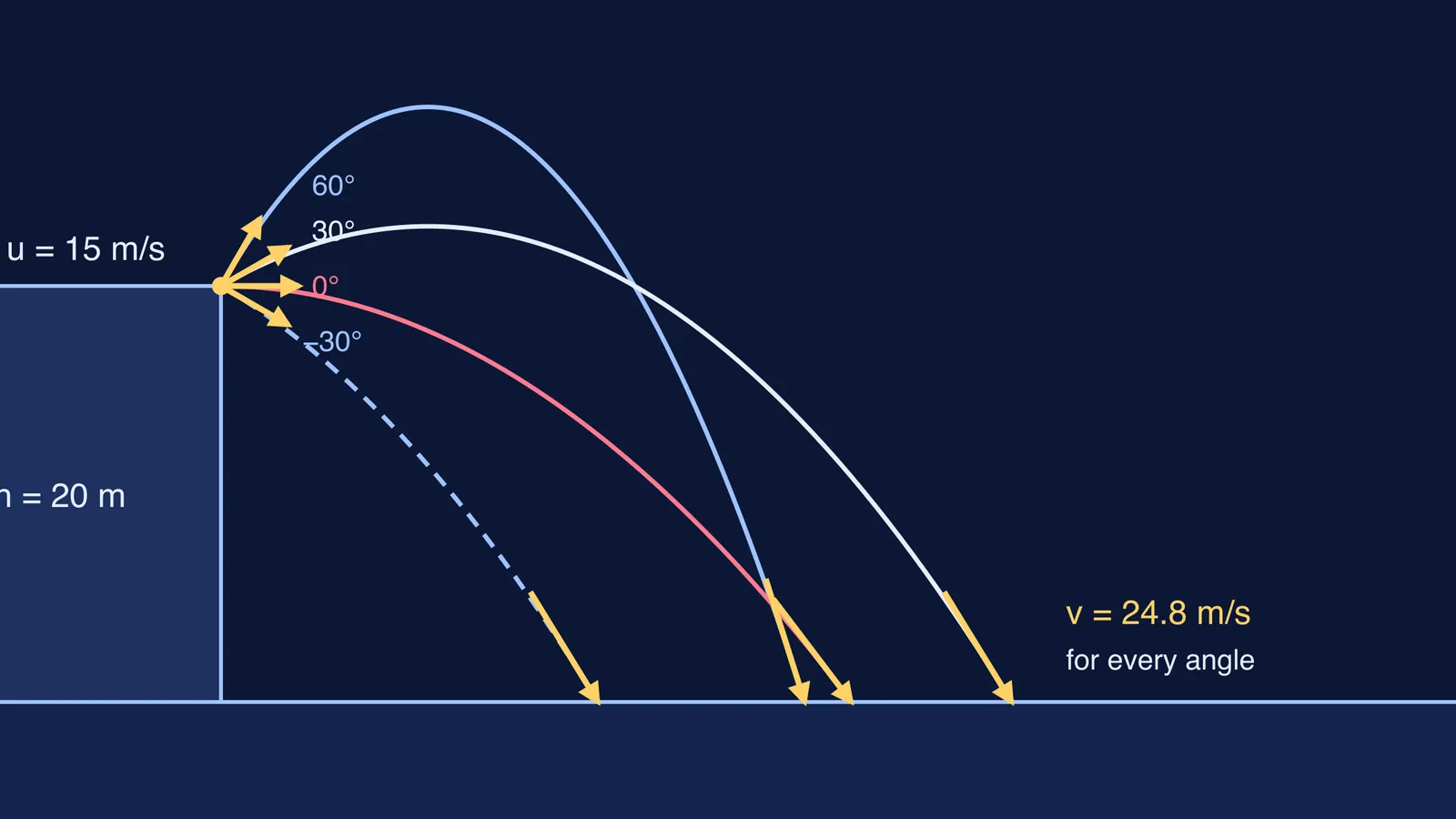
Stand on a cliff and throw four balls at the same speed: one steeply upward, one at a gentle upward angle, one flat, one aimed down at the ground. Which one hits the ground fastest? Many students pick the downward throw. All four land at the same speed, and you can prove it in two lines. It looks like a components problem; it is really an energy problem.
Do balls thrown at different angles land with the same speed?
Yes, if three things hold: the same launch speed, the same drop in height, and negligible air resistance. The rule comes from conservation of mechanical energy, which OpenStax University Physics states as: "The mechanical energy of a particle does not change if all the non-conservative forces that may act on it do no work."
For a ball of mass m thrown at speed u from height h above the ground:
Start: kinetic energy ½mu², potential energy mgh
Landing: kinetic energy ½mv², potential energy 0
So ½mu² + mgh = ½mv², and the mass cancels: v = √(u² + 2gh)
There is no angle anywhere in that equation. A PhysicsLab worksheet makes the same point with balls launched off a cliff at one speed in different directions, concluding that they "will all strike the ground traveling at the same resultant impact velocity". Read "velocity" there as speed: the size is the same, the direction is not.
Why doesn't the launch angle change the landing speed?
You can see it in components too. In projectile motion the horizontal acceleration is zero and the vertical acceleration is g downward, as OpenStax projectile motion sets out. So:
Horizontal velocity stays u cos θ the whole flight.
Vertical velocity at landing satisfies vy² = (u sin θ)² + 2gh.
Add the squares: v² = u² cos² θ + u² sin² θ + 2gh = u² + 2gh.
The angle only decides how the starting speed is split between horizontal and vertical. Gravity then adds the same 2gh to v² for every ball, because every ball falls through the same net height.
Worked example: four balls off a 20 m cliff
Take u = 15 m/s, h = 20 m and g = 9.8 m/s². Energy gives the landing speed at once: v = √(15² + 2 × 9.8 × 20) = √617 ≈ 24.8 m/s for every ball. Now the parts that do depend on angle, worked from the OpenStax component equations above:
Thrown 60° above horizontal: in the air 3.74 s, lands 28.1 m out, moving 72.4° below horizontal.
Thrown 30° above horizontal: in the air 2.93 s, lands 38.0 m out, moving 58.5° below horizontal.
Thrown horizontally: in the air 2.02 s, lands 30.3 m out, moving 52.8° below horizontal.
Thrown 30° below horizontal: in the air 1.40 s, lands 18.1 m out, moving 58.5° below horizontal.
Notice balls 2 and 4 land at the same angle. The upward ball comes back past the cliff edge at 15 m/s, pointing 30° below horizontal, which is exactly how ball 4 started. From there its flight is a copy of ball 4's, just about 1.53 s later.
What does change with the angle?
Almost everything except the speed: the direction at landing, the time of flight, the maximum height and the horizontal distance. Range has its own neat pattern, covered in why 30° and 60° projectiles have the same range. Speed at the top of the path is a related energy question, worked through in kinetic energy of a projectile at its highest point. And if you want the timing side of the story, dropped or thrown horizontally: which ball lands first? shows why time depends only on the vertical motion.
When does the same-speed rule break?
Air resistance matters. OpenStax's projectile treatment neglects drag and notes that in practice it is not completely negligible. A ball that spends 3.7 s in the air usually loses more energy to drag than one that spends 1.4 s, so in real life the steep throw tends to land a little slower.
Different landing heights. The rule needs the same h. A ball that lands on a ledge has a smaller drop and a smaller landing speed.
The question asks for velocity. Velocity is a vector. Same speed, different directions means different velocities, and some MCQs test exactly that.
A 30-second checklist for exam questions
Same launch speed and same height drop, no drag mentioned? Use v = √(u² + 2gh) and skip the components.
Asked for velocity, angle of impact or time? Now you need components: horizontal u cos θ, vertical from vy² = (u sin θ)² + 2gh.
Asked which ball lands first? The one with the smallest upward vertical component; the downward throw wins.
Asked which lands fastest? Trick question: all the same.
To practise choosing between energy and components, the Fermi Problem Library has worked problems with a step-by-step solver that explains the reasoning rather than printing an answer. If the four paths are hard to picture, try the Fermi Simulation Lab.