

On this page
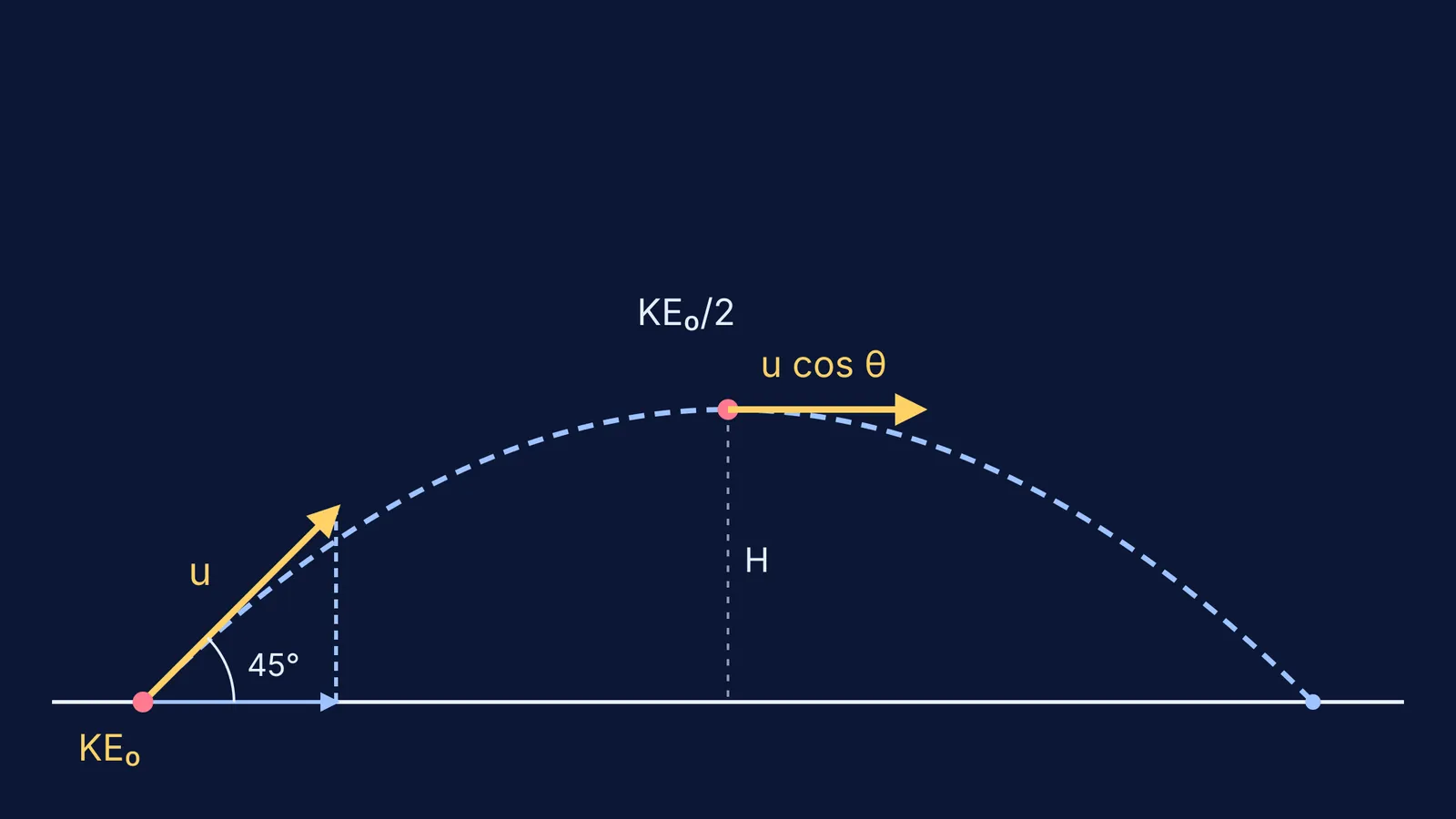
A ball leaves your hand at speed u and angle θ above the ground. At the top of its arc, how much kinetic energy is left? Many students say zero, because the ball "stops" at the top. It does not stop. It stops going up, and that difference is the whole answer.
This is a standard question in school physics and JEE Main practice, usually asked as "find the ratio of kinetic energy at the highest point to the kinetic energy at launch". Here is why the answer is cos²θ, where the 45° "half" comes from, and the traps that cost marks.
What is the velocity of a projectile at its highest point?
Split the launch velocity into two parts: a horizontal part u cos θ and a vertical part u sin θ. The OpenStax University Physics projectile motion chapter treats the two directions separately and assumes no air resistance.
Two facts from that chapter do all the work:
With no air resistance there is no horizontal acceleration, so the horizontal velocity at every moment equals its launch value, u cos θ (OpenStax).
The highest point of any trajectory is reached when the vertical velocity is zero (OpenStax).
So at the top the velocity is not zero. It is u cos θ, pointing horizontally. Only a ball thrown straight up (θ = 90°) is momentarily at rest at the top.
Why is the kinetic energy at the top KE₀cos²θ?
Kinetic energy is one-half of mass times the square of speed, K = ½mv², and it depends only on the size of the velocity, not its direction (OpenStax, kinetic energy).
At launch the speed is u, so KE₀ = ½mu².
At the top the speed is u cos θ, so KE_top = ½m(u cos θ)² = ½mu² cos²θ.
Divide one by the other and the mass and speed cancel: KE_top = KE₀cos²θ.
The square matters. Speed scales with cos θ, but kinetic energy scales with speed squared, so it scales with cos²θ.
Where did the rest go? The missing part, KE₀ − KE₀cos²θ = KE₀sin²θ, is the kinetic energy that belonged to the vertical motion. It has turned into gravitational potential energy mgH. You can check this: the maximum height is H = u²sin²θ/2g, so mgH = ½mu²sin²θ = KE₀sin²θ. The energy books balance.
Why is it exactly half at 45°?
At 45°, cos 45° = 1/√2, so cos²45° = 1/2. The projectile reaches the top with half its launch kinetic energy, and the other half is stored as potential energy.
Because kinetic energy goes with speed squared (OpenStax, kinetic energy), the fraction left at the top is cos²θ:
0° (thrown flat): 100%
30°: 75%
45°: 50%
60°: 25%
90° (thrown straight up): 0%
Notice that the speed at the top at 45° is u/√2, about 71% of the launch speed. The speed falls to about 71%, but the kinetic energy falls to 50%. Mixing up those two numbers is an easy slip.
A worked example you can check by hand
A 0.5 kg ball is thrown at 20 m/s at 60° above the horizontal. Take g = 9.8 m/s², the value used in OpenStax.
Launch kinetic energy: KE₀ = ½ × 0.5 × 20² = 100 J.
Speed at the top: 20 × cos 60° = 10 m/s.
Kinetic energy at the top: ½ × 0.5 × 10² = 25 J. Shortcut: 100 × cos²60° = 100 × 0.25 = 25 J.
Check with energy: H = 20² × sin²60° / (2 × 9.8) ≈ 15.3 m, so mgH ≈ 0.5 × 9.8 × 15.3 ≈ 75 J.
25 J + 75 J = 100 J. Nothing is lost.
If you get stuck on a variation, the Fermi Problem Library has worked problems with a step-by-step solver that explains the reasoning rather than printing an answer.
What mistakes do students make with this question?
Run through this checklist before you write the final answer:
Saying KE is zero at the top. Only true for a vertical throw.
Writing cos θ instead of cos²θ. That is the speed ratio, not the energy ratio.
Angle measured from the vertical. If θ is given from the vertical, the horizontal part is u sin θ and the answer becomes KE₀sin²θ. Redraw the angle first.
Launched from a height. A cliff or building does not change the horizontal velocity, so the kinetic energy at the top of the arc is still KE₀cos²θ.
Air resistance in the problem. Drag slows the horizontal motion too, so the formula no longer holds exactly. Our post on projectile motion with air resistance shows how the path changes.
The same "only horizontal velocity at the top" idea gives you the radius of curvature at the top of a projectile's path. For range, height and time of flight in one place, see projectile motion on level ground.
If the split into components still feels shaky, the Fermi Concept Library gives every physics concept its own lesson, so you can revisit vectors before coming back to energy.


