On this page
Rounding to two decimal places comes up everywhere: rupees and paise, physics answers, marksheet percentages. The rule is short, but two things trip students up: a carry that ripples left, as in 2.996, and why an exact 5 goes up.
What is the rule for rounding to two decimal places?
Find the hundredths digit (the second digit after the point). Then look at the digit right after it, the thousandths digit, and only that digit.
If the next digit is 0, 1, 2, 3 or 4, keep the hundredths digit as it is and drop everything after it.
If the next digit is 5, 6, 7, 8 or 9, add 1 to the hundredths digit and drop everything after it.
Always write exactly two digits after the point, even if they are zeros.
The US standards body NIST gives matching rules in its Guide to the SI, section B.7.1: if the discarded digits begin with a digit less than 5, the digit before them is not changed. If they begin with a 5 and at least one later digit is greater than 0, it goes up by 1. Its rule for an exact 5 differs (see below).
If place value itself feels shaky, start with how to read tenths, hundredths and thousandths.
How do you round 2.996 to two decimal places?
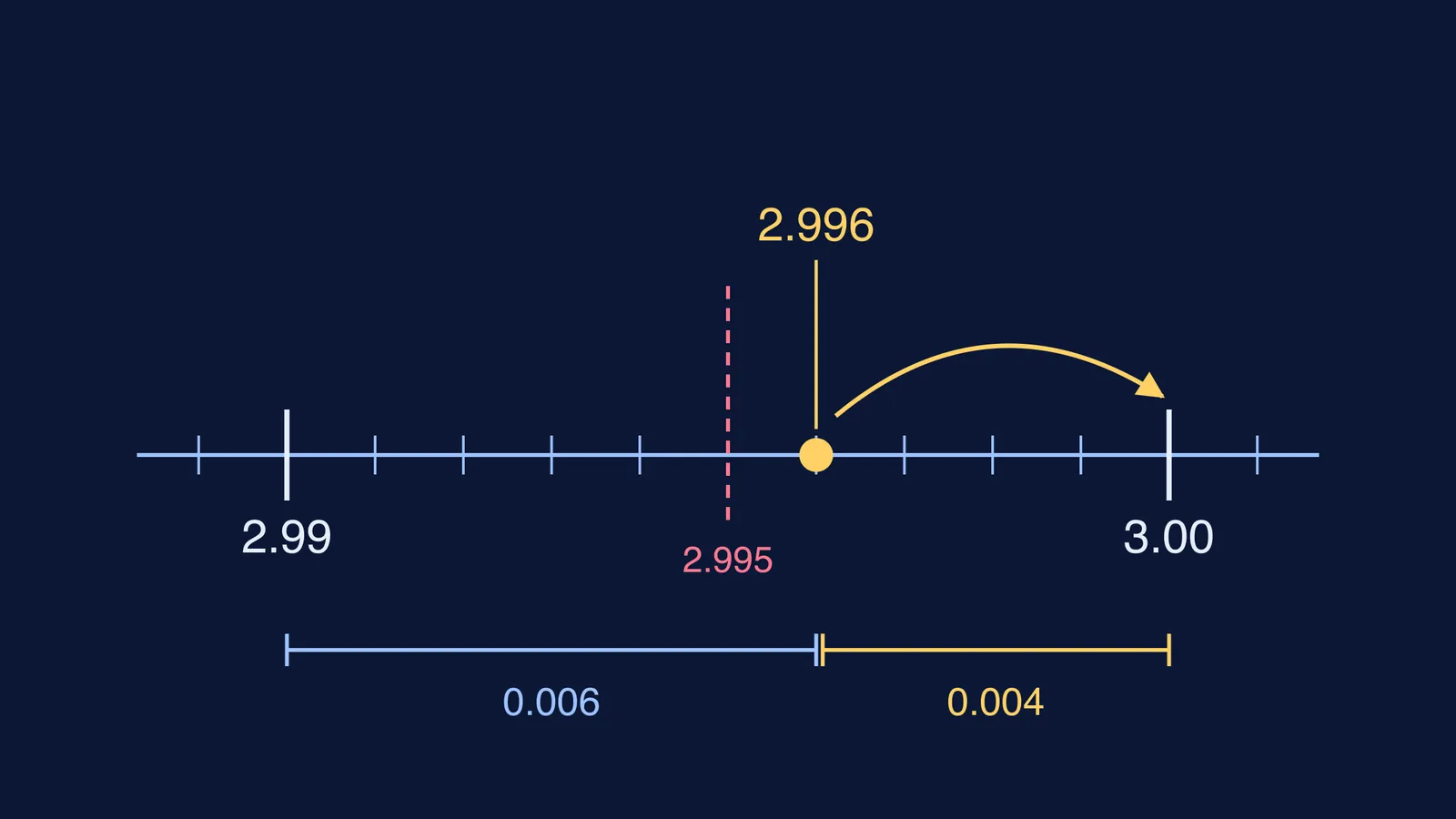
The hundredths digit is the second 9. The next digit is 6, which is 5 or more, so the 9 must go up by 1. A 9 cannot become 10 in one column, so it becomes 0 and carries 1 left. That makes the tenths 9 a 0 too, and the carry moves into the units: 2 becomes 3.
Another way to see it: 2.996 is 299.6 hundredths, which rounds to 300 hundredths, or 3.00. On a number line, 2.996 sits 0.004 from 3.00 and 0.006 from 2.99, so 3.00 is simply the nearer one.
Write 3.00, not 3. The two zeros tell the reader the answer is accurate to the hundredth. The NCERT Class 6 exemplar works the same kind of carry in Example 9: it rounds 87.952 to the tenths place, gets 88.0 and adds a note: do not write it as 88.
Here are more to try, with answers:
3.14159 becomes 3.14 (next digit 1)
0.0951 becomes 0.10 (9 hundredths plus 1 makes 10 hundredths)
12.999 becomes 13.00 (the carry runs through three places)
2.4449 becomes 2.44 (next digit 4; the 9 further along never matters)
Why does 0.5 round up in school?
Most of the time, rounding a 5 up is not a convention at all. Take 7.8251. The part you drop, 0.0051, is more than half a hundredth, so 7.83 really is nearer. NIST's rule above agrees: a 5 followed by any non-zero digit goes up.
The only real choice comes with an exact tie, such as 7.825. It sits exactly halfway between 7.82 and 7.83, so neither is nearer. Someone has to pick a tie-break, and school maths picks "5 always goes up".
That tie-break has a side effect: always rounding exact halves up nudges the total of many rounded numbers upward. NIST's third rule handles ties differently: if the discarded digits are a 5 followed only by zeros, the digit before them stays if it is even and goes up if it is odd. Under that rule 7.825 becomes 7.82. You may meet this even-odd rule when rounding measured data, and we explain it in the even-odd rule for dropping a 5. In a maths exam, follow your textbook: 5 rounds up.
Why do Excel and Python sometimes give a different answer?
Microsoft's ROUND function documentation shows =ROUND(2.15, 1) giving 2.2 and =ROUND(-1.475, 2) giving -1.48. Both examples send a half away from zero, which matches the school rule for positive numbers.
Python's round() documentation says ties go to the even choice, so round(0.5) is 0 and round(1.5) is 2.
The same page warns that round(2.675, 2) gives 2.67, not 2.68, and says this is not a bug but a result of most decimal fractions not being stored exactly as a float. The stored value of 2.675 is a tiny bit below the halfway point.
If software disagrees with your hand answer on a 5, check its tie-break before assuming you are wrong.
A checklist before you write the answer
Underline the last digit you are keeping.
Look at the next digit only, never the ones after it.
5 or more: add 1 and carry through any 9s. 4 or less: leave it.
Write the full number of decimal places, zeros included (3.00, 0.10).
In a long numerical, round only at the end; how many digits to carry mid-numerical shows why.
If a carry like 2.996 still feels slippery, the Fermi Concept Library covers every concept in mathematics, each with its own lesson. When a numerical goes wrong and you can't tell whether the rounding or the method is to blame, the Fermi Problem Library has worked problems with a step-by-step solver that explains the reasoning rather than printing an answer.