

On this page
You have found T = 1.795 s, the next step multiplies it by 50, and the answer box wants two decimal places. Round T now, or carry the long number? Carry it.
Should you round off in the middle of a numerical?
No. NCERT's Class 11 Physics textbook, in its chapter on units and measurement, says that in a multi-step calculation you should keep, in intermediate steps, one digit more than the significant digits, and round off to proper significant figures at the end of the calculation. The same chapter gives the reason: otherwise rounding errors can build up.
NCERT's example: round 1/9.58 to three significant figures and you get 0.104; take the reciprocal of 0.104 and you get 9.62, not the 9.58 you started with. Keep one more digit (0.1044) and the reciprocal gives back 9.58.
How does rounding early change the final answer?
A simple pendulum is 0.80 m long and g = 9.8 m/s². Find the time for 50 oscillations, to two decimal places.
The steps: L/g, square root, times 2π, times 50. Done exactly, L/g = 4/49, so √(L/g) = 2/7 and T = 4π/7 = 1.79520 s. Fifty oscillations take 89.7598 s, which rounds to 89.76 s.
Now round every intermediate result to a fixed number of significant figures:
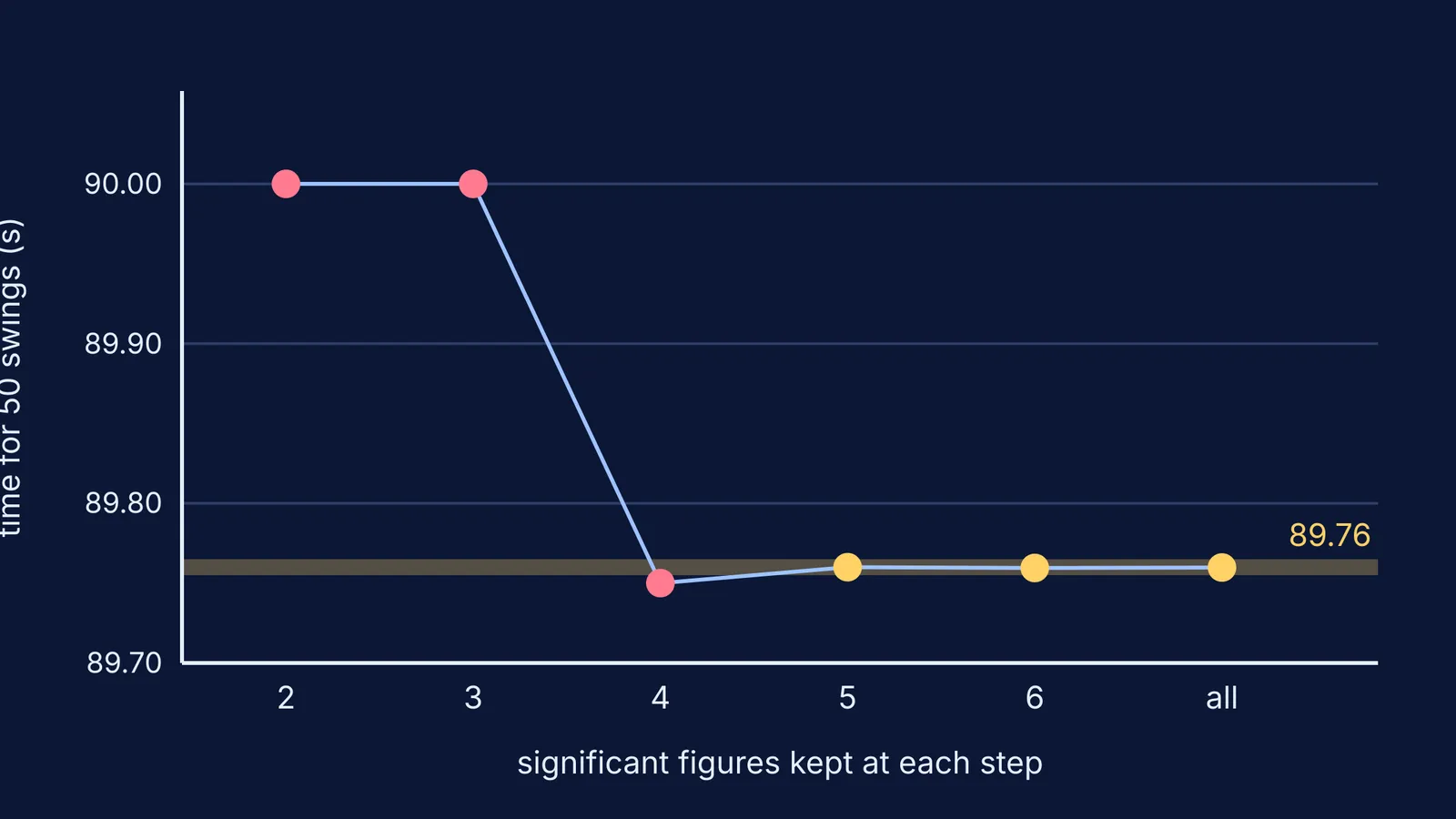
2 figures: 0.082, then 0.29, then T = 1.8 s, giving 90.00 s
3 figures: 0.0816, then 0.286, then T = 1.80 s, giving 90.00 s
4 figures: 0.08163, then 0.2857, then T = 1.795 s, giving 89.75 s
5 figures: 0.081633, then 0.28571, then T = 1.7952 s, giving 89.76 s
Four significant figures looks careful, and it still misses by 0.01 s. The last step multiplies any error in T by 50, so trimming 0.0002 s off T becomes 0.01 s off the answer.
How many digits should you carry?
NCERT frames its rule around the significant figures of your data, but an exam answer box sets its own format. 89.76 has four significant figures, so carry at least five, and the list above shows five is where the answer comes out right.
Carry extra digits when the chain contains:
a multiplication by a large number, like the 50 above
a subtraction of two nearly equal numbers, where the leading digits cancel
an exponent or a logarithm, as in decay, pH or a charging capacitor
Exact numbers do not limit you: the NCERT chapter notes that exact numbers such as the 2π in T = 2π√(L/g) have a large (infinite) number of significant figures.
And never round twice. Round 2.346 to two decimals and you get 2.35; round that to one decimal and you get 2.4. Round 2.346 straight to one decimal and you get 2.3. For a dropped digit of exactly 5, see the even-odd rule for dropping a 5.
How do JEE Main and JEE Advanced want numerical answers rounded?
JEE Main. The NTA's JEE (Main) 2027 Information Bulletin says each subject in Paper 1 has 5 Section B questions, where you enter an integer and the answer should be rounded off to the nearest integer. It gives +4 for a correct numerical answer and −1 for an incorrect one, so drift across a .5 boundary costs marks.
JEE Advanced. The numerical-value section of JEE (Advanced) 2026 Paper 1 told candidates that if the value has more than two decimal places, they should truncate/round-off it to two decimal places, with +4 only for the correct value and 0 in all other cases. In the provisional answer key, one of the four maths numerical answers was listed as a range, 3.9 to 4.1, while the other three were single values. We found no official rule on ranges, so aim for the correctly rounded value.
For the pendulum, 89.7598 rounds to 89.76 but truncates to 89.75; you only see that if you carried the third decimal. For integer answers, see our guide to checking integer-type JEE answers.
A five-step routine for any numerical
Solve in symbols first and substitute once. T = 2π√(L/g) is one calculation, and it shows that 0.80/9.8 is exactly 4/49.
Write intermediate values with one digit more than the final answer needs, two if a later step multiplies, subtracts close values or uses a log.
Keep fractions and surds, such as 2/7 or √3, until the last line.
Round once, from the full value, to the format the paper asks for.
Check size and unit: 50 swings at about 1.8 s each should take about 90 s.
If you still land a digit away, the slip may be in the method. The Fermi Problem Library has worked problems with a step-by-step solver that explains the reasoning rather than printing an answer, so you can see where your numbers part ways with the solution.


