

On this page
The National Testing Agency (NTA) has removed the optional questions in Section B of the Joint Entrance Examination (JEE) Main. Starting in 2025, the JEE Main exam pattern dictates that Section B contains exactly five mandatory numerical value questions per subject (NTA Information Bulletin). An incorrect answer in Section B carries a −1 penalty (NTA Information Bulletin).
Because you must calculate and enter the exact numerical value rounded to the nearest integer, there are no multiple-choice options to guide you if your calculation goes slightly off. You cannot use elimination strategies or work backwards from the given options. This leaves zero room for arithmetic slips.
When you study with an AI tutor, you might be tempted to just check if its final integer matches yours. But reading an AI's final answer is risky because language models process mathematics differently than humans do. A 2025 study found that when the numbers in a maths word problem become more complex, an AI model's rate of logical errors increases by up to 14 percentage points (arXiv:2502.08680). The model might have the physics right but the arithmetic wrong.
A separate 2025 study on two-integer addition revealed that while AI models appear highly accurate with normal digits, their accuracy plummets to under 7.5% when numbers are replaced with unfamiliar symbolic tokens (arXiv:2504.05262). Because these models rely on pattern matching rather than genuine mathematical rules, an AI can easily drop a carry-over digit or misalign a decimal point.
How to check an AI's math answer by substitution?
If an AI gives you an integer answer for an algebraic or trigonometric problem, do not just accept the final number. Instead, ask the AI for the algebraic expression it used before plugging in the values.
Once you have the expression, substitute a simple integer—such as 0, 1, or 2—into both the AI's expression and your own. If they yield different results, one of you has made a structural error. This method is exactly like counting intersections of two sketched curves; you are verifying the shape of the logic rather than the final coordinate.
For example, if a calculus problem requires integrating a function and evaluating it at specific limits, an AI might skip steps and just print "42". Ask it to print the indefinite integral first. You can then differentiate that expression yourself to see if it returns the original integrand.
How to verify physics and chemistry answers?
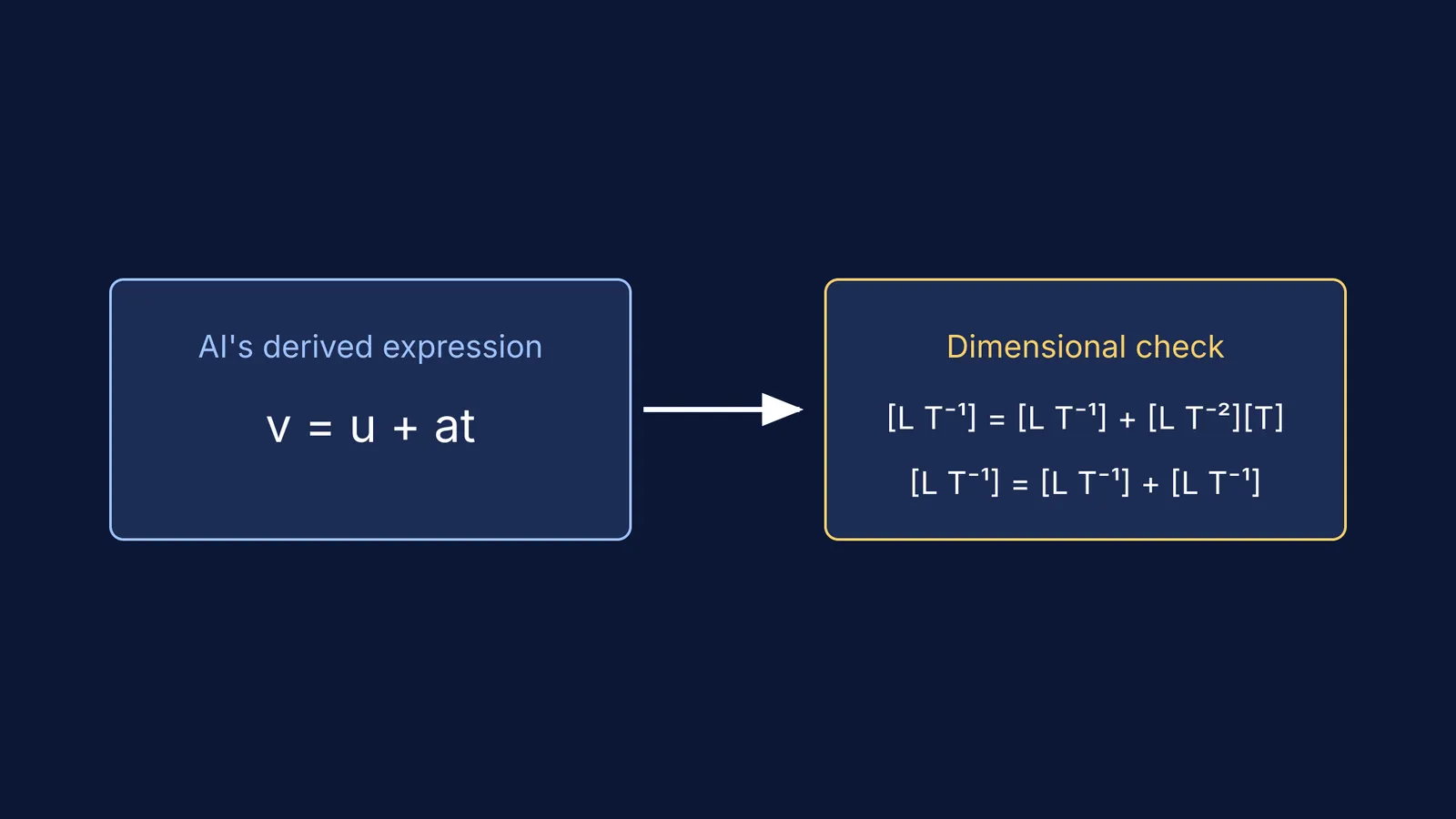
For physical chemistry and physics, dimensional analysis is your best defence against a hallucinated integer. Before looking at the AI's final integer, ask it to state the formula it used in symbols. Check that the units on both sides of the equation match. If you are unsure how to set this up, reviewing converting a quantity between unit systems using dimensions is a great place to start.
Next, check the order of magnitude before you look at the exact integer. In topics like thermodynamics or modern physics, the scale of the answer is often predictable. If a chemistry problem asks for the number of photons emitted per second by a lamp or a laser, and the AI suggests 15, you know it has missed a factor of 10¹⁹.
What is the best plan for integer questions?
To build a habit that protects you from AI arithmetic errors, run through this quick checklist every time you encounter an integer-type question:
Ask the AI to print the purely algebraic formula before it inserts any numbers.
Check the dimensions of that formula to ensure the physics is sound.
Substitute a trivial integer (like 2) into the formula to see if it behaves as expected.
Estimate the final answer's order of magnitude yourself.
Only then, compare your final calculated integer with the AI's answer.
Instead of arguing with a chatbot over a final integer, you can use the Fermi Problem Library. It has worked problems with a step-by-step solver that explains the reasoning rather than printing an answer. This means you can follow the logic line by line, catching arithmetic slips before they cascade into the final integer. If you hit a concept you do not understand, Fermi's AI tutor can work out what you already know and build a plan for the session, so you sit down to a clear next step.


