On this page
Your biology chapter gives the two kinds of endoplasmic reticulum one line each, and exams love asking which cell has more of which. Here is the difference, what each one makes, and a quick test for sorting any cell a question gives you.
What is the difference between rough ER and smooth ER?
The endoplasmic reticulum (ER) is a network of tiny tubular structures in the cytoplasm that divides the inside of the cell into two compartments: the space inside the ER (luminal) and the cytoplasm outside it, as the NCERT Class 11 Biology chapter Cell: The Unit of Life explains.
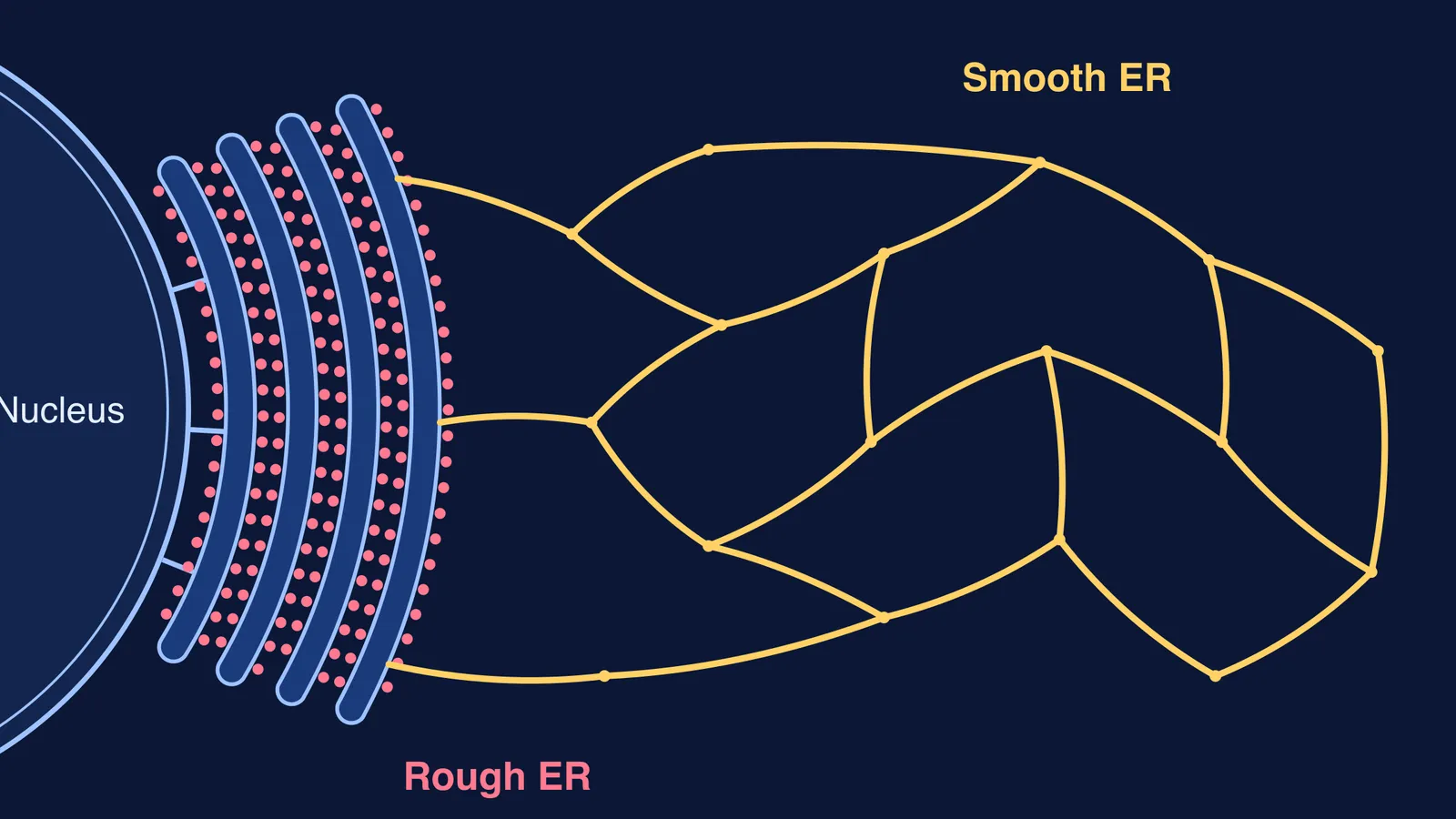
Rough ER is ER with ribosomes attached to its outer surface, and smooth ER is ER without ribosomes, according to the NCERT textbook.
That one difference in surface decides the job. Ribosomes make proteins, so the ribosome-studded ER is the cell's protein factory. NCERT calls smooth ER the major site of lipid synthesis, and in animal cells it is where lipid-like steroid hormones are made.
The two also differ in shape. A 2016 review by Dianne Schwarz and Michael Blower explains that ribosomes, 25 to 30 nm across, sit on the flat regions of ER sheets and make them look rough, while tubules carry far fewer ribosomes and look smooth (Schwarz and Blower, Cellular and Molecular Life Sciences, 2016). Our guide to micrometre vs nanometre units for cells and membranes puts these sizes in context.
What does rough ER do?
Here is what the rough ER does, as set out in OpenStax Biology 2e:
Ribosomes on its surface pass newly made proteins into the ER's lumen, where they are folded or given side chains.
These proteins either become part of membranes or leave the cell as secreted products, such as protein hormones and enzymes.
It also makes phospholipids for cell membranes, which leave in transport vesicles if they are not staying in the ER.
NCERT adds that rough ER is extensive and continuous with the outer membrane of the nucleus.
What does smooth ER do?
Smooth ER makes carbohydrates, lipids and steroid hormones, detoxifies medications and poisons, and stores calcium ions, according to OpenStax Biology 2e.
In muscle cells, a specialised smooth ER called the sarcoplasmic reticulum stores the calcium ions that trigger contraction (same source).
Which cells are rich in rough ER or smooth ER?
A cell builds more of the ER its job needs. Schwarz and Blower write that cells making vast amounts of secreted protein, such as pancreatic secretory cells and B cells, have an ER made largely of sheets, while adrenal, liver and muscle cells have a mostly tubular network (Schwarz and Blower, 2016).
Cells that make large quantities of steroid hormones, such as those of the ovaries and testes, contain large amounts of smooth ER (OpenStax Anatomy and Physiology 2e).
How can you tell which ER a cell is rich in?
When a question names a cell, ask these in order:
Does the cell export large amounts of protein, such as enzymes or protein hormones? Then rough ER.
Does it make steroid hormones or other lipids? Then smooth ER.
Does its work depend on storing and releasing calcium, as in muscle? Then smooth ER, in the form of sarcoplasmic reticulum.
Applied to common exam cells:
Pancreatic secretory cell: exports protein, so rough ER.
B cell: makes vast amounts of secreted protein, so rough ER.
Testis or ovary cell making sex hormones: steroids, so smooth ER.
Adrenal cell: mostly tubular ER, so smooth ER.
Skeletal muscle fibre: calcium store, so sarcoplasmic reticulum.
Liver cell: both, so name the job before you answer.
How do you remember rough vs smooth ER for exams?
Learn the pairs side by side, one line each:
Surface: ribosomes attached, or none.
Shape: mostly flat sheets, or mostly branching tubules.
Main product: proteins for export and for membranes, or lipids and steroid hormones.
Rich in: protein-secreting cells such as pancreatic cells and B cells, or steroid-making cells of the testes and ovaries, adrenal cells and muscle.
In a labelled animal cell, mark both kinds of ER; see how to draw plant and animal cell diagrams that score marks. For the other organelles, use cell organelles and their functions, one line each.
If the endomembrane system still feels like a list of names, the Fermi Concept Library has a lesson for every concept in biology, each with its place in the map, so you can see where the ER sits among related ideas. And Fermi's AI tutor works out what you already know and checks your understanding as it goes, which suits practising the cell-sorting test above.
Next time a question names a cell, ask what it exports before you pick rough or smooth.