

On this page
Open any biology chapter on the cell and the unit changes under your feet. Cells come in micrometres (µm), viruses and membranes in nanometres (nm), and a question can quietly mix the two. This guide puts both units on one scale, shows the single conversion you need, and lists the typical sizes from the NCERT textbook so you can check your answers.
What units are used to measure cells?
Cells are measured in micrometres, because most of them are a few to a few tens of micrometres across. The official SI prefix table from the International Bureau of Weights and Measures (BIPM) defines micro (µ) as 10⁻⁶, milli (m) as 10⁻³ and nano (n) as 10⁻⁹.
So 1 µm is one-millionth of a metre, or one-thousandth of a millimetre.
The NCERT Class 11 chapter Cell: The Unit of Life gives the sizes you are expected to know:
Mycoplasmas, the smallest cells, are only 0.3 µm in length.
Bacteria could be 3 to 5 µm (the chapter's Figure 8.2 labels typical bacteria 1–2 µm).
Human red blood cells are about 7.0 µm in diameter.
A typical eukaryotic cell is 10–20 µm.
If you want the full chapter in exam-ready form, our post on cell as the unit of life walks through it.
Why are viruses and membranes measured in nanometres?
Because they are too small for micrometres to read well. The same NCERT chapter labels viruses as 0.02–0.2 µm and PPLO (pleuropneumonia-like organisms) as about 0.1 µm. Written in nanometres, viruses are 20–200 nm, which is easier to compare.
A real example: in an early report on the new coronavirus later named SARS-CoV-2, Chinese researchers wrote in the New England Journal of Medicine that particle diameter varied from about 60 to 140 nm.
Membranes are thinner still. In a study of yeast membranes in the Journal of Cell Biology, the average thickness of the membranes was 7.1 nm and the plasma membrane measured 9.2 nm, as recorded in the BioNumbers database.
This is also why viruses and membrane detail need an electron microscope. Our explainer on light vs electron microscopes covers why.
How do you convert micrometres to nanometres?
From the BIPM prefixes, 10⁻⁶ m divided by 10⁻⁹ m gives 1,000, so 1 µm = 1,000 nm. The same logic gives 1 mm = 1,000 µm.
Use this three-step check every time:
Going to a smaller unit (µm to nm), the number gets bigger: multiply by 1,000.
Going to a bigger unit (nm to µm), the number gets smaller: divide by 1,000.
Before you compare two sizes, write both in the same unit.
Worked example: how many times bigger?
Question: how many times wider is a red blood cell than the largest SARS-CoV-2 particle?
Red blood cell: 7.0 µm (NCERT, linked above) = 7.0 × 1,000 = 7,000 nm.
Largest particle: 140 nm (NEJM, linked above).
Ratio: 7,000 ÷ 140 = 50.
So the red blood cell is about 50 times wider. Try the same for the plasma membrane: a 10 µm cell is 10,000 nm, and 10,000 ÷ 9.2 is about 1,090, so the membrane is roughly a thousandth of the cell's width.
What are typical sizes on one scale?
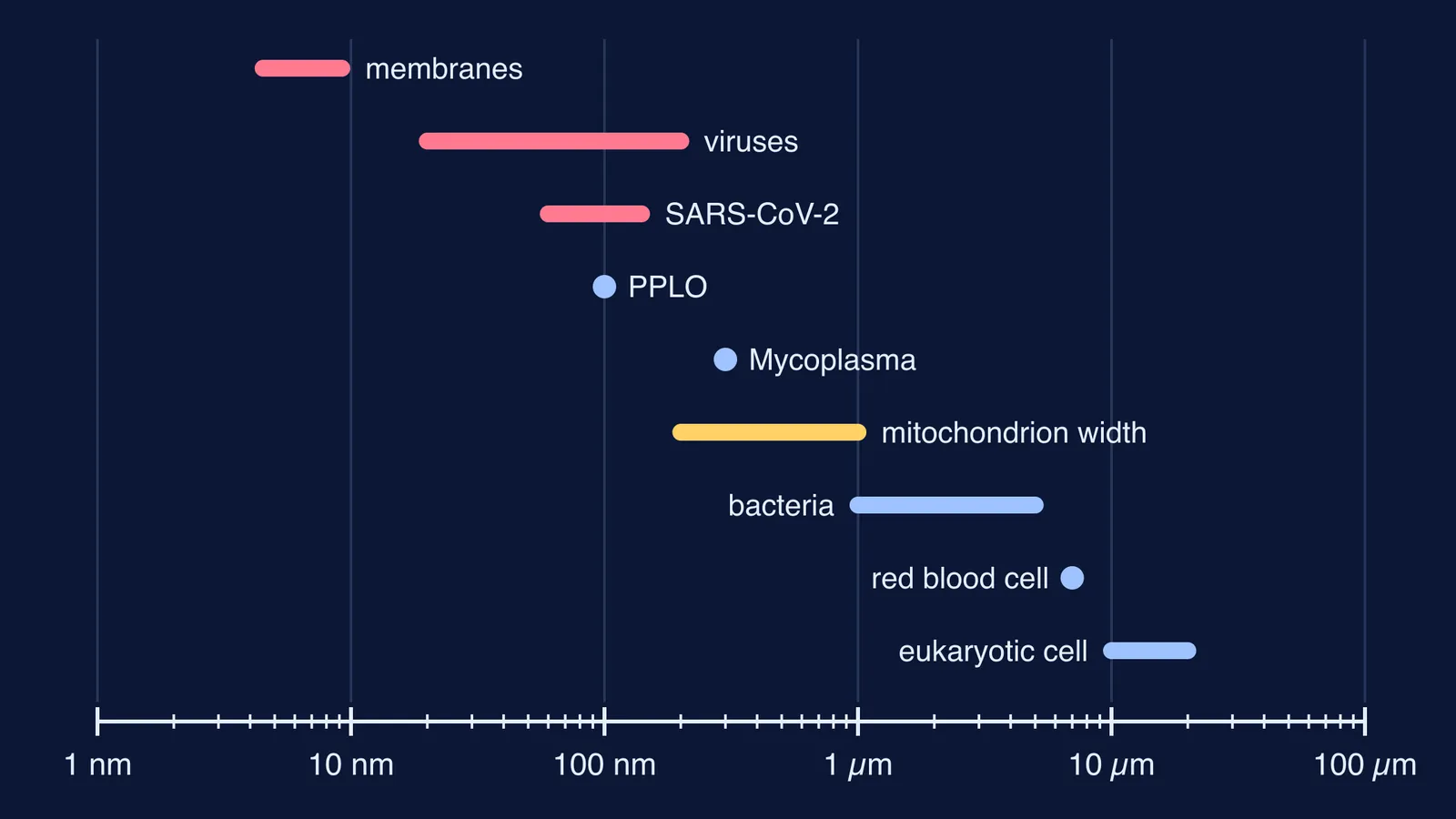
Here are the sizes from the NCERT chapter, the NEJM report and BioNumbers, smallest to largest, in both units:
Yeast plasma membrane: 9.2 nm = 0.0092 µm
Viruses: 20–200 nm = 0.02–0.2 µm
SARS-CoV-2 particle: 60–140 nm = 0.06–0.14 µm
PPLO: about 100 nm = 0.1 µm
Mycoplasma: 300 nm = 0.3 µm
Bacteria: 1,000–5,000 nm = 1–5 µm
Human red blood cell: 7,000 nm = 7.0 µm
Typical eukaryotic cell: 10,000–20,000 nm = 10–20 µm
Notice the overlap: a 200 nm virus is not far from a 300 nm mycoplasma cell, even though one is alive on its own and the other is not. Our bacteria vs virus difference table explains why size is not the deciding feature.
A five-minute self-test
Cover the answers and convert, using the SI prefixes:
0.3 µm to nm (answer: 300 nm)
60 nm to µm (answer: 0.06 µm)
15 µm to mm (answer: 0.015 mm)
Which is bigger, 0.2 µm or 150 nm? (answer: 0.2 µm, because it is 200 nm)
How many 1 µm bacteria fit side by side across 1 mm? (answer: 1,000)
If the units themselves feel shaky, the Fermi Concept Library has a lesson for every concept in physics, chemistry, biology and mathematics, including where each sits in the map. For ratio and conversion questions where you keep losing a factor of 1,000, the Fermi Problem Library has worked problems with a step-by-step solver that explains the reasoning rather than printing an answer.
Pin the ladder metre, millimetre, micrometre, nanometre above your desk, and convert before you compare.


