

On this page
Ride the Gulmarg Gondola and you climb from a meadow to a snowy mountain shoulder, hanging from a steel rope. That rope is doing three jobs at once: holding you up, pulling you along, and staying tight enough not to droop into the trees. All three come down to Class 11 mechanics: tension, components of force, and friction.
How does a ropeway cable car work?
A gondola lift is a type of aerial lift that is supported and propelled by cables from above, and its cable is driven by a bullwheel in a terminal, typically connected to an engine or electric motor, according to Wikipedia's gondola lift article. The same article describes a haul rope that moves continuously round two terminal stations, and says that in some systems the cabins hang from it on spring-loaded grips that let them detach from the moving cable and slow down in the terminals.
The Gondola Project's lesson on propulsion explains that the cabins have no engine of their own: the cable moves them, and engines and bullwheels in a wheelhouse move the cable. In a reply below the lesson, the site's author adds that there is one powered drive bullwheel; the wheel at the other end is not powered and sends the rope back.
Gulmarg's gondola is run by the Jammu & Kashmir Cable Car Corporation; its first stage opened in 1998 and its second on 28 May 2005, per Wikipedia's Gulmarg Gondola page, which gives a base at 2,650 m, a top at 3,980 m and six-person cabins. The J&K Tourism Development Corporation puts the total lift at 1,330 m.
Why is a ropeway cable under so much tension?
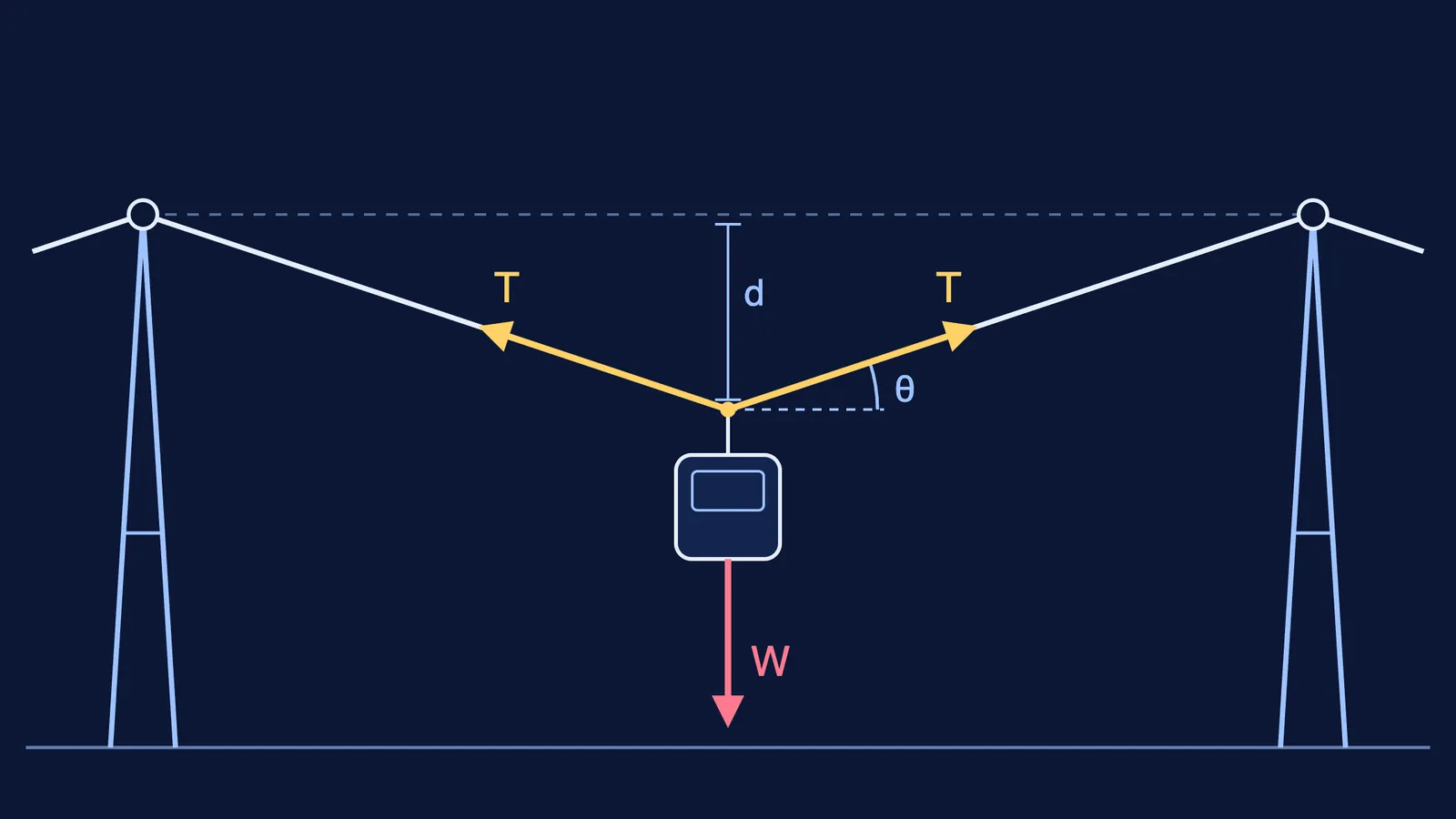
A rope can only pull along its own length. So when a cabin hangs on it, the only thing holding the cabin up is the small vertical part of the tension in the two sides of the rope.
Take a cabin of weight W hanging at the middle of a span L, with the rope dipping by a sag d. Each side of the rope makes an angle θ with the horizontal, where tan θ = 2d/L. Balancing vertical forces:
2T sin θ = W, so T = W / (2 sin θ)
When θ is small, sin θ is tiny, and T becomes far larger than W. This is the same idea as a wet towel on a clothesline or a rope held taut by two people: you can never pull a loaded rope perfectly straight.
How much tension does a sagging cable need?
These numbers are illustrative, not Gulmarg's. Suppose a loaded cabin has a mass of 1,000 kg, so W is about 9,810 N, on a 200 m span, and ignore the rope's own weight.
Sag 10 m: tan θ = 20/200 = 0.1, so sin θ is about 0.0995. T = 9,810 / (2 × 0.0995), about 49 kN, roughly five times the cabin's weight.
Sag 5 m: tan θ = 10/200 = 0.05, so sin θ is about 0.0499. T is about 98 kN, roughly ten times the weight.
The pattern: for small angles, halving the sag roughly doubles the tension.
So some sag is the price of a rope that is not impossibly strong. A real rope also carries its own weight and hangs as a catenary, a curve compared in our post on the catenary versus the parabola.
How do grips and drive wheels hold on?
Both work by friction, and both need tension.
The grip is a spring-loaded clamp. The friction from its squeeze must exceed W sin α, the part of the cabin's weight along a rope sloping at angle α, so steeper stretches demand a stronger clamp. On a detachable lift, the grip lets go in the terminals and the cabin slows while the rope keeps running.
The drive bullwheel has to move the rope through friction where the rope wraps round it. The capstan equation gives the limit: T(tight) = T(slack) × e^(μφ), where μ is the coefficient of friction and φ is the angle of wrap in radians. For a rope wrapped halfway round (φ = π) and an assumed μ of 0.2, e^(0.2π) is about 1.87. The pulling side can be at most about 1.87 times the slack side before the rope slips, so the slack side must stay tight too.
A five-step check for any rope problem
Draw the free-body diagram at the point where the load hangs.
Find the angle from the geometry: tan θ = sag ÷ half-span.
Balance vertical forces to get T; horizontal forces should cancel.
Ask whether T is bigger than the load. If θ is small, it must be.
For anything that turns a rope by friction, use T(tight) ≤ T(slack) × e^(μφ).
If a picture helps, change the sag in your head and watch the arrows grow. Fermi's AI tutor can draw the figure and run the simulation as it teaches, and the Fermi Simulation Lab has interactive simulations for the ideas that are easier to see than to read.


