On this page
Picture two friends carrying a bucket of water on a rope slung between them. With the rope in a deep V, holding it is easy. Pull it nearly straight and their arms ache, though the bucket weighs the same. Here is how to calculate the tension in each side, and why it rises so steeply.
How do you find the tension when two ropes hold a load at an angle?
OpenStax's College Physics 2e defines tension as "a force along the length of a medium, especially a force carried by a flexible medium, such as a rope or cable." Each side pulls on the knot along its own length, so each tension has a horizontal and a vertical part.
Use the knot where the load hangs as your free-body point. Say the left rope makes angle α with the horizontal and the right rope makes angle β.
Draw three forces at the knot: T₁ up and to the left, T₂ up and to the right, and the weight W straight down.
Horizontal balance: T₁ cos α = T₂ cos β.
Vertical balance: T₁ sin α + T₂ sin β = W.
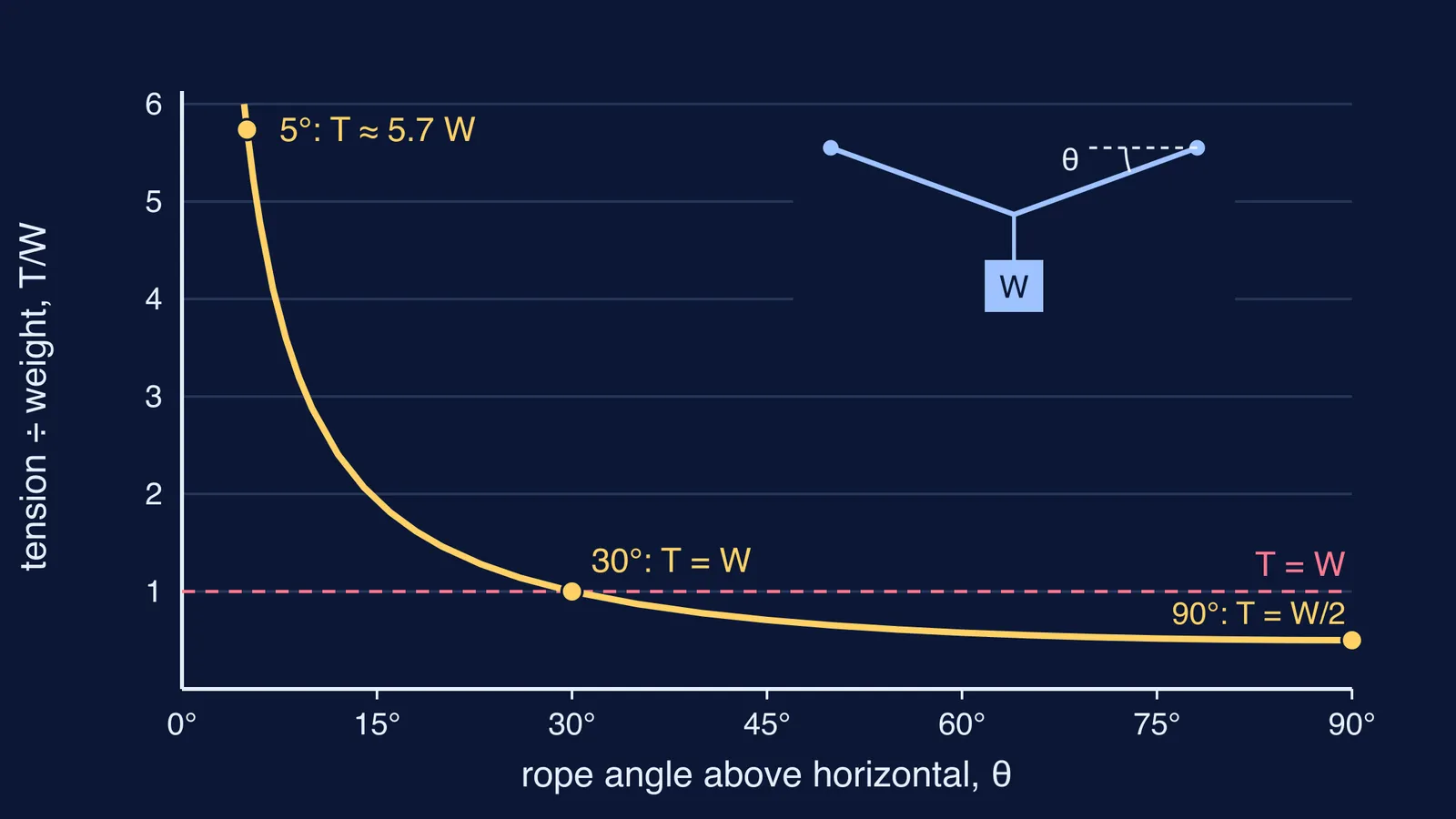
Solve the two equations together. If the angles are equal (α = β = θ), the tensions are equal too, and step 3 becomes 2T sin θ = W, so T = W/(2 sin θ).
If the angle is measured from the vertical, swap sin and cos. Our guide to resolving a vector into components with the parallelogram law goes over the geometry.
Worked example: what is the tension at different angles?
Take a 10 kg bucket, so W = 10 × 9.8 = 98 N. Two people hold the rope symmetrically, each side at angle θ above the horizontal. Using T = W/(2 sin θ), the formula OpenStax uses for its tightrope example:
θ = 90° (both sides straight up): T = 49 N
θ = 60°: T ≈ 56.6 N
θ = 30°: T = 98 N, the full weight of the bucket on each side
θ = 10°: T ≈ 282 N
θ = 5°: T ≈ 562 N
θ = 2°: T ≈ 1,404 N
At 2° each person pulls about 28 times as hard as with the rope vertical, and more than 14 times the bucket's weight. The bucket has not changed.
Now make it lopsided: the left side is at 30° and the right side at 60°. Horizontal balance gives T₁(0.866) = T₂(0.5), so T₂ = 1.732 T₁. Vertical balance gives 0.5 T₁ + 0.866 T₂ = 98, which becomes 0.5 T₁ + 1.5 T₁ = 98. So T₁ = 49 N and T₂ ≈ 84.9 N. The steeper rope carries more of the load. You can check this with Lami's theorem for three forces meeting at a knot.
Why does tension shoot up as the rope gets flatter?
Only the vertical parts of the two tensions hold the load up. The horizontal parts cancel each other out. As the rope flattens, sin θ gets close to zero, so each side has to pull much harder to produce the same vertical support.
OpenStax's tightrope example shows the scale: a 70.0 kg walker on a wire that dips 5° below horizontal on each side needs a tension of about 3,900 N, according to College Physics 2e. That is almost six times the walker's weight of 686 N. The same section notes that even a light rope must sag a little, "since an infinite tension would result if it were horizontal."
Our post on why a tight clothesline carries huge tension with only a small sag follows the idea further.
What mistakes do students make with angled ropes?
Check these before you circle an answer:
Angle from which line? "Makes 30° with the ceiling" means 30° from the horizontal. "Makes 30° with the vertical" means you use cos 30° for the vertical part.
Forgetting the 2. In the symmetric case both sides share the load, so the equation is 2T sin θ = W, not T sin θ = W.
Assuming equal tensions. Equal tensions only come from equal angles. With unequal angles, solve both equations.
Using mass for weight. W = mg in newtons. Plugging in 10 instead of 98 gives a tension nearly ten times too small.
No limit check. Ask what happens as θ approaches 0° and 90°. Your formula should blow up at 0° and settle at W/2 at 90°.
If you keep picking the wrong method on problems like these, the Fermi Problem Library has worked problems with a step-by-step solver that explains the reasoning rather than printing an answer. The Fermi Simulation Lab has interactive simulations for ideas that are easier to see than to read.
In your next practice set, guess before each rope problem whether each tension will be more or less than the weight. Then check your guess.