On this page
Roller sums turn up in NCERT's Class 8 mensuration chapter and again in the Class 9 surface-area chapter. They look like word problems, but there is only one idea in them. Once you can see what the roller leaves behind on the ground, the area, the cost and the number of revolutions each take one line.
How much area does a roller level in one revolution?
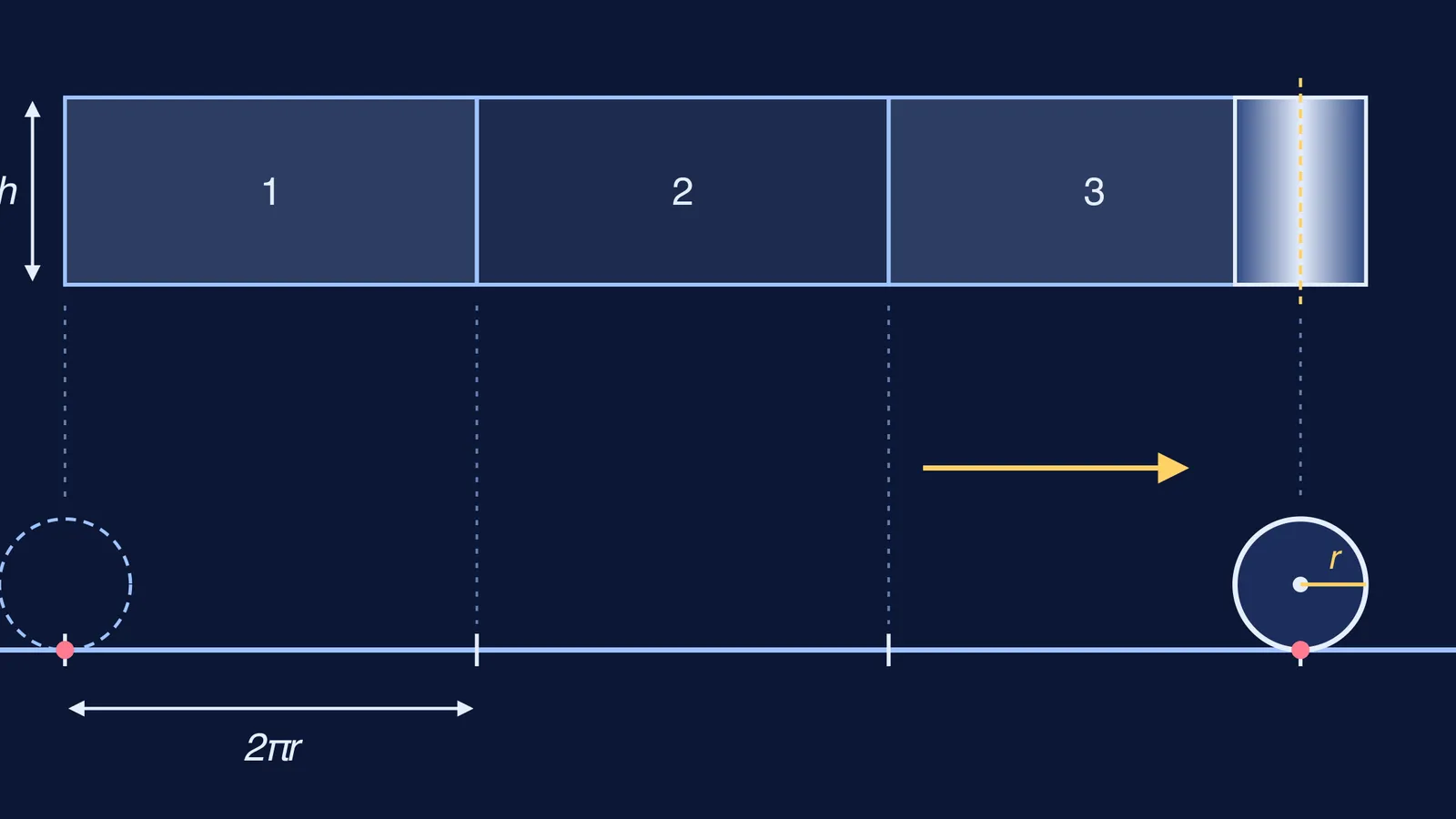
A lawn roller or road roller is a cylinder lying on its side. As it turns once, every point of its curved surface touches the ground exactly once, so the strip it presses flat is the curved surface, unrolled. That strip is a rectangle: one side is the roller's length h, the other is the distance the roller moves in one turn, which is its circumference 2πr.
Area levelled in one revolution = curved surface area of the roller = 2πrh.
The flat ends of the roller never touch the ground, so they play no part. This is the same unrolling you use when a rectangular sheet is bent into a tube; our post on which way a rolled sheet holds more shows it from the other direction.
How do you find the area levelled from the number of revolutions?
Multiply the curved surface area by the number of revolutions. An NCERT Class 9 exercise question gives a roller 84 cm in diameter and 120 cm long that takes 500 complete revolutions to level a playground, and the answer is 1,584 m² (solution on Cuemath). Here is the working, with π = 22/7:
Radius r = 84 ÷ 2 = 42 cm, length h = 120 cm.
Curved surface area = 2 × 22/7 × 42 × 120 = 31,680 cm².
Area levelled = 500 × 31,680 = 1,58,40,000 cm².
Convert: 1 m² = 10,000 cm², so the area is 1,584 m².
The Class 8 version gives a road roller 84 cm in diameter and 1 m long that takes 750 revolutions to level a road; working in metres, one revolution covers 2 × 22/7 × 0.42 × 1 = 2.64 m², and the road is 1,980 m² (question and solution on Teachoo).
There is a second way to see it. The roller travels 2πr per revolution, so after n revolutions it has rolled a distance of n × 2πr, and it levels a rectangle of that length and width h. Our post on distance covered by a wheel in revolutions builds the distance part step by step.
How do you find the cost of levelling?
Cost = area levelled × rate per m². This is the same last step as in our post on the cost of fencing, flooring and tiling; the only care needed is that the rate and the area use the same unit. Here is a practice example with our own numbers, built on the NCERT pattern above.
A school's garden roller is 70 cm in diameter and 2 m long. It makes 200 revolutions to go once over the lawn, and levelling costs ₹2.50 per m².
r = 0.35 m, h = 2 m.
One revolution: 2 × 22/7 × 0.35 × 2 = 4.4 m².
Lawn area: 200 × 4.4 = 880 m².
Cost: 880 × 2.50 = ₹2,200.
How many revolutions does a roller take to level a given area?
Run the formula backwards: revolutions = total area ÷ 2πrh. Take the Class 8 road roller above, which levels 2.64 m² per turn, and a school ground 66 m long and 40 m wide. The ground is 2,640 m², so the roller needs 2,640 ÷ 2.64 = 1,000 revolutions. If the division does not come out whole, round up to the next whole number, since a part revolution still has to be made.
What mistakes cost marks in roller questions?
Check these before you write the final line:
Did you halve the diameter to get r?
Did you use the curved surface area 2πrh, not the total surface area 2πr(r + h)?
Did you treat the roller's length as h, not as the diameter?
Are r and h in the same unit, and is the answer in the unit the question asks for?
For cost, did you multiply by the rate per m² and not per cm²?
If you keep picking the wrong formula, the Fermi Problem Library has worked problems with a step-by-step solver that explains the reasoning rather than printing an answer. And if curved surface area itself feels shaky, the Fermi Concept Library gives every maths concept its own lesson and its place in the map.
Try it now: a roller 1 m long and 56 cm across makes 400 revolutions. Sketch the strip, then find the area. You should get 704 m².